
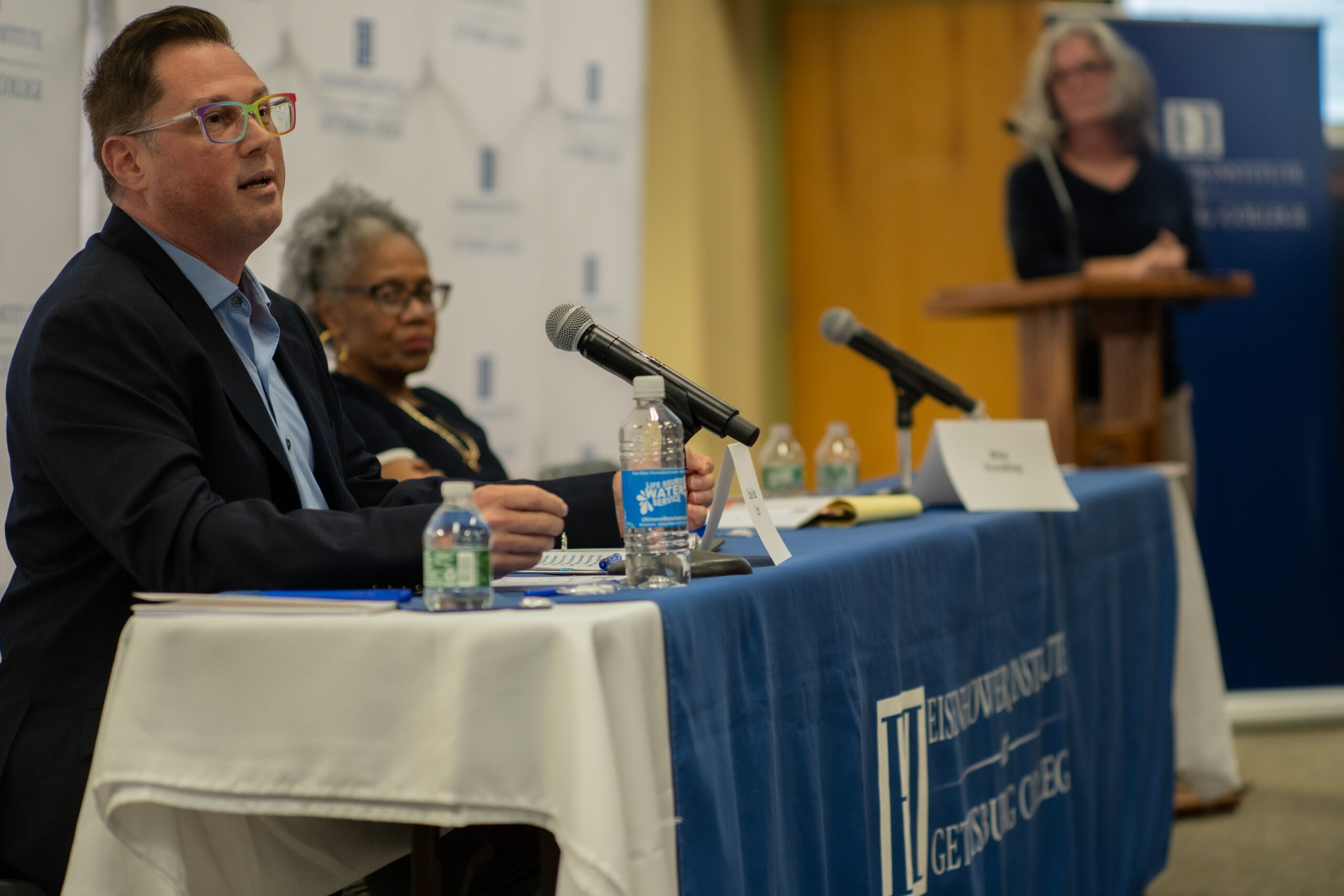
Councilman Chad-Alan Carr answering a question. (Photo William Oehler/The Gettysburgian)
By Brandon Fey, News Editor
This Nov. 4, Gettysburg voters will decide whether to re-elect the incumbent Mayor Rita Freeling as part of the 2025 Municipal General Election.
Mayor Frealing is challenged by Councilman Chad-Alan Carr, who holds the at-large seat of the Gettysburg Borough Council. Carr defeated Frealing in the Democratic Primary in May, after receiving 268 votes compared to Frealing’s 237. However, Frealing was able to continue her campaign with a place on the November mayoral ballot because she received 119 write-in votes from registered Republicans, thus exceeding the 10 write-in minimum to remain on the ballot as the Republican nominee. Frealing has served as mayor of the Gettysburg borough since her initial election in 2021, after she had defeated Carr in the Democratic Primary of that spring.
This electoral rematch under novel circumstances has raised several questions about the nature of the mayoral office and the future of the borough over the next four years.
Gettysburg has operated under a “weak mayor, strong council” system of local government since its ordination in 1806. The Borough Council is the primary governing body, which consists of seven members, six of whom are elected from three wards and the other chosen at-large. This council works alongside the mayor, with each holding separate responsibilities.
Per the Pennsylvania Borough Code, the Mayor of Gettysburg is elected to four-year terms, serving as the sole elected executive officer of the borough. The office is tasked with preserving order, enforcing ordinances, ensuring faithful performance of borough officers, approving legal documents and reporting to the Borough Council. The mayor also has direct oversight over the Gettysburg Borough Police Department and possesses emergency powers to maintain public safety in times of crisis.
Carr and Frealing expressed their aims and official positions on some of the issues facing the borough at a forum hosted by the Eisenhower Institute and affiliated campus organizations on Sept. 16 at Gettysburg College.
Police Oversight
One of the primary issues of this mayoral race involves the oversight of the borough police.
State law provides that the mayor may choose to delegate non-legislative and non-judicial powers, including oversight of the police department, to a borough “officer.” Any other change to the current system of police oversight would require a change to the structure of the borough government through a home rule charter approved by a vote of the people.
Both candidates shared their thoughts on the issue at the forum when asked about ensuring the fairness and accountability of the Gettysburg Police Department in light of recent concerns about the alleged misconduct and aggression of some local officers.
Frealing is in favor of retaining the current system of mayoral oversight, and if change is desired, it should be enacted by a committee of elected officials. At the forum, she stated that during her tenure, relations between the police and the local community have improved, and mentioned that she often speaks with officers and sees that they undergo proper training. She said that the public must also be held accountable, just as officers are expected to exhibit professionalism. “It’s a duty of respect between each other, and not fearing one or the other,” she said.
She cited Section 1121, subsection A of the Pennsylvania Borough Code as stating that “the mayor shall have full charge and control of the chief of police and the police force.” Frealing remarked that there are only two places in the commonwealth (Bethel Park and Penn Hills) that use a different structure of police oversight, which in both cases was instated by home rule. She said that if residents wish to change the oversight of the police in Gettysburg, it should be done by a vote of committees comprised of different elected officials, as opposed to the mayor signing authority over to another individual. She emphasized that the structure of police oversight has been clearly stated in Pennsylvania law, and claimed that, per her experience as an attorney, a change to this system will likely invite a lawsuit, which she has been able to avoid during her tenure.
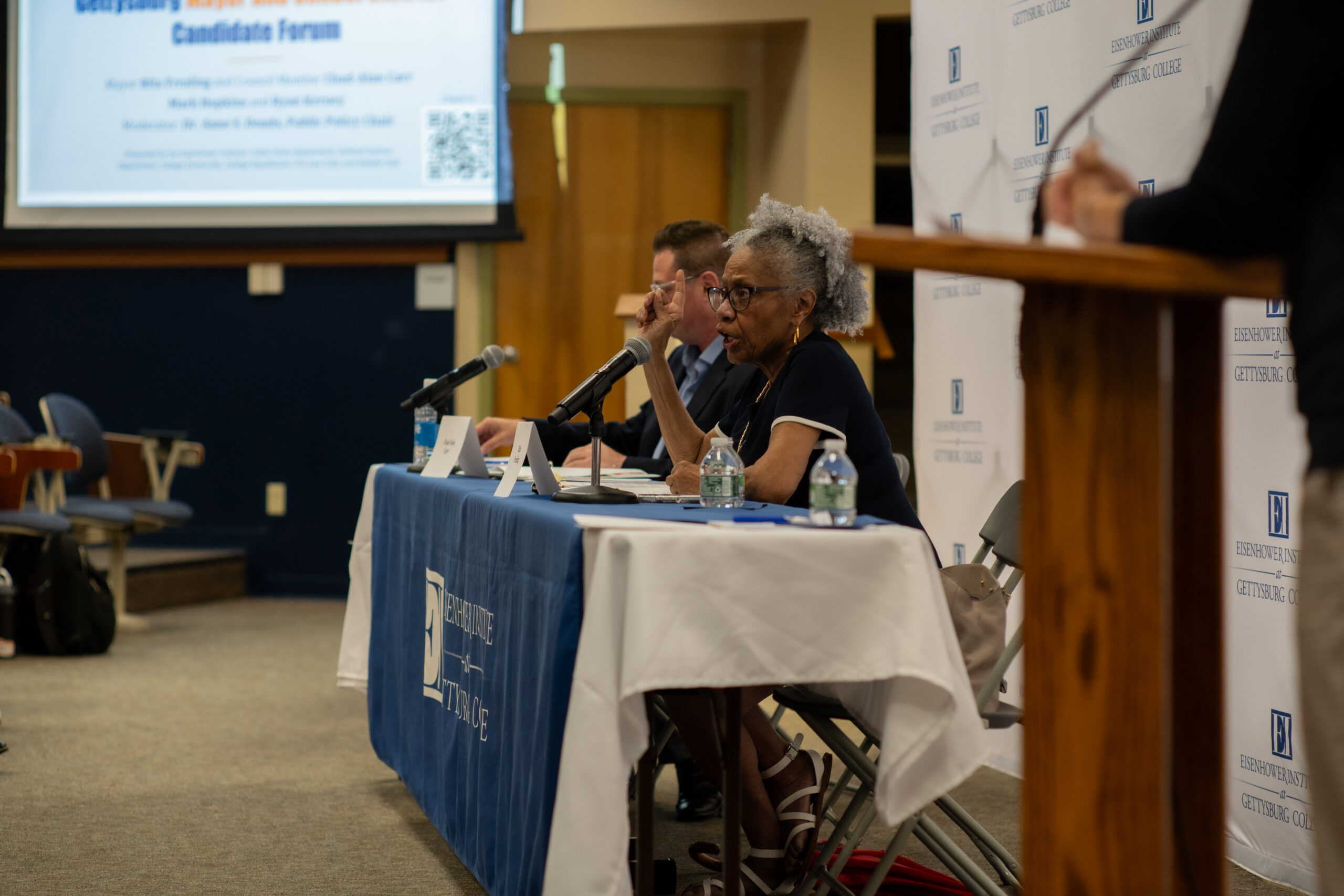
Mayor Rita Frealing answering a question.(Photo William Oehler/The Gettysburgian)
She also acknowledged that there had been issues between the police and some community members, and stated that she believed that they had been corrected. Frealing invited community members to attend the “National Night Out” event held each August, where they can interact with the police department. She announced as well that she will increase her office hours on the Gettysburg College campus, during which she will be accompanied by the new officer in charge, Sergeant Evans, for students to voice concerns and ask questions.
On this issue, Carr believes that the police department needs “more and better oversight,” and said that the police department ought to be under the same oversight as each of the other departments of the borough, which report to the Borough Council directly. He stated that a true transfer of oversight to “the people” cannot be done without home rule. Carr expressed his support for home rule, connecting it to the importance of listening to the wants of residents.
“That is why I ran three years ago, and that’s why I’m still running again,” he said. “I do not feel that things have changed in the last three years.”
Carr spoke in favor of police oversight from a council as opposed to just the mayor, as it is currently. He also applauded the “good work” Sergeant Evans has done as officer in charge, as the borough continues to search for a new chief. He said that, despite wishing him well, he is glad that the former Chief Robert Glenny is no longer in the Borough of Gettysburg.
Economic Development, Affordable Housing and Historical Preservation
The other main issue that has confronted Gettysburg over the past few decades is the question of the town’s need for economic growth and affordable housing, while still preserving its historic character. Candidates were asked about this at the forum.
Carr is generally in favor of development, hoping to strike a balance between growth and preservation. He spoke about the difficulties of economic development due to the limited size of the borough, much of which, he said, is owned by the National Park Service. He discussed limited opportunities for tax revenue, as the borough does not have many taxable properties, and despite its many tourists, only a small percentage of the county’s “pillow tax” on temporary lodging goes to the borough. He argued that “smart growth” could attract business and young families to Gettysburg, and the town should increase communication with community partners to create an economic balance that can actively pursue development while maintaining the historical character of the town.
“We are going into the year 2026, and we’ve got to think forward about how we can bring in more people to Gettysburg that are tax-paying residents, and more businesses as well,” Carr said.
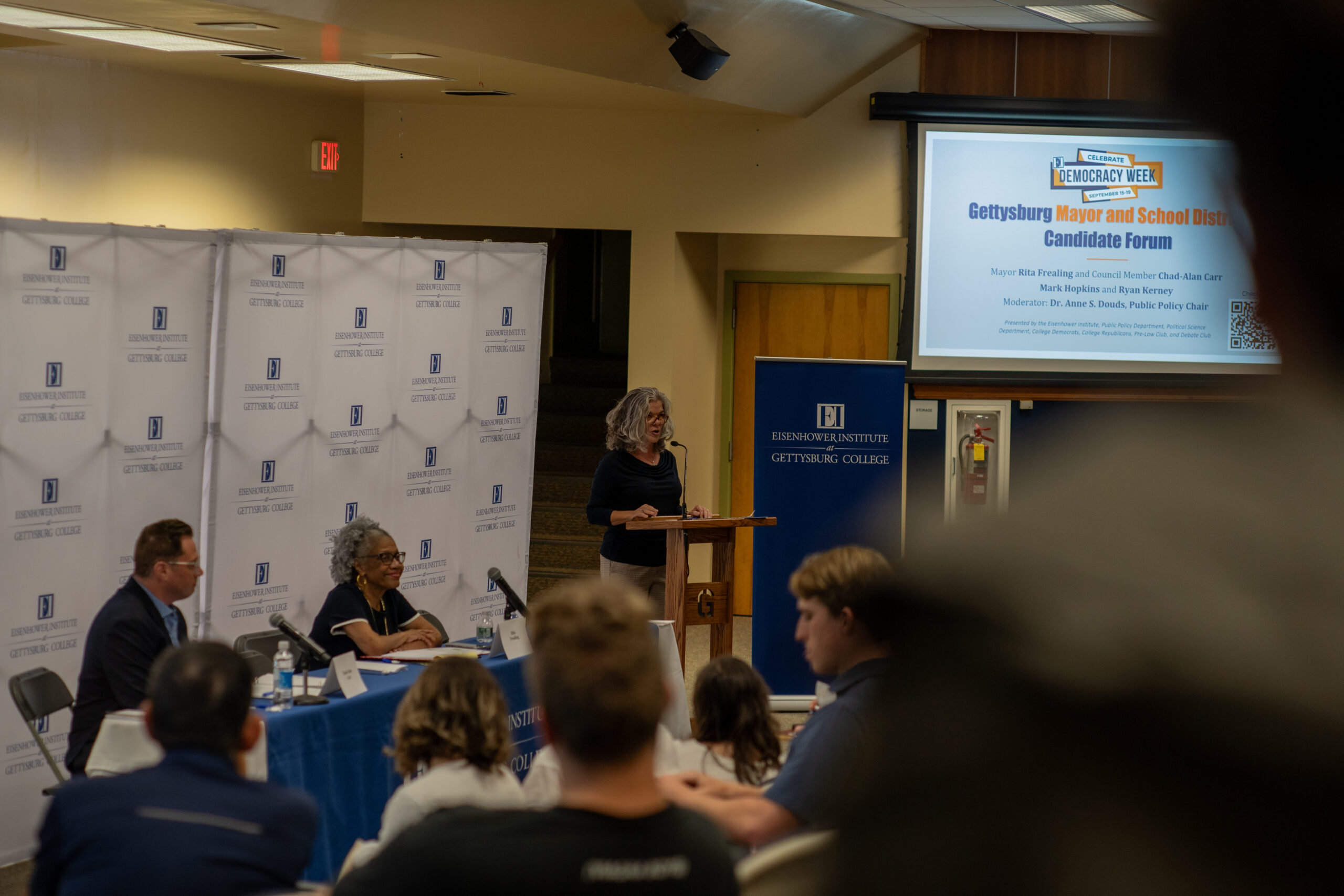
Moderator Associate Professor of Public Policy Anne Douds along with the two mayoral candidates.(Photo William Oehler/The Gettysburgian)
Carr also mentioned that he proposed the Non-Discrimination Ordinance to the Borough Council that established the Gettysburg Human Relations Commission, which is tasked with eliminating discrimination in housing. He emphasized the importance of the local service industry to support tourism in the town, and argued that these workers must be able to afford to live in the town where they can walk to work. On this, he said that he would like to work with the Adams County Economic Alliance and @Home In Adams County, to create incentives for future developers to work with property owners in downtown Gettysburg.
Frealing believes that Gettysburg should follow a model that is unique to the historic nature of the borough, which separates it from other small towns. She is in favor of utilizing existing resources to support the economy without sacrificing the town’s history, which she believes is crucial to the local tourism industry. She spoke about repurposing existing buildings in the borough, such as that of the public library, which is expected to be vacant, as “business incubators.” She also said that Gettysburg needs more jobs that attract young people and encourage Gettysburg College students to remain in the community after graduating.
In terms of housing, Frealing stated that there are existing resources for people to purchase homes, such as the PA Housing Finance Agency, that should be further utilized to help people with low credit ratings finance homes. She also stated that a high cost of living is not unique to Gettysburg, and called for constructive collaboration with neighboring communities to find common solutions.
“We need to find a way that we can get people to buy their own homes through agencies and banking programs that people aren’t yet aware of,” said Frealing. “You have to ask to find out about these things.”
While the Gettysburg Mayor remains a limited public office given the nature of borough law, the election is likely to represent the sentiments of the Gettysburg voter base on the perceived need (or lack thereof) for change, the extent of concerns over local policing and the pursuit of development versus the historical preservation of the community.
This article originally appeared on pages 8-9 of the October 2025 edition of The Gettysburgian’s magazine.


