
Schmucker Art Gallery Hosts Landmark: Landscaping Photography in the Arab World
By Kieran Caves, Staff Writer
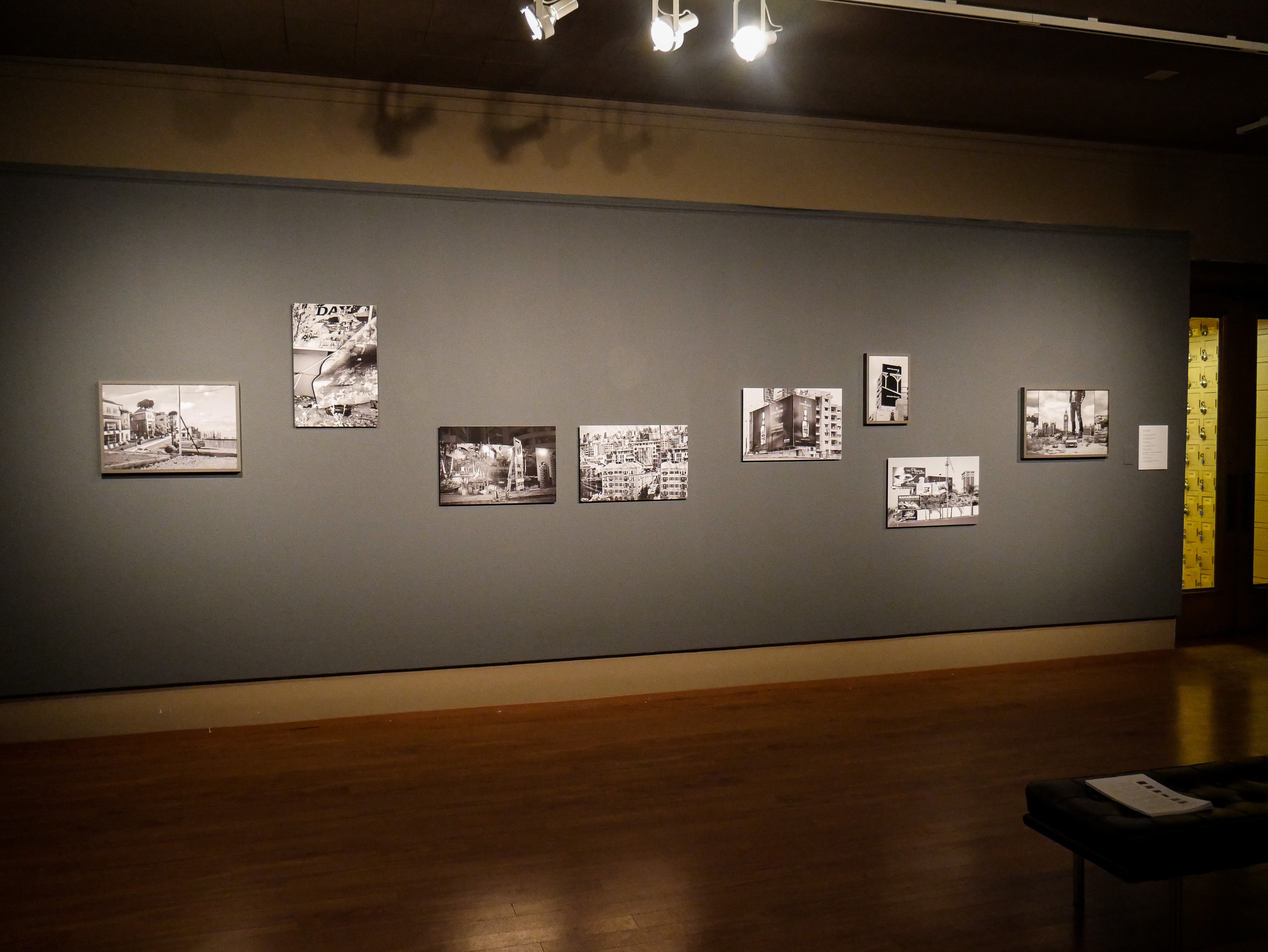
Landmark: Landscaping Photography in the Arab World on display in the Schmucker Art Gallery in February 2023 (Photo Sofia Gutierrez/The Gettysburgian)
On Friday, assistant professor of interdisciplinary studies at Gettysburg College and photographer Dr. Aisha Mershani, photographer Manal Abu-Shaheen, and professor of Middle East studies at the College of William and Mary Dr. Stephen Sheehi gave a talk on landscape photography in the Arab world, specifically presenting the work of Mershani and Abu-Shaheen. This exhibition will be on display in the Schmucker Art Gallery until March 3. It focuses on how photographing spaces can act as a means of resistance to various manifestations of colonization which threaten to redefine these spaces or erase violence that has been imposed upon them and the people living within them.
Aisha Mershani completed their PhD in 2015 from the UNESCO program in International Peace, Conflict, and Development Studies at the Universitat Jaume I in Castellón de la Plana, Spain, and now works as an assistant professor of Interdisciplinary Studies here at Gettysburg in addition to being a photographer, according to their website.
They have been working in Palestine photographing Israeli violence for nearly two decades, and though they normally focus on the people of Palestine, this collection concerns itself with space as an inroad to understanding the crisis. A black and white series depicts the town of Lifta; once a highly populated town, Lifta’s inhabitants were forced to flee during the Nakba of 1948 in which Palestinian Arabs were forcibly displaced by the incoming Israelis. The fact that Lifta remains standing is a product of Palestinian activism, according to Mershani; the photographs are haunting, drawing one into the skeletal remains of this town whose presence speaks to the never-ending Palestinian refusal to relinquish their stolen spaces. In this way, a physical space—and, even more so, the documenting of this space—becomes an act of resistance. Mershani said the series: “should be a depressing experience.” They even positioned their current work as merely moving images from one place to another, not creating art—the images are horrible, not beautiful.
The same is true of the series which forms the other half of Mershani’s project: a series of photographs of the Apartheid Wall which Israel is constructing in order to redraw borders and further displace Palestinians. Mershani emphasized the fact that the wall is not separate from Lifta, but connected through history—it is a continuation of Israel’s ongoing colonial project, a project which relies on the creation of illegal Israeli settlements; these settlements in turn change the demographics of the region, giving the appearance that there is not a great enough Palestinian presence for Palestine to have any authority in the area. The wall, problematic in the first place, only keeps expanding—Mershani’s images show the movement in the wall as it continues to dip into Palestinian territory. Mershani’s goal is to frame the wall not as a border, as Israel positions it, but as a violent structure attempting to create an uninhabitable environment for Palestinians. One image shows a former Palestinian hotel, just beyond the fencing which constitutes a part of the wall, which has been turned into a prison: a physical, violent colonization of a space which is now hostile. The image, through its indictment of how it was stolen, works towards a reclamation of the space, especially since even being close enough to this part of the wall to take the image is dangerous. An image of a football pitch with the wall rearing in the background—only feet away—demonstrates how the wall has been normalized into the environment. Still, resistance is not absent, as graffiti proclaiming: “free Palestine” spreads itself across the wall. Graffiti—a method of resistance at once artistic and pragmatic—is everywhere on the wall. Some pieces attempt to beautify the wall, a project which Mershani positioned as understandable though problematic; other graffiti is more straightforward—one piece reads: “As a grandchild of a Holocaust survivor, free Palestine.”
Manal Abu-Shaheen is a Lebanese American photographer currently living in the Bronx, NY. She was born in Beirut, but eventually relocated to the US and received her B.A. from Sarah Lawrence College and an MFA in photography from the Yale School of Art. Abu-Shaheen’s Beirut project, which is placed alongside Mershani’s work in this exhibition, focuses on billboard advertisements as spaces that “bring idealized images from one culture in contact with the realities of another.” According to Abu-Shaheen’s website, these ads once demonstrate capitalist growth while also imparting mythologized western ideals which are “incongruous in the post-conflict city” of Beirut, Lebanon.
From 1975-1990 Lebanon suffered a period of wars known as the Lebanese Wars, and there has been intermittent conflict since. The country’s history of violence and struggle is largely not taught in schools there, and Abu-Shaheen posited a kind of cyclical process of erasure as endemic to the place. This “under documented place,” then, is “populated” with these images from elsewhere in the form of advertisement. Abu-Shaheen positioned this as a kind of contemporary colonialism—a “system using images as the main form to inspire desire.”
In one image, a billboard advertises food which is eaten by a more traditionally ‘Western’ figure as the consumer, while another billboard in the foreground features an overly sexualized Arab woman. The juxtaposition situates the West as what consumes and a stereotypic, objectified version of the ‘East’ as what is offered up for consumption. One image depicts a famous Johnnie Walker ad with the slogan “keep walking” placed alongside a man walking over a broken bridge—an allusion to an act of violence in Lebanon, adulterated and transformed as strategic capitalism. Many of the advertisements cover up war damage on buildings—something which is allowed in the legislation of the country—in an attempt to beautify the city and, in Abu-Shaheen’s words, use “capitalism as a band-aid.” What works so well in Abu-Shaheen’s images, and what she defines as her goal, is images’ ability to approximate the experience of moving through Beirut, a city which is so dominated by this hyper-capitalism as to be disorienting.
In August of 2020, the government’s criminal negligence led to a massive explosion of ammonium nitrate in Beirut. Thousands were injured, and hundreds of thousands were left homeless, not to mention the billions in property damage; a mass exodus ensued. In the aftermath, many of the billboards Abu-Shaheen photographed are left blank, erased. This, the fact that the country faces the prospect of further cultural erasure, is why Abu-Shaheen works to create an archive of the city through her images. She doesn’t consider herself to be documenting anything, as what is there to document? The only stability lies in precarity, as she ironically points out. Rather, she wants to create an archive of images that speak to the reality of existence in Beirut, a reality which will be erased and avoided otherwise.
The exhibition as a whole seems to speak not only to the powers of landscape photography, but, as the title slyly refers to, the power of photography to landscape. Mershani and Abu-Shaheen’s images, in capturing modern-day manifestations of colonialism (in the form of the displacement of peoples and the imparting of hyper-capitalism), seek to define these spaces formally, to resist their destruction or complete transformation. It’s impressive, challenging work which asks the viewer to participate in the conservation of these spaces.


