
By Gabriel Renelt, Staff Writer
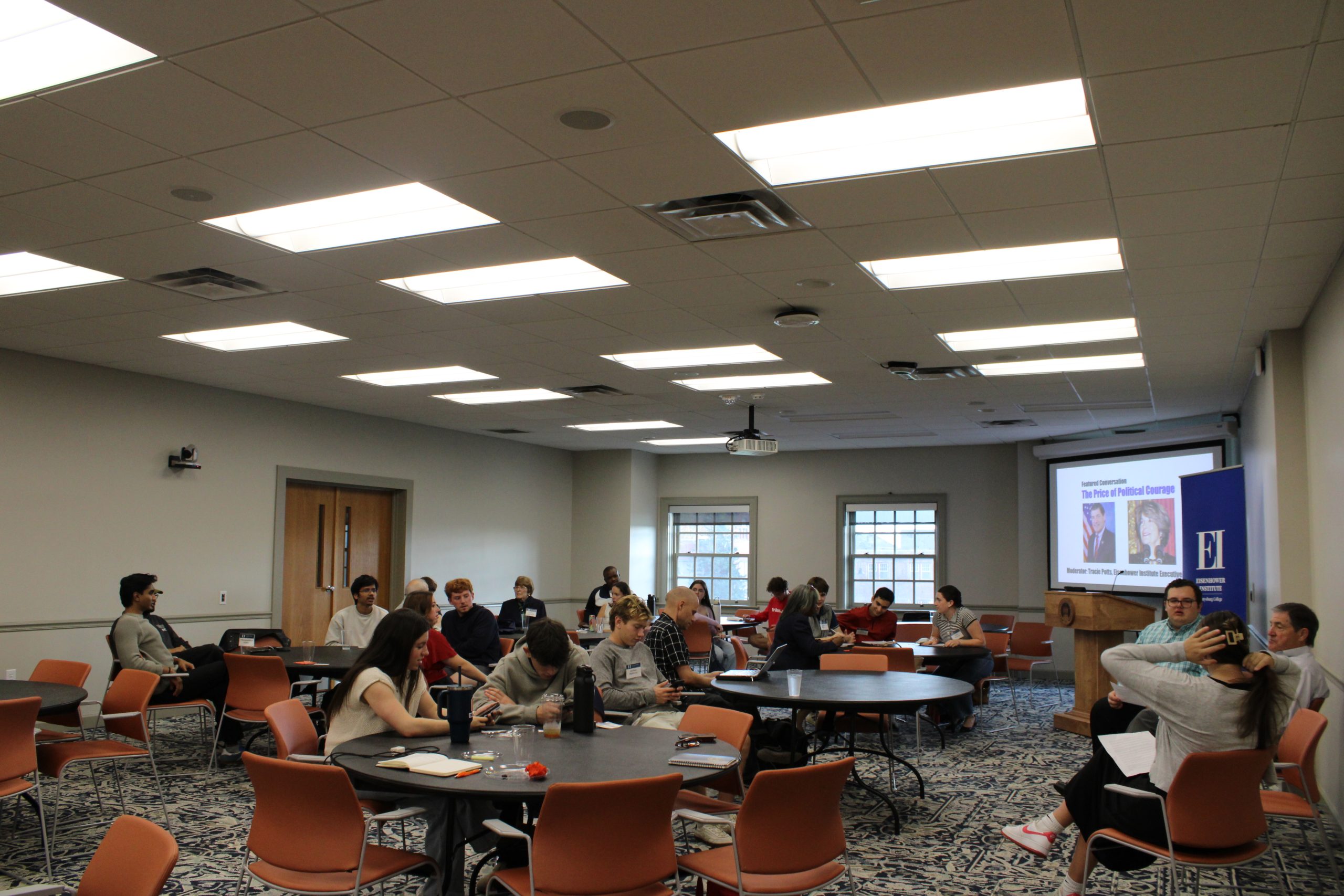
On Friday Nov. 6, in the College Union Building, the Eisenhower institute welcomed two former members of congress, Jim Gerlach and Marjorie Margolies. They were invited to speak following the recent midterm elections.
Both Jim Gerlach and Marjorie Margolies held Congressional House seats in the state of Pennsylvania. To promote bipartisanship, the Eisenhower Institute invited both a Democrat and Republican to come speak. Gerlach, a Republican, was the former representative for Pennsylvania’s 6th congressional district from 2003 to 2015. Marjorie Margolies, a Democrat, was the former representative for Pennsylvania’s 13th district from1993 to 1995.

(By Emily Cook/The Gettysburgian)
Tracie Potts, Executive Director at the Eisenhower Institute, opened the event by emphasizing Eisenhower’s leadership abilities.
“President Eisenhower, our namesake, is known for his character and how his character is infused into the leadership decisions that he made” Potts said.
Furthermore, Potts discussed the leadership, which she states Eisenhower was well admired for, by President Eisenhower prior to the D-Day invasion of Normandy beach.
“At the end of the day, if D-Day is successful, [Eisenhower] orchestrated it. And if its unsuccessful, he pledged to take responsibility of it… [Eisenhower] wasn’t going to say, orders weren’t followed, or it was bad weather… that’s leadership” Potts noted.

(By Emily Cook/The Gettysburgian)
After her opening statements on Eisenhower’s leadership characteristics, Potts introduced Gerlach and Margolies for an open, mediated discussion, in which she served as the moderator directing questions.
To begin, Potts asked both candidates for their election night stories, Margolies went first.
“And I went into election night only with a concession speech. there was no way that I was
Going to win this… I really only won because Clinton ran so well” Margolies reasoned.
After, Gerlach gave a brief overview on what he states interested him to become a representative for the state of Pennsylvania.
“While I was at law school at Dickinson… I was able to work for a state senator from Delaware county over in Harrisburg… being a part of the process of constituent work and legislation drafting really piqued my interest in wanting to run for legislative office” Gerlach stated.
(By Emily Cook/The Gettysburgian)
Following their stories, the discussion shifted to the increase of dark money in American politics as well as the increased political polarization since the time when both members held office.
“We seem to just have just 2 teams in their own ecosystems… without any crosscurrents of efforts” Gerlach stated.
The term dark money refers to political spending to influence elections, public policy, or political discourse in which the original source of the funds is kept hidden from the public. The legal basis for the rapid expansion of dark money in American politics is the hallmark Citizens United v. FEC decision which lifted limits on independent political spending by outside groups (Super PACs, politically active nonprofits, a labor unions and others).
“There is however, growing consensus in D.C., bipartisan consensus, I think, on what’s called dark money reform” Gerlach added.
Dark money reforms vary from limitations on individual donations to and through these organizations to a complete ban of this undisclosed political money.
“Spending half a billion dollars on a race for a job that pays 100 thousand dollars — Its bizarre” Gerlach and Margolies concluded.
On the topic of leadership, Margolies discussed, through a personal story, the idea that leaders must take hard action, even when they know its unpopular.
“There was a very important vote… and I broke the tie at 218. There were Republicans shouting bye-bye Marjorie… they knew I was going to lose [in the next election]” Margolies said.

(By Emily Cook/The Gettysburgian)
The Republicans prediction was accurate. Margolies faced backlash from voters in her district upon returning home. In the following 1994 midterms she was voted out of office after serving just one term.
Gerlach added, “elections all across the country, every cycle… come down to a couple votes per precinct… so remember that when you think about whether [you] should turn out to vote or participate in the process.”
The event finished with an interactive roleplay style program set up by Potts in which students acted as citizens weighing the possibility of a new AI data center being built within their town.


