
By Brandon Fey, News Editor
On Tuesday, Sept. 16, Gettysburg College hosted a public forum featuring Gettysburg’s Mayoral candidates for the Nov. 4 election in the Mara Auditorium on campus. The event was presented by the Eisenhower Institute, the Public Policy and Political Science Departments, Gettysburg College Democrats, Gettysburg College Republicans, the Pre-Law Club and the Patrick Henry Debate Society. The forum was part of the programming for the Eisenhower Institute’s annual “Democracy Week.”
The forum was held between the incumbent Mayor Rita Frealing and Councilman Chad-Alan Carr. Carr, an at-large member of the Gettysburg Borough Council, had defeated Frealing in the Democratic Primary in May, after receiving 268 votes compared to Frealing’s 237. Frealing was able to continue her campaign with a place on the November mayoral ballot because she received 119 write-in votes from registered Republicans, exceeding the 10 write-in minimum to remain on the ballot as the Republican nominee. Frealing has served as mayor of the Gettysburg borough since her initial election in 2021, after she had defeated Carr in the Democratic Primary of that spring.
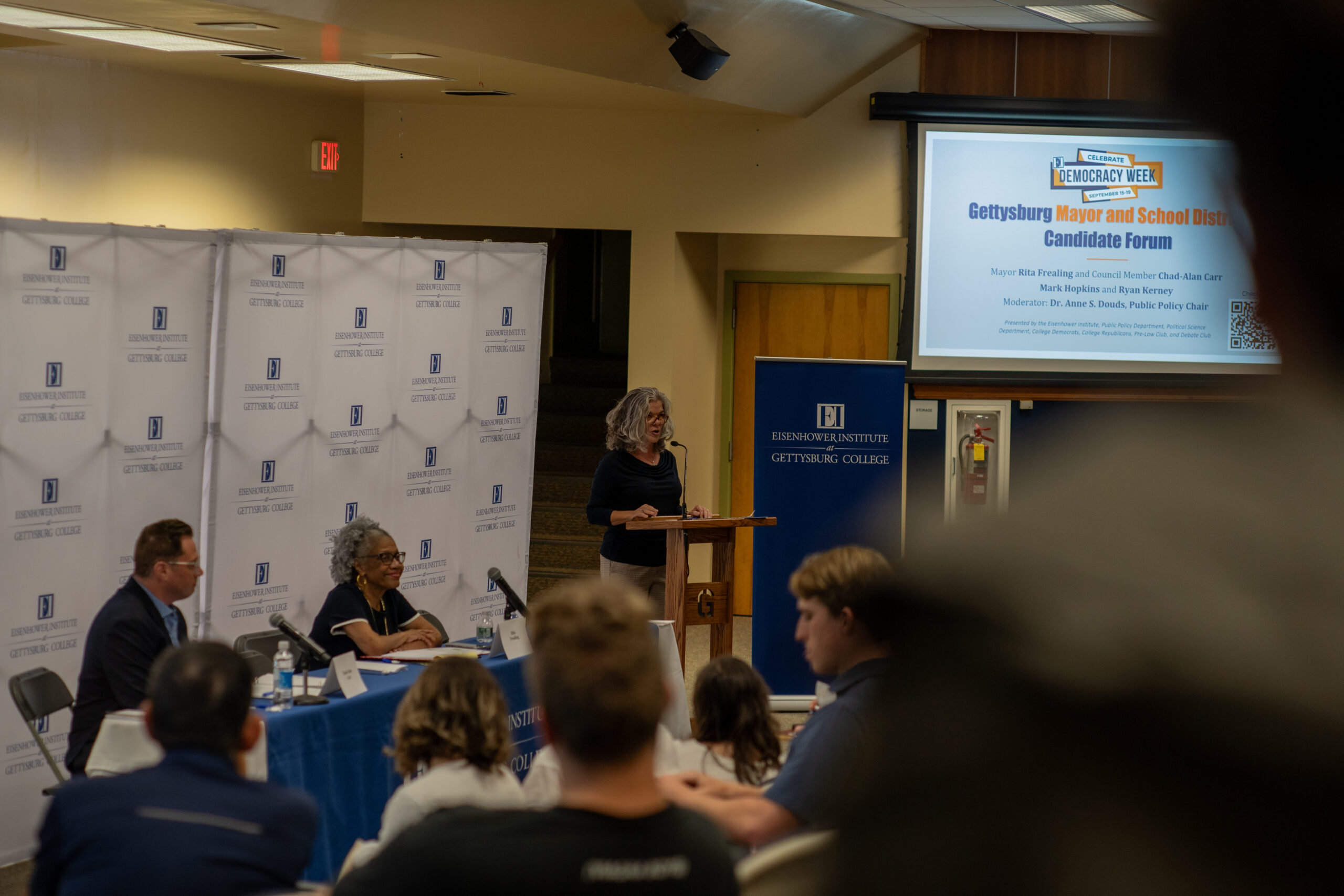
Moderator Associate Professor of Public Policy Anne Douds, along with the two mayoral candidates. (Photo William Oehler/The Gettysburgian)
The forum was moderated by Associate Professor Anne Douds of the Department of Public Policy. Douds opened the forum by thanking the campus organizations that sponsored the event and outlining the rules of the evening, which were approved by both candidates prior to the event.
Each candidate was allowed two minutes to give an opening statement. Two minutes were then given to each candidate to answer formal questions, alternating in the order of first response. If, during a response, a candidate were to specifically mention their opponent, the one mentioned would be offered one minute for rebuttal. 15 minutes were reserved for questions from the audience, the responses to which were also limited to two minutes. Audience members were allowed to applaud, but interruptions and partisan signage were forbidden. The Patrick Henry Debate Society moderated the time of each response.
Prior to opening statements, Assistant Professor Alauna Safarpour of the Department of Political Science explained the scope of the mayor’s authority and responsibilities to the Gettysburg Borough. She emphasized the impact that local elections have in shaping one’s daily life, and how, despite this, few voters tend to participate in local politics. She stated that 1,300 voters cast ballots in the previous mayoral election, and the winner was determined by about 250 votes.
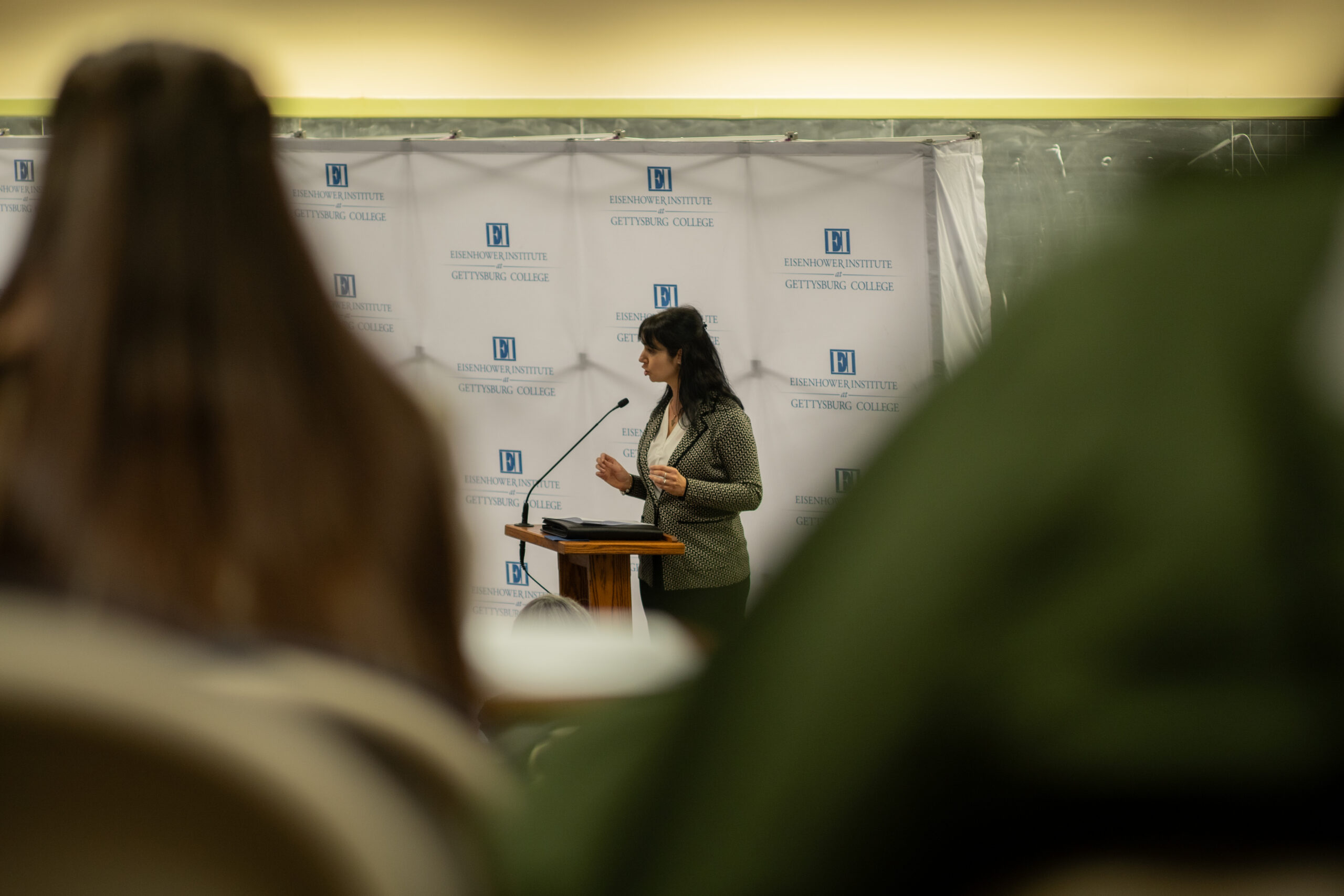
Assistant Professor of Political Science Alauna Safarpour explained the scope of the mayor’s authority and responsibilities to the Gettysburg Borough before the candidates’ opening statements. (Photo William Oehler/The Gettysburgian)
Safarpour explained that under Pennsylvania state law, the Mayor of Gettysburg serves as the borough’s sole elected executive officer, who is tasked with preserving order, enforcing ordinances, ensuring faithful performance of borough officers, approving contracts and legal documents, and reporting to the Borough Council. The mayor also possesses emergency powers to maintain public safety in times of crisis. She acknowledged that the current debate over the mayoral powers over the police, and whether they ought to be delegated instead to the borough manager. State law provides that a mayor may choose to delegate non-legislative and non-judicial powers, such as oversight of the Gettysburg Police Department, to that office. It is also possible to change the current system of police oversight by changing Gettysburg’s government structure through a home rule charter approved by a vote of the people.
Opening Statements
Opening statements were delivered in alphabetical order by surname.
Councilman Carr mentioned that he had run for mayor of Gettysburg three years ago for the same reasons he does so now, namely: the need for proven and energetic leadership, and government accountability and transparency. He stated his belief that the police department needs “more and better oversight,” and said that he had to “respectfully” correct Professor Safarpour’s statement about the legal delegation of mayoral power in the borough. He said that the Pennsylvania Borough Code states that powers could be delegated to any “officer,” the definition of which he said is not given in the code, and not exclusively the borough manager. He said technically, he and the other members of the Borough Council are sworn officers who would be eligible for such a delegation of powers. He then said that the police department ought to be under the same oversight as each of the other departments of the borough, which report to the Borough Council directly.
Mayor Frealing opened by speaking about her past, having grown up in Gettysburg, and her personal experience of over 40 years in law, public policy, communications and direct public services. She then specified that Section 1121, subsection A of the Pennsylvania Borough Code states that “the mayor shall have full charge and control of the chief of police and the police force.” She remarked that there are only two places in Pennsylvania (Bethel Park and Penn Hills) that use a different structure of police oversight, which in both cases was instated by home rule. She said that if residents truly wanted a change to the oversight of the police in Gettysburg, it should be done by a vote of committees comprised of different elected officials, instead of the mayor just signing over authority to another individual. She emphasized that the structure of police oversight is clearly stated in Pennsylvania law, and per her experience as an attorney, she claimed that a change to this system will likely invite a lawsuit, which she has been able to avoid during her tenure.
Police Oversight
Professor Douds’ first question asked how each candidate would ensure fairness and accountability of the Gettysburg Police Department, given recent concerns about alleged misconduct and aggression of local officers.
Frealing responded that during her tenure, relations between the police and the local community have improved, and mentioned that she speaks with officers and sees that they undergo proper training. She said that the public must also be held accountable, just as officers are expected to exhibit professionalism. “It’s a duty of respect between each other, and not fearing one or the other,” she said.
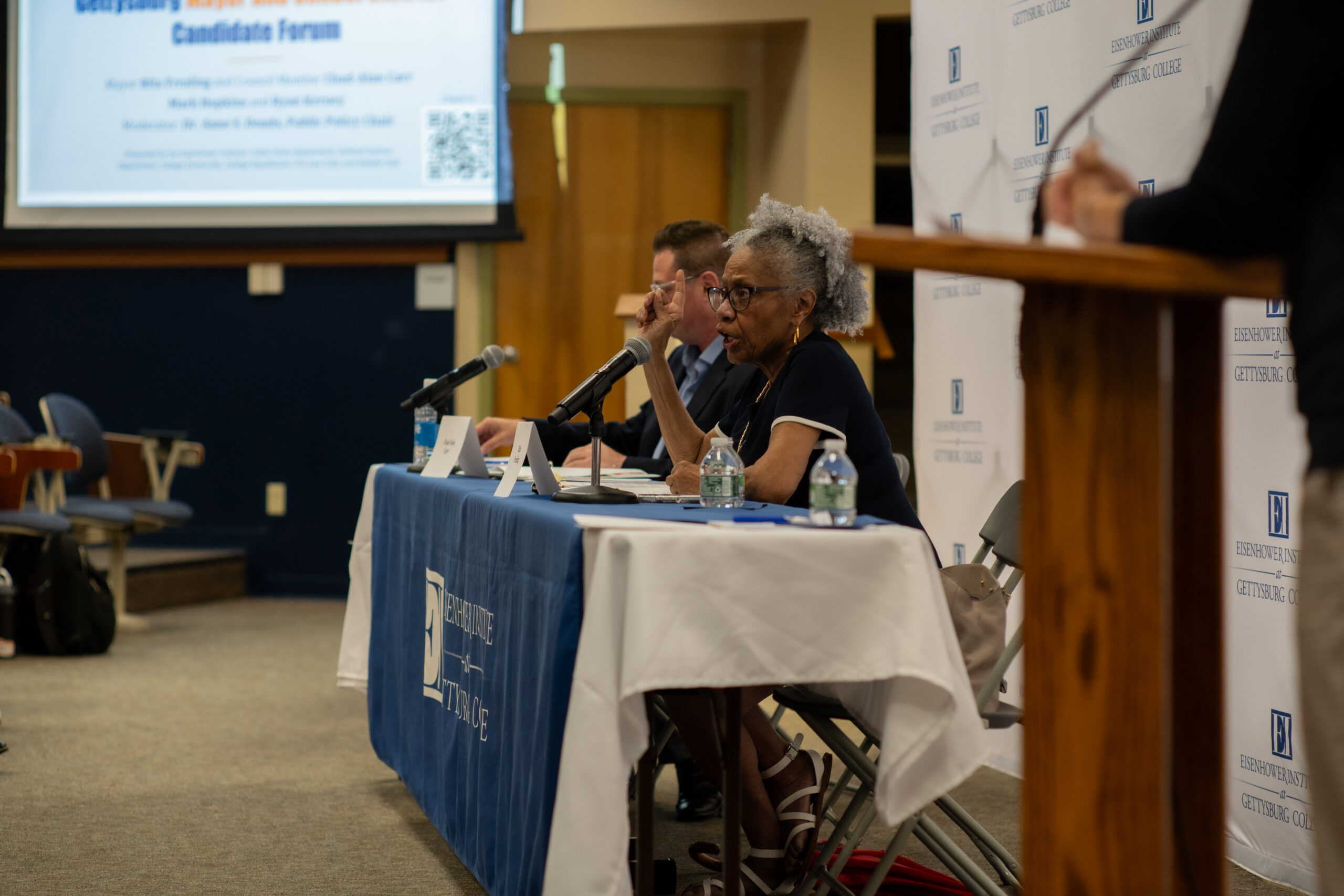
Mayor Rita Frealing answering a question.(Photo William Oehler/The Gettysburgian)
She then acknowledged that there had been issues and stated that she believed that they had been corrected. Frealing also mentioned the “National Night Out” event held in August, where community members can interact with the police department. She said that she will increase her office hours on the Gettysburg College campus and will be accompanied by the new officer in charge, Sergeant Evans, for students to voice concerns and ask questions.
Carr restated that the commonwealth’s borough code holds that oversight power can be delegated to a borough officer, so transfer of oversight is therefore doable. He said, however, that a true transfer of oversight to the people cannot be done without home rule. Carr stated that he is in favor of home rule, connecting it to the importance of listening to residents. “That is why I ran three years ago, and that’s why I’m still running again,” he said. “I do not feel that things have changed in the last three years.”
Carr spoke in favor of oversight from a council as opposed to just the mayor. Carr also applauded the “good work” Sergeant Evans has done as officer in charge, as the borough continues to search for a new chief. He also stated that, despite wishing him well, he is glad that the former Chief Robert Glenny is no longer in the Borough of Gettysburg.
Since May 2025, Glenny has been serving as the Police Chief of the neighboring Mechanicsburg, Pennsylvania.
Economic Growth and Historical Preservation
The next question asked the candidates how they would address Gettysburg’s need for economic growth and expansion, while still preserving its historic character.
Carr spoke about the difficulties of economic development due to the limited size of the borough, much of which, he said, is owned by the National Park Service. He also spoke of the limited opportunities for tax revenue, as the borough does not have many taxable properties, and despite its many tourists, only a small percentage of the county’s “pillow tax” on temporary lodging goes to the borough.
Carr stated that “smart growth” could attract business and young families to Gettysburg, and the town should increase communication with community partners to create an economic balance that does not overburden residents. He said that as part of this balance, the historic nature of Gettysburg should be protected, but the community must also actively pursue economic development.
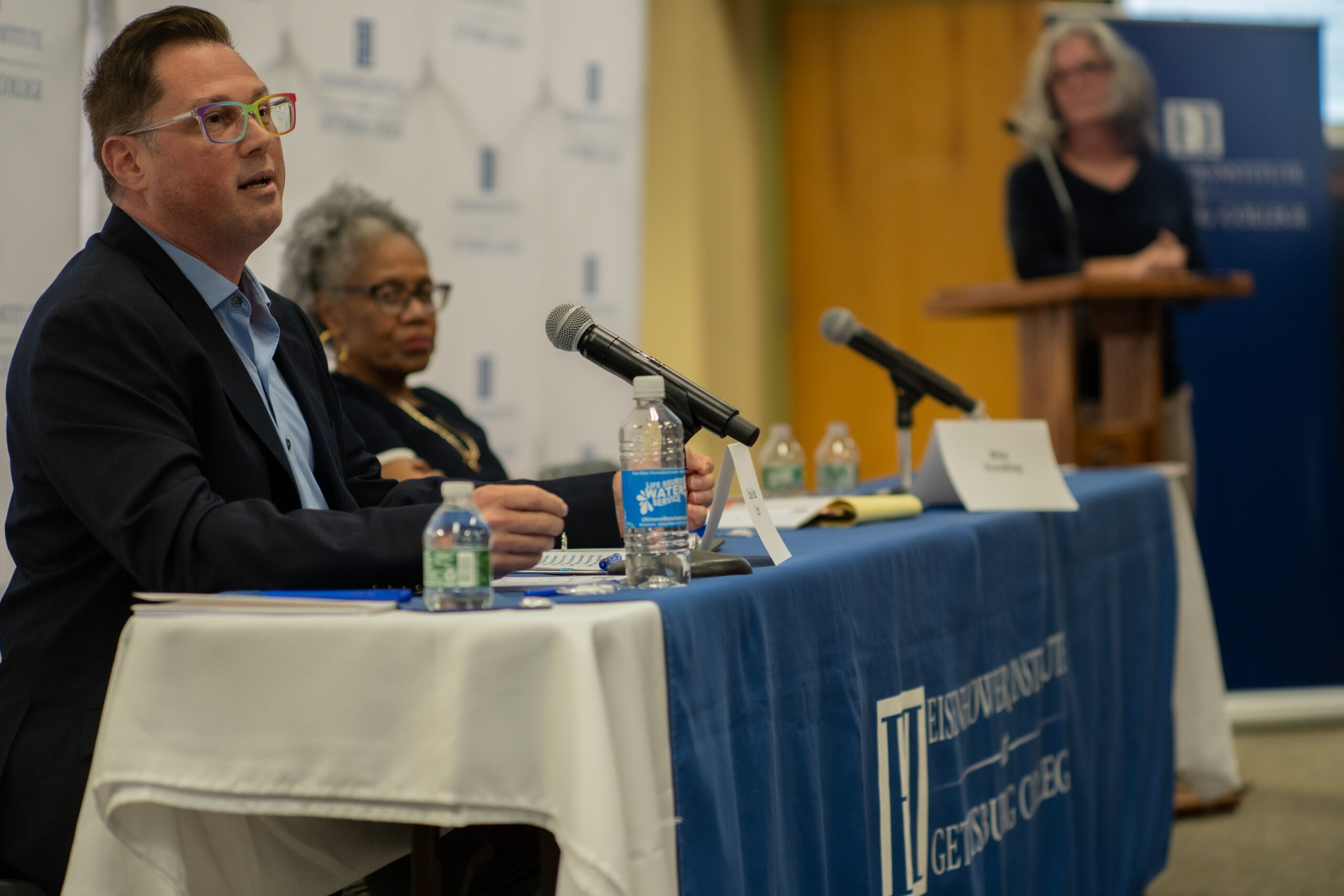
Councilman Chad-Alan Carr answering a question. (Photo William Oehler/The Gettysburgian)
“We are going into the year 2026, and we’ve got to think forward about how we can bring in more people to Gettysburg that are tax-paying residents, and more businesses as well,” he said.
Frealing said that she believed that, contrary to Carr’s claim, most of the National Park Service’s land surrounds the borough, but is not within its bounds, claiming that this encloses much of the borough, making expansion difficult. She said that there are certain existing buildings in the borough, such as that of the public library, which she said is “getting ready to be vacant,” that can be used as “business incubators.” She also said that Gettysburg needs more jobs that attract young people and encourage Gettysburg College students to remain in the community after graduating.
“And that’s a community plan that we can all get together for,” said Frealing.
She used the remainder of her response time to expand on her previous point about police oversight, asking the audience to consider the consequences if the governor were to give control of the state police to the Pennsylvania General Assembly, or if the President were to cede power over the military to Congress.
Affordable Housing
Douds’ next question asked how the candidates would plan to address Gettysburg’s rising costs of housing to provide affordable homes while balancing the need to protect the town’s historic identity and support local businesses.
Frealing replied that there are existing resources for people to purchase homes, such as the PA Housing Finance Agency, which helps people with low credit ratings finance a house. She acknowledged that housing is expensive in Gettysburg and said that had she not inherited her house, she would not be able to live in Gettysburg, as the tax burden has been difficult for her as well.
“We need to find a way that we can get people to buy their own homes through agencies and banking programs that people aren’t yet aware of,” she said. “You have to ask to find out about these things.”
She stated that a high cost of living is not unique to Gettysburg, but is an issue for several local communities in the region, such as that of Frederick, Maryland. Frealing expressed her belief that these communities can collaborate to find common solutions.
Carr stated that in 2019, two years before he was elected to the Borough Council, he introduced the Non-Discrimination Ordinance to the Borough Council, which was unanimously passed the following year. The ordinance established the Gettysburg Human Relations Commission, which is tasked with eliminating discrimination in employment, housing, public accommodations, and commercial property. He said that he both respects the character of the town and understands the need to balance growth with preservation. “I will always support responsible, inclusive housing policies that keep Gettysburg visible without losing what makes Gettysburg unique,” he said. He specifically mentioned the importance of the local service industry to tourism in the town, and emphasized that these workers must be able to afford to live in the town where they can walk to work. He then said that he would like to work with the Adams County Economic Alliance and @Home In Adams County, among other partners, to create incentives for future developers and help property owners create more housing in downtown Gettysburg.
Party Affiliation
The following question asked how closely the candidates’ policies align with their party tickets and the importance of party affiliation in this election.
Carr emphasized that his work revolves around building community, as he invited audience members to view his website and social media platforms to verify that message.
“The goal is to listen and stay approachable and address concerns with transparency and care,” he explained.
He stated that he believes those qualities most align with the Democratic Party, which, he explained, is why he “immediately” conceded his loss in the 2021 primary, out of respect for the voice of his party. He reemphasized that his goal is to be transparent and approachable, which is why he said he is proud to be the nominee for the Democratic Party.
Frealing explained that despite losing the Democratic Primary by a “slim margin,” she acknowledged the Republicans who wrote her in. She said that this dynamic presented an opportunity for greater political cooperation.
“The Republicans who wrote me in took the time to root for me, and I’m not going to ignore them. I have worked for Democrats and Republicans, and I want to reach out to the independents. Unity means we’re all in this together.”
She then spoke about her past, having grown up with parents of different political affiliations, which gave her a “different, more collaborative” view of party affiliation. Frealing then stated that while she applauds the Gettysburg Human Relations Commission of Carr’s Non-Discrimination Ordinance, and is proud that it is in Gettysburg, a similar entity has been in Harrisburg for years. She discussed the Gettysburg peacelight as a symbol of national unity, and connected it to the potential for political unity in Gettysburg. Regarding the peacelight, she said, “It shows that our nation came together here in Gettysburg, and I really believe in my heart we can do it again.”
Carr was offered a response to Frealing’s mention of the Gettysburg Human Relations Commission, for which he said that while it is good that the Pennsylvania Human Relations Commission is in Harrisburg, it is unrelated to the Borough of Gettysburg. He said that the Borough of Gettysburg’s Non-Discrimination Ordinance extends to address discrimination on the additional bases of sexual orientation and gender identity, as Harrisburg’s does not. He also claimed that he lost the 2021 primary to Frealing by less of a margin than Frealing’s loss in 2025, and emphasized his subsequent concession. “I lost to you (Frealing) by less, and I conceded immediately.”
To that, Frealing then responded: “You (Carr) weren’t written in by a group of people, whom I am just not going to ignore.”
This exchange was stopped by the moderator as the candidates had exceeded their allotted time.
Role of the Mayor
The final formal question of the forum spoke to the limited role of the Gettysburg mayor compared to that of other cities. It asked the candidates how they would pursue their mayoral responsibilities in shaping policy, providing leadership and representing the community, to make the most of the office to benefit residents.
Frealing stated that while the office has limited responsibilities other than overseeing the police department, the mayor serves as an “ambassador for Gettysburg.” She described her experience promoting the town, citing a recent Rotary Club meeting, where she spoke with people from foreign countries who are interested in bringing tour groups to Gettysburg. She said that she will continue to work to increase tourism and promote the town. “I want people to know how wonderful Gettysburg is. What you can see here, the things to do, and how it’s just a wonderful place to live,” she said.
She also spoke on the uniqueness of Gettysburg’s character. “People come to Gettysburg because it’s quiet, it’s laid back, it’s not a city, it is not a State College, and it is not Chambersburg. People come here (Gettysburg) because of our quaintness and the importance of our history.” She then said that in light of the approaching semiquincentennial anniversary of the United States, people must remember that “the union was made in Philadelphia, but it was preserved in Gettysburg.”
Carr said that while the borough follows a weak-mayor, strong council system, he believes that the role of the mayor is to be a “champion for the town.” “That includes everyone, no matter if they are a Republican, Democrat, Independent, or even those that choose not to vote at all, because that is their right.” He then emphasized the importance of listening to all people, and connected it to his victory in the recent primary. “I am very proud to be listening to those of my party that made their voice heard at the primary, and I’m thrilled to be their elected nominee,” he said.
Carr said that his work in creating the Gettysburg Community Theatre and the Gettysburg Pride festival was done because of his love for the town and was accomplished by listening to people who wanted something like that done.
“I believe that is exactly what needs to happen with the mayor: listening to what people want here in the borough,” he concluded.
Audience Questions
The forum was then opened to the audience to ask questions to the candidates.
One resident inquired about potential support for efforts to retain the streams to pass through Gettysburg, preventing them from draining too quickly to allow for potential trout fishing, as had apparently been possible according to accounts from about 75 years ago.
Both candidates remarked that it was the first time that the issue had been presented to them. Carr said that he is willing to speak with more people interested in local streams, and imagined that it would be possible to retain them if it did not interfere with the borough’s current issues with managing stormwater. Frealing said that she would also want to learn more about the issue, mentioning potential concerns with water infrastructure, and acknowledging that Carlisle has running streams.
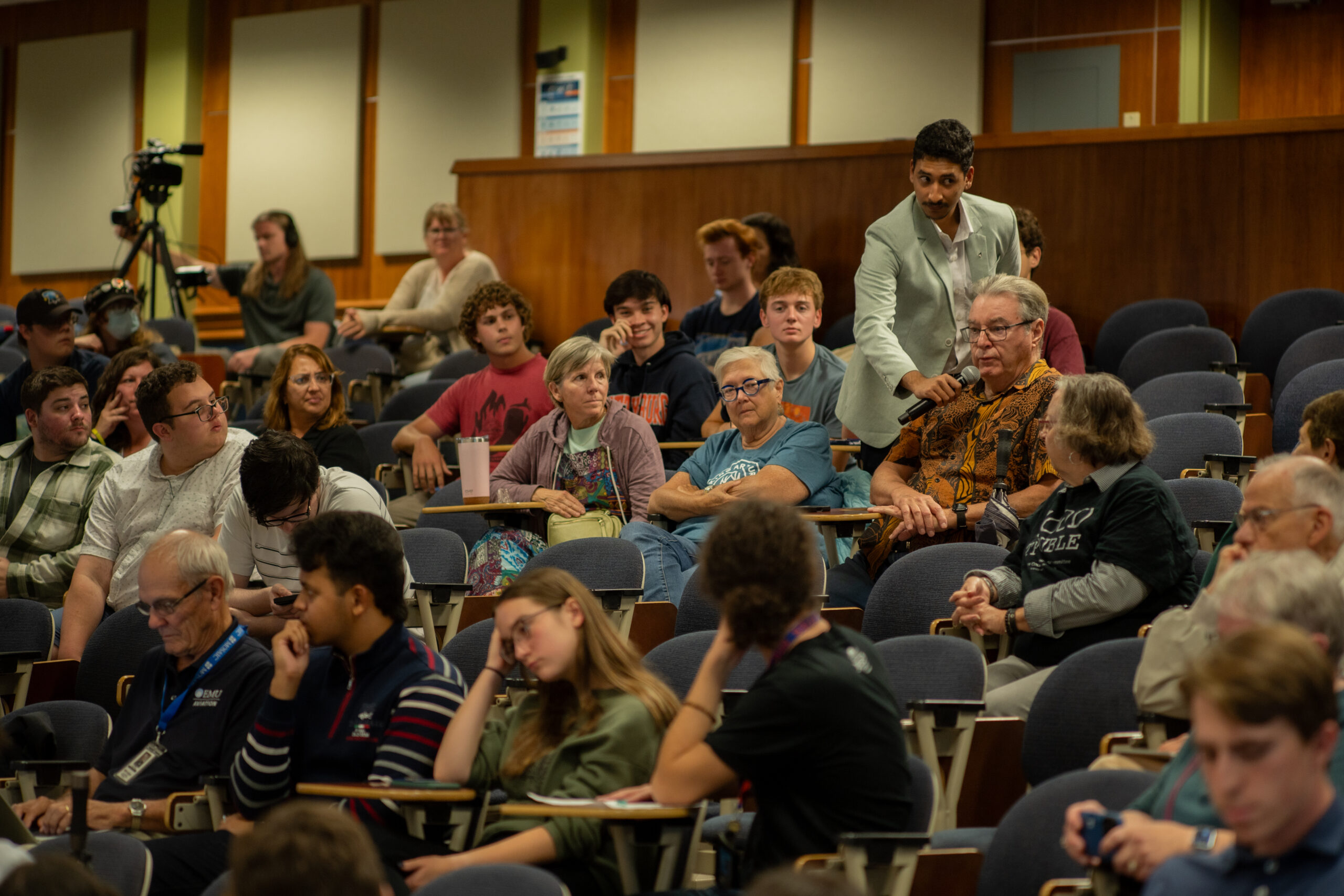
An audience member asking a question.(Photo William Oehler/The Gettysburgian)
Another resident asked if there should be a “civilian review board” that would allow the people to influence the conduct of the police department.
Frealing said that she consulted Harrisburg’s statute on such a board, and said that she would not be against its implementation in Gettysburg if it is approved by the voters. Carr said that he would be in favor of a volunteer board to be among the town’s other boards and committees to voice concerns and provide insight on certain situations within the department.
The next audience question asked about how a change to police oversight would impact the mobilization of the department in a state of emergency.
Carr said that if the department were to be overseen by a council that accepted that responsibility, it would likely be codified that the mayor and borough manager would still lead the department in an emergency. Frealing also said that the mayor would still lead emergency management, and reiterated that she believed that the transfer of oversight is unnecessary.
Another question asked about the specific “backup plan” that each candidate would have if they were unable to attend a ribbon-cutting ceremony for a small business in the town, to which they would be invited.
Both Carr and Frealing stated that they would make an effort to attend such events and try to send another borough officer if they were ultimately unavailable.
Other residents asked about the candidates’ thoughts on the planned Gettysburg Station Project to build a residential and retail complex on Carlisle Street.
Carr acknowledged that the issue has been divisive for several years. He said that a previous council set the project in motion over a decade ago, and that the project can not be reversed at its current stage of approval. He specified, however, that Gettysburg is the only borough in Adams County whose borough council does not have the final word on development. This is instead the right of the Planning Commission. He then emphasized that the borough is very small, and while there is limited space to grow outward, it can grow upwards in terms of constructing higher buildings. He said that such development would attract more tax revenue, similar to the $150,000 that he claimed would result from the station project.
Frealing said that the property where the project is to be built is privately owned by a man named Timothy Harrison from Staten Island, so the borough has limited impact on it. She explained that Harrison’s plans were approved by the Historical Architectural Review Board and then by the Borough Council in December of 2024, and the Land Department is currently reviewing the plan. She said that the owner still must comply with certain obligations, and she would not consider the project a “done deal” until those obligations are fulfilled.
Executive Director of the Eisenhower Institute Tracie Potts delivered the final remarks of the evening, during which she thanked the audience for attending the forum. She spoke about the importance of civil discourse and community and civic engagement to the institute and said that both goals were achieved that evening. She emphasized the importance of community participation exhibited by those who attended the forum.
“It matters that you care about what happens in your community, and I want to thank you for that,” she said to the audience.
The Mayoral Forum was followed by a second forum between the Area School District Board special election candidates Mark Hopkins and Ryan Kerney that was presented by the same organizations.


