
By Jake Gramanz, Staff Writer
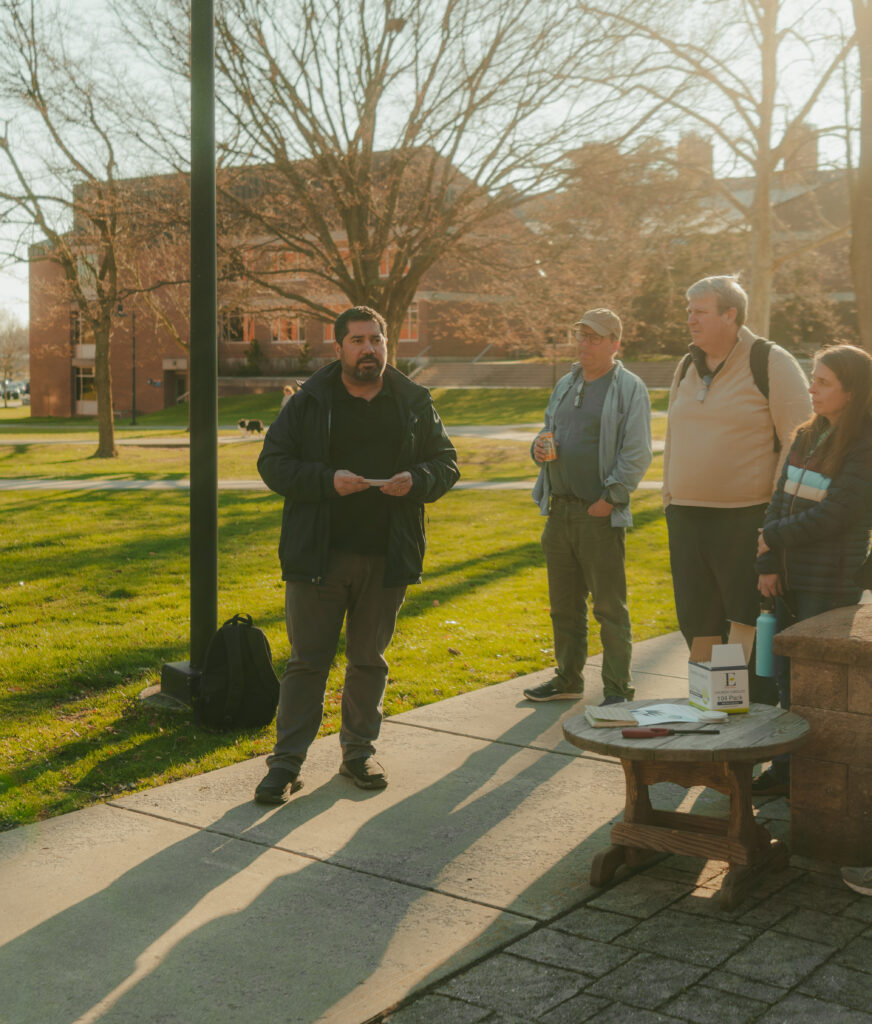
Assistant Economics Professor Gokcer Ozgur shared a statement about the earthquake at the vigil on Thursday, March 30, 2023 (Photo Borna Ganji/The Gettysburgian)
Last Thursday, a group of students held a candlelight vigil for the victims of an earthquake that took place in Syria and Turkey last February. The candlelight vigil took place at Gettysburg College’s Peace Pole at 5 p.m. The event was sponsored by the Middle Eastern & Islamic studies department, the political science department, peace and justice studies department and International House.
Student organizer Leila Elshehawy ’24 shared how the organizers wanted to create an event of remembrance and hope.
“We are gathered here today for remembrance and solitude for the victims in Syria and Turkey. Both countries have been suffering, with 56,000 people found dead and counting as bodies continue to be found each day,” Elshehawy said.
Monica Solis ’25 shared a poem by John O’Donohue titled “On the Death of the Beloved.”
“Let us not look for you only in memory, where we would grow lonely without you,” Solis read. “You would want us to find you in presence, beside us when beauty brightens, when kindness glows and music echoes eternal tones.”
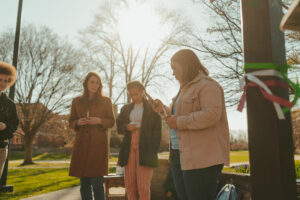
Monica Solis ’25 shares a poem at the vigil for Earthquake victims in Syria and Turkey on Thursday, March 30, 2023 (Photo Borna Ganji/The Gettysburgian)
Students then gathered candles to light and were asked to share their thoughts.
“This vigil is a space for remembrance and care,” one student said. “We grieve for and with the families who lost their lives and the lives of their loved ones. We pray for the people who live under the Bashar al-Assad regime in Syria. The effects of this earthquake is something these people will have to live with for the rest of their lives.”
Following this, Assistant Economics Professor Gokcer Ozgur gave a brief statement about the earthquake.
“A 200 mile line and 50 miles long was the affected area, that’s the area between D.C. and here. Hundreds of thousands of people lost their homes and their livelihoods. 1999 was one of the biggest earthquakes in this region, and since 1999, Turkey implemented special earthquake taxes and new construction codes in order to help prevent future earthquakes from such massive destruction,” Ozgur said.
Ozgur detailed how corruption was a large part of the earthquake’s destruction.
“The Turkish government accumulated nearly three billion dollars, but this money was spent elsewhere, and the new construction codes were not enforced,” Ozgur explained. “Corruption and nepotism played a huge role in this earthquake’s destruction.”


