
By: Ainsley Green, Arts and Entertainment Editor
This article originally appeared on pages 18 to 19 of the Sept. 2026 edition of The Gettysburgian magazine
On Friday, Sept. 11, Duo Mantar performed a concert in Paul Recital Hall at 8 p.m. following a masterclass taught at 3 p.m. The Sunderman Chamber Music Foundation’s Concert Series sponsors guest artists to visit the Sunderman Conservatory for a residency, allowing students to interact with professional performers and scholars on a personal level.
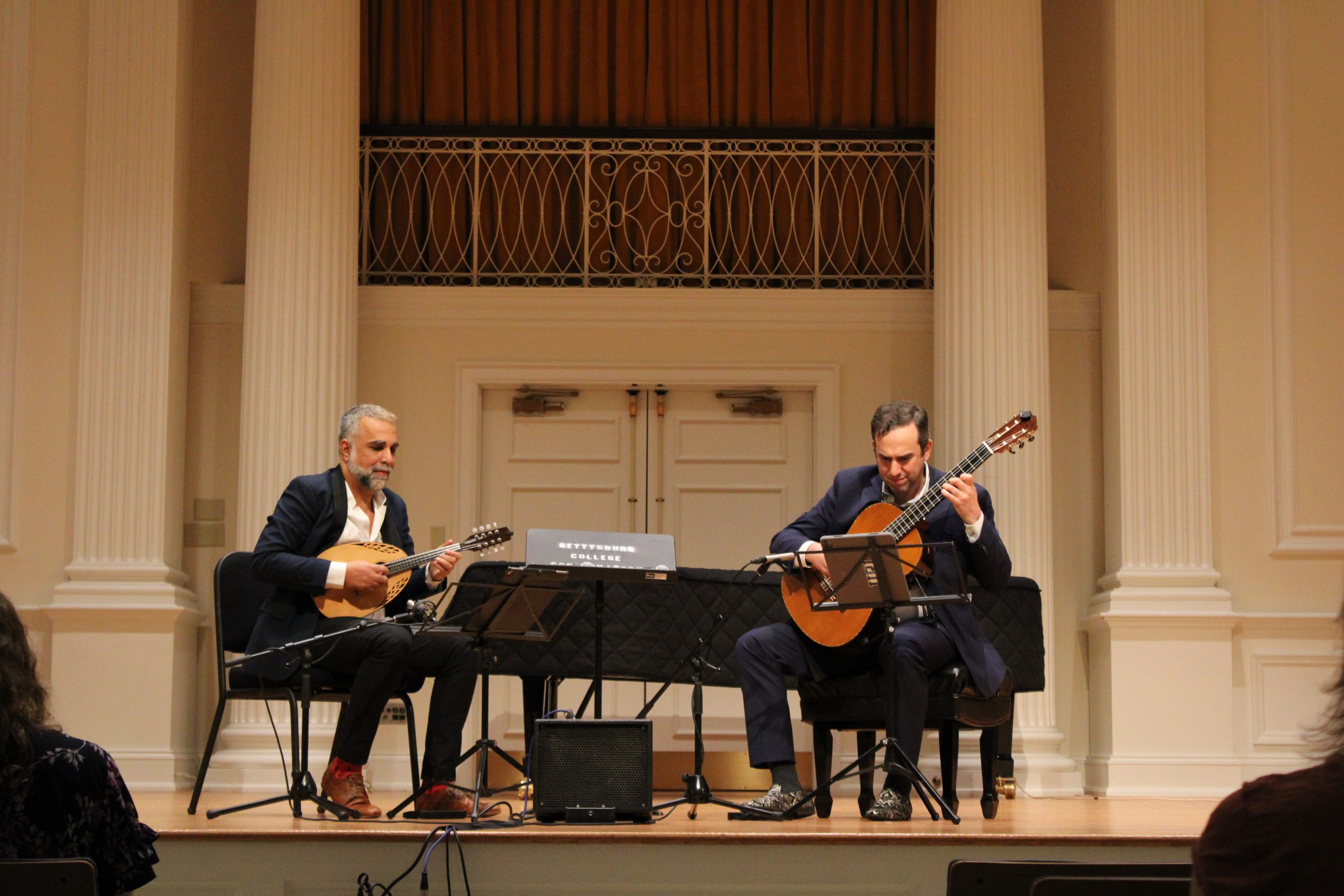
Duo Mantar is composed of American classical guitarist Adam Levin and Israeli mandolinist Jacob Reuven, who began collaborating in 2017. The duo aims to spread mandolin and guitar repertoire and is currently working on a recording project of works by Dr. Avner Dorman, assistant professor of music theory and composition at Gettysburg College, including a newly commissioned double concerto. Later that weekend, on Sunday, Sept. 13, Duo Mantar performed the double concerto at the United Lutheran Seminary at 4 p.m. as part of Music, Gettysburg! Duo Mantar visited a variety of classes to teach about their work to students at the College in the days leading up to the performance.
“[We had] such rich conversations about the meaning of music and survival,” said Dr. James Day, director of the Sunderman Conservatory of Music, when recalling the experience he had having Duo Mantar join his sophomore seminar class. Duo Mantar also visited Germany from 1945 to the Present taught by Tres Lambert, associate professor of German studies, as well as the composition studio class of Dorman.
The program of the concert was entitled “Rachela’s Mandolin from Auschwitz,” which told the story of Rachela Zelmanowicz-Olewski, a Holocaust survivor who was saved by her talent on the mandolin, placing her in the women’s camp orchestra. Levin and Reuven narrated Rachela’s story in between each piece on the program to illustrate how the music related to true events that occurred in her life before, during, and after her incarceration.
(Emily M Cook/The Gettysburgian)
The program included music from a variety of different styles, from Jewish folk melodies to very famous orchestral works in the Western canon, many of which were arranged for mandolin and guitar by Gregg Nestor. The program began with “Nigun” by Ernest Bloch, the Hebrew melody “Shalom-aleichem,” and “Wiegala, Wiegala,” a lullaby by Ilse Weber, which documented songs from Rachela’s childhood as understood by extensive research in an attempt to gain a picture of her life through the music that was in it.
The middle set of pieces on the program documented Rachela’s journey as a musician and her thoughts about the impending World War II in Poland. “Eliyahu Hanavi,” another Hebrew melody, and “Undzer Shtetl Brennt (Our Little Town is Burning)” by Mordechai Gebirtig demonstrate struggles that Rachela’s family faced, detailed in the program with captions reading “Rachela’s opinion of the lack of food,” and “They burned our synagogue.”
In between these two pieces, the well-known “Csardas,” by Vittorio Monti, demonstrated the level of skill that Rachela was estimated to have at playing the mandolin when she entered the Auschwitz women’s orchestra as a teenager, with fast, syncopated rhythms and technical control shown in the performance. “Variations on a Moravian Theme,” by Gideon Klein was an example of music documented as being performed at Auschwitz, following the chronological timeline of the program.
Next, Duo Mantar played an arrangement of “Symphony No. 5, Op. 67 Mvt. I: Allegro con spirito,” by Ludwig van Beethoven, a piece known for its recognizable opening motif and its notable stamp on the Western musical canon. Reuven shared the anecdote that Beethoven’s “secret code,” replacing the first violin part of the symphony with the distinctive mandolin, was a code for the prisoners to know that the Allies were on the way to liberate them. He shared that at a previous performance for Rachela’s 100th birthday, a Holocaust survivor in the audience confirmed that the arrangement performed very closely matched the music she heard while watching the camp orchestra.
The program concluded with “Zemer zemer lach,” a Hebrew melody, and “Hora,” by Marc Lavry, concluding with the hopeful sentiment that survivors of the Holocaust could have hope for a new life in Israel, free from the terrors they faced.
(Emily M Cook/The Gettysburgian)
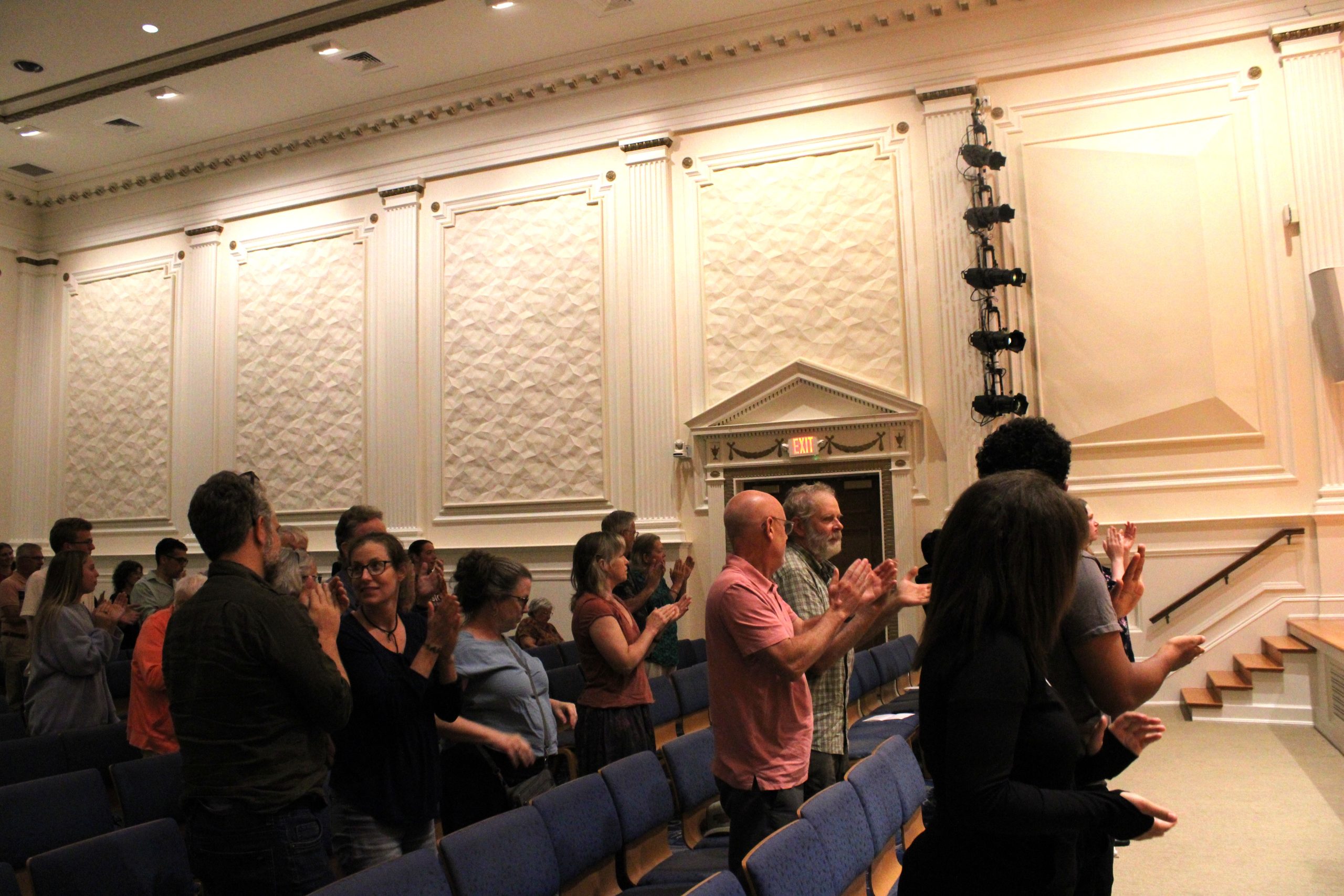
Many students who attended the masterclass came back that evening to watch the full performance with the context of the question and answer opportunity from earlier in the afternoon.
“I really enjoyed how they used the two instruments in tandem to tell a story of someone that doesn’t get told very often,” said Paige Sweeney ’30 after the program concluded. “I found it deeply moving and inspiring to hear that person’s story through music.”
The Sunderman Conservatory hosted these artists in a multi-day residency through the Sunderman Chamber Music Foundation, founded in 1983 by F. William Sunderman to promote community through music, and has many more programs planned for the rest of the academic year.


