
By John McDermott and Gabriel Renelt, Staff Writers
On Thursday, Oct. 1, the Africana Studies Department, the Economics Department and the Office of Diversity and Inclusion hosted the 20th Annual Derrick K. Gondwe Memorial Lecture on Social and Economic Justice. This year’s edition of the event named for Dr. Gondwe, a former professor of the Economics Department and founder of the Africana Studies Department, was titled “Of Storytelling and Structural Change: Film, Philanthropy, and the Fight for a Fairer Economy” and ran from 5:15 to 6:30 in the CUB Ballroom.
President Bob Iuliano gave welcoming remarks and Jevon C. Gondwe, son of the late Professor Derek Gondwe intrudced the lecture with some words about his father. “Now, losing our father was the greatest tragedy of my life at that time. But being able to come to these [lectures] every single year for 20 years is the greatest gift that our family could have ever asked for,” he said.
Chief Diversity Officer Eloísa Gordon-Mora, introduced the three panelists, including keynote speaker Dr. Abigail Disney.
Disney arrived in Gettysburg for a screening of her film: “The American Dream and other Fairy tales” on Wednesday at the Majestic Theater.
Joining Disney, was Professor Jennifer Collins Bloomquist, Chair of the Africana Studies Department, and Professor Zhiuing Hu, Chair of the Economics Department. Professor Bloomquist is an expert in linguistics whose research focuses on regional varieties in African American English and has received funding from the National Science Foundation. Professor Hu is known for her research in economic inequality and recently researched how the effect of rising food prices, debt, and agricultural finance have impacted economic and social outcomes on a national scale.
Disney is an award-winning filmmaker, writer, philanthropist and activist, who has one Emmy Awards for her documentaries, “The Armor of Light” and “Pray the Devil Back to Hell.” She has founded and supported various charitable organizations that support peace building, gender justice, systemic cultural change and the power of storytelling to inspire social movements.
Disney started by explaining how her work as a documentary filmmaker has given her the opportunity to “tell human stories that have a larger significance than one individual,” adding that “the first thing you need to do is find a story, the right story.” She used the example of women from war-torn Liberia who looked past their differences to unite for peace and persuade the country’s dictator to attend peace talks. The leader of this movement went on to win the 2011 Nobel Peace Prize and women in other regions of the world were inspired to take similar action.
Disney shared that while travelling in Liberia, she was struck how powerful the story was and decided to make a film. She would go on to make more films about stories she believed were overlooked because “film has this unlocking power … you go to some other third space … you open in this incredibly important way,” she said. When someone gives a film their undivided attention, they leave room for empathy and inspiration to take action to support certain causes or combat certain issues, which is what Disney hopes her films can lead to.
Disney discussed systemic issues, related to the theme of the lecture, through her first film “Pray the Devil Back to Hell.” Disney’s film focused in on the Women of Liberia Mass Action for Peace movement during the tail end of the Second Liberian Civil War.
“After years of civil war, they came together across the lines that divided them… They worked out their differences, and then they stood on an airfield that was along the side of the road where the dictator Charles Taylor would drive to work every day,” Disney detailed.
“They were able to persuade [Charles Taylor] to go to the peace talks organized by the international community that were happening in Ghana. They went to Sierra Leone and worked out the same thing with the rebels under similar circumstances,” she said.
She also believes that it is hard to fully understand what someone is going through until you listen to them and give them the opportunity to share their experiences. One of her goals in filmmaking is to try to replicate the experience of listening to someone in person so that the audience can build empathy for the people in the film and become more committed to making change.
Disney, a multi-millionaire herself, has become a vocal critic of extreme wealth and corporate inequality.
“When we’re talking about hundreds of billions and even a trillion dollars, you have to ask yourself, is there such thing as too much money?” Disney said.
Disney commented on the psychology of billionaires, “there is just so much fear… they live in constant state of fear… I think deep in their hearts, they know this is not right and that people are coming for them because it’s not right”
She also contrasted the greed of the billionaire class with the ideal of a moral CEO. A “moral” CEO being a member of the billionaire class who considers the needs of their workers before that of excess profit.
“If the [crew of the] ship [are] sick, hey, people are going home and they don’t get enough food. At the end of the day, you don’t take your $60 million payday. Perhaps you’re the last one to get your year’s compensation decided, after everyone else has enough to eat,” she illustrated.
Disney argued that the push for broader changes focuses too much on creating individual heroes. She said that she believes that fighting for justice needs to be a collective effort and that “the relationships that you forge are the real reward and if you’re looking for some kind of credit, you’ve kind of lost the plot.” She added that “the other flaw is the idea that there’s a finish line … there is no place where we’ll all get to at the same time in the same way.” She believes that America has lost its sense of unity in the struggle for justice, and that it was more personally fulfilling to her to work with groups united for a common cause.
Disney also stated her hopes that people who see others suffering are driven to do something about it, especially people who have the means to make a major impact. She believes that those in her position have a responsibility to call others out when they are not doing enough. She is concerned with “the expectation online that life be seamless or frictionless which is an expectation that has been built in us by a lot of technology,” and thinks “we need to recognize that there’s no such thing as a seamless or frictionless life.”
Disney concluded the main discussion portion by urging the audience to reject the myth of the lone hero, made popular by Disney cartoons, and promoted the idea of finding yourself through adversity. “If you can find a way to see in the struggle the meaning of your life, not in the victory, then you have a chance,” she noted.
The panel then opened the floor to questions, which mostly centered around workers’ rights and the way modern businesses are run. Disney believes the responsibility of CEOs has strayed too far from providing for workers and that CEOs are being put in a position where everything they do is for their shareholders and board members, who are rarely company insiders.
Later, when taking questions, Disney shared her thoughts on how to fix the issues of economic inequality. “Tax the s—t out of them [billionaire]. There should be a wealth tax,” she said.
Disney stated that there is reason for hope for her cause by telling the story of her friend who taught ethics to business students at Harvard and how young people started taking her class more seriously. She believes that “whole systems and structures can be changed. But they won’t change unless there’s somebody courageous enough to step into it,” going on to mention a prestigious series of fellowships for business students at top universities that centers around “moral ambition” and how that will reward “people who are brave enough to speak in a moral voice.”
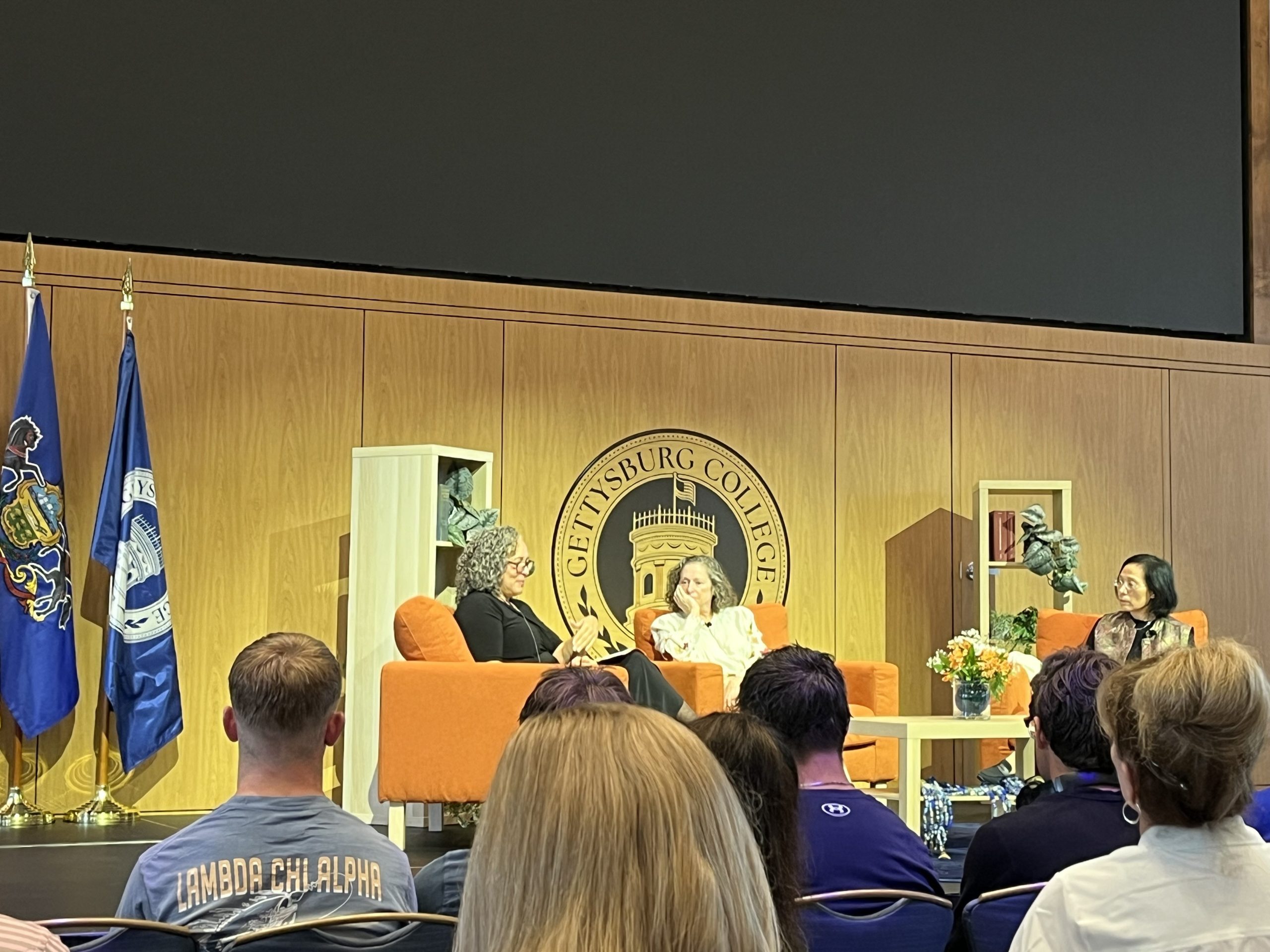
Leture Panel Left to Right: Bloomquist, Dinesy, Zhiuing
(Photo: The Gettysburgian)


October 4, 2026
I once found that attending these talks requires a specific prior knowledge of the field. My experience differed significantly when I first began learning the material.