
By Celena Glaghassi, Contributing Writer
On Thursday, Oct. 16, the Department of Sociology, in collaboration with the Center for Public Service (CPS) and the Office of Diversity and Inclusion hosted “Forests, Farms, & Migrant Work: From the West to the East Coast.” The event began at 7 p.m. in Mara Auditorium and consisted of a film screening followed by a panel. To begin the event, Professor Cassie Hays, Chair of the Department of Sociology, introduced the panelists and gave a brief overview of the film.
The film, “A Thousand Pines,” follows the story of a man named Raymundo Morales on his journey leading a crew of 12 workers from Mexico to the United States to plant commercial pine forests. Produced by one of the panelists as part of his dissertation at the University of Pennsylvania, the documentary focuses on the 12 workers and their eight-month-long journey planting thousands of trees in the United States as part of reforestation efforts. The documentary highlights the sacrifices, as well as the mental and physical challenges experienced by certain migrant workers to financially support their families in Mexico.
According to the film, the guest workers are forced to work long hours, six to seven days a week, making about $500-$600. It described their mental strain from being away from their families while battling constant physical exhaustion.
“You can either sleep well, or you can eat well,” said one of the workers in the documentary.
A portion of the film also discusses the controversy of the “guest worker visa program,” and its mistreatment of workers using the program. It claimed that workers often endure terrible conditions from their employers to maintain their work visas.
The film stated that tree planting wasn’t always the grueling, physically demanding job that it portrayed. It said that in the early 70s, tree planting was a seasonal job typically occupied by young hippies. During that time, the schedules weren’t as intense, and the wages were substantially better. Over time, as wages decreased and work increased, companies shifted to hiring Latino workers— bringing them to the U.S. on H2-B visas as guest workers. The film explained that guest workers were willing to accept pay that most Americans would not, and they were also willing to work harder to maintain their work visas.
After the screening, the audience had a chance to ask questions about the film and migrant farm work to the four panelists. These included the producer and director of the documentary, Noam Osband, alongside Antoni Esquivias ’25, who had been a student employee at CPS. They were joined by CPS grant coordinator Brenda Reyes-Lúa, who is the daughter of a migrant farm worker and currently works with the Pennsylvania Migrant Education Program to support the children of migrant workers. The final panelist was Yeimi Bautista, who has spent over two decades working to improve health access for migrant and underrepresented communities in Adams County and the surrounding regions.
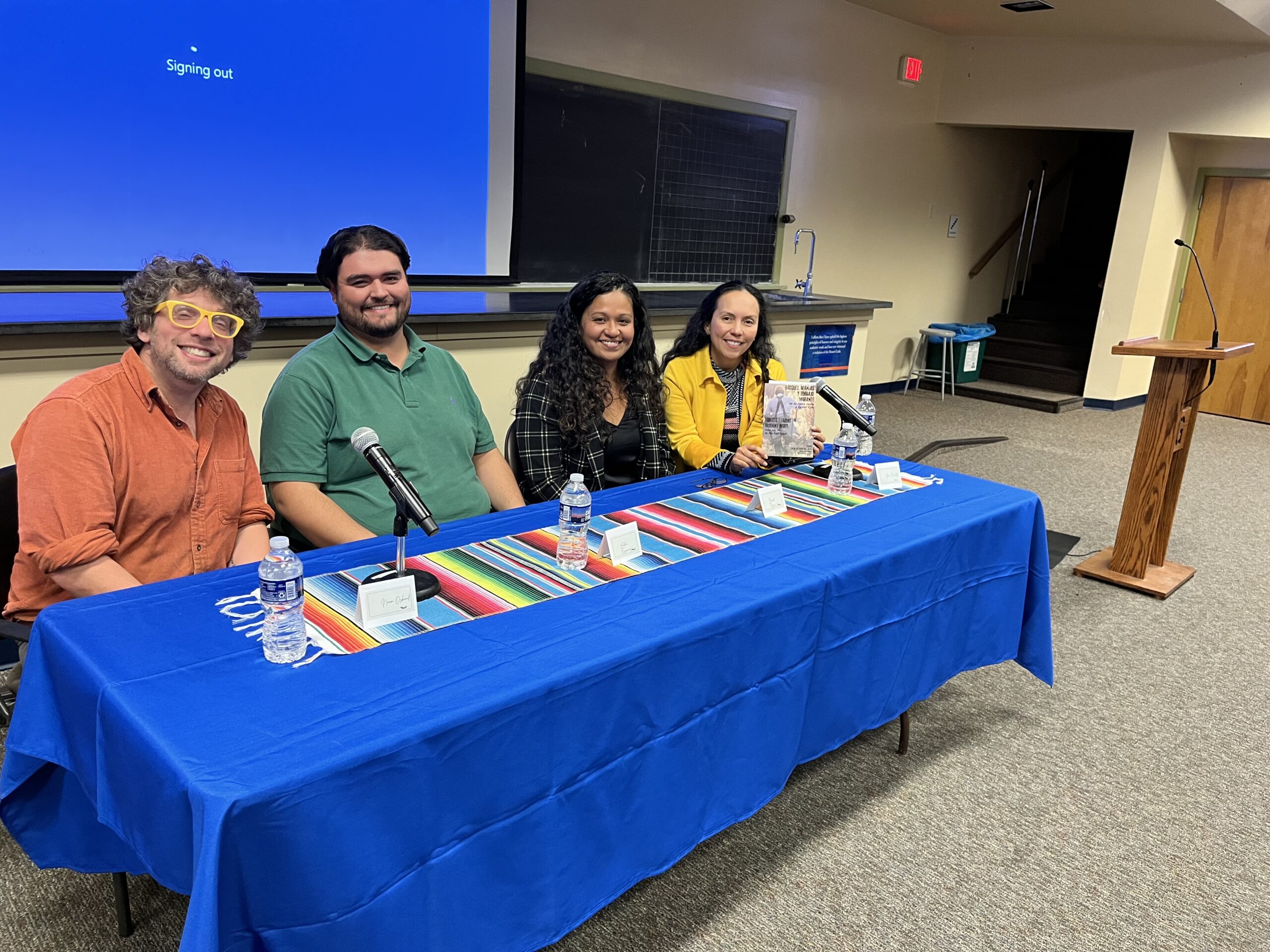
Discussion Panel (Photo Curtesy of Professor Cassie Hays, Department of Sociology)
The first question, posed by Hays, asked the panelists for their thoughts and reflections on how migrant workers were depicted in the documentary, and how their work changes from region to region.
“Through my work with a migrant education program and just being the daughter of a migrant farm worker, I just want to parallel, in terms of the quantity of the work that they do. And, sometimes, they’re everywhere, but they’re also hidden. We don’t really see them until we do,” Reyes-Lúa said.
The last question focused on the guest worker program and H2-B visas, asking the panelists to share some of the unseen challenges of the program with people who might not be familiar with it.
“There is a very, very real sense of that— that there is this abuse, because these guest worker visas are tied to the type of employment, and to the employer. So, guest workers are here, and if they want to stay here, they can’t not work for the employer that brought them here,” said Reyes-Lúa.
“The United States is the world’s largest producer of wood [products], and each year the industry relies almost entirely on foreign guest workers— who plant almost 1 billion
trees to replenish harvested forests,” said Hays, in conclusion of the event.


October 19, 2025
How do work conditions and pay compare to same in Mexico?