
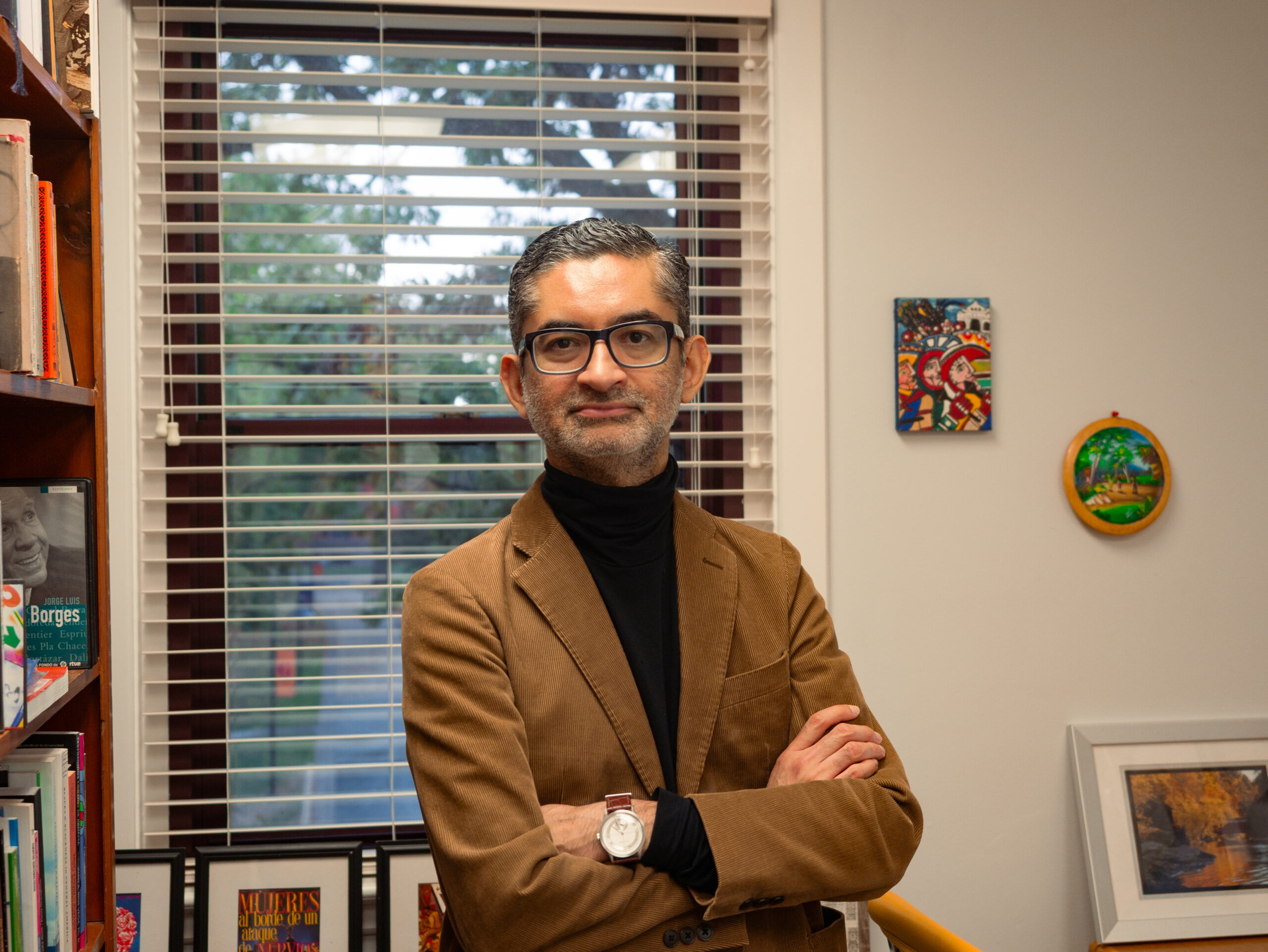
Professor Aarón Lacayo. (Photo Sofia Gutierrez/The Gettysburgian)
By Sophie Lange, Managing Editor
Assistant Professor and Mellon Faculty Fellow of Spanish & Latin American Studies Aarón Lacayo graduated with a Bachelor of Arts from New York University with a double major in Spanish and History before continuing his education at Rutgers University-New Brunswick, where he received his Master’s and PhD in Spanish/Latin American Literature & Culture. During his PhD program, he also earned a certificate in Film Studies, as his doctoral dissertation focused on Central American cinema, and he took a variety of film classes in graduate school.
“It sounds like a straight path of study, but it certainly wasn’t. I took several years off doing other jobs that couldn’t be any more different from each other, such as magazine advertising/publishing and a very short stint as a high school Spanish teacher in NYC public schools,” Lacayo explained.
He had always felt the desire to pursue a career related to literature due to his lifelong love of reading, writing, and literary analysis, but it was not until his late 20s that he began to consider going back to college to pursue that goal. He had always enjoyed college and found inspiration from his Spanish professors, which led to his decision to pursue his PhD in Spanish with the aim of becoming a professor in the end. Then, while visiting a professor at Rutgers-Newark, he discovered a year-long position in the Gettysburg Spanish Department, where they were searching for someone whose focus was on Central America.
“It was a matter of wonderful luck and timing!” He said of the position. “While I was teaching that first year and on the job market, a tenure-track position with a one-year Mellon Fellowship opened up. I decided to apply, got the job, and I’ve been teaching here since.”
In his professorship, Lacayo has three main areas of focus: Central American studies, film studies, and environmental humanities. The majority of his recent projects, including journal articles, book volumes, and academic panels, fall within one of these areas.
“A few years ago, I enjoyed writing a pedagogical article on how to teach short films in class using two Nicaraguan short films, Cinema Alcazar and Blanco organdí (White Organdy). I enjoyed the autobiographical “hands-on” nature of the essay since I had taught both films in my courses, and I incorporated some of the things that my own students had done in class. They were a crucial part of my research!” Lacayo elaborated.
In addition, he works as a literary translator, with two published books of fiction. He translated Gordon Matta-Clark’s visual poetry collection, Art Cards, into Spanish (Fichas de arte), and Claudia Hernández’s novella, La han despedido de nuevo, into English (They Have Fired Her Again). He is also working on his manuscript, Unaccompanied Cinema: Ecologies of Violence in Contemporary Central American Film, which focuses on Central American cinema.
“These academic projects are vital because scholarship is always evolving, and it’s both important and relevant to be aware of new and exciting critical ideas taking shape among my fellow scholars and colleagues,” he explained when asked why projects such as these are important not just to academia but to the greater world.
As a professor who focuses on literature and cinema, many of the works with which Lacayo engages continue to inspire him well after he has finished them: “I feel as if what I’m currently reading or watching is taking hold of me in ways that I might not know or understand until I think about it further.”
He is currently reading Ocean Vuong’s 2019 memoir, On Earth We’re Briefly Gorgeous, which focuses on his experiences growing up in the United States as a refugee from Vietnam.
“It’s devastatingly beautiful,” Lacayo said. “As a queer immigrant, Vuong has the power to get to the root of things like the pain of fragmented memories with genuine sensitivity.”
He has found that the most fulfilling part of being a professor is the students. He said that last year, he ran into a former student who had taken Lacayo’s Spanish 301 course on short films, but Lacayo had not seen him since that semester. The student, now a senior, told him that he remembered all the films, particularly Yo no soy de aquí (I’m Not From Here), a documentary about a woman from the Basque Country who migrated to Chile and lives with Alzheimer’s disease. Lacayo was thrilled to learn that the student had visited the woman’s home village in Spain while studying abroad. To Lacayo, this was a clear demonstration of the power of cinema and teaching.
In the classroom, Lacayo enjoys talking with his students about the wide variety of perspectives each student brings to the courses Lacayo teaches. He engages students in these courses by listening as the students share the stories of their lives, their viewpoints on current events, and the insights they bring to each class, particularly during class discussions about the literature, cinema, and culture of the Spanish-speaking world. Because most of the courses Lacayo teaches are in Spanish, he has found that speaking in another language both challenges and invites students to think and speak about their ideas regarding difficult and complex topics in a way that they may not have in English.
“I think learning often occurs somewhere between understanding and unease. I encourage students to allow themselves to recognize this positive discomfort as they approach challenging material and discuss sensitive topics,” Lacayo said.
He also believes that higher education plays a range of roles in preparing students for life beyond college. It fosters spaces for critical thinking, debate, the exchange of ideas, and the opportunity to question the institutions that provide these learning possibilities.
“In our current times, the value of a college education in the humanities is being questioned and threatened more than ever before. The ability to take apart and critique any text is a marketable skill in any industry beyond the classroom,” Lacayo explained. “The difficult but rewarding process of thinking and learning is not a clear-cut path from one idea to another.”
He described the study of Spanish as a world language as being inherently interdisciplinary. It is more than simply reading and analyzing literature because it extends into a wide variety of fields, such as healthcare, business, law, and many others. To Lacayo, the fact that such a substantial number of the Spanish majors at Gettysburg are also majoring in something else is further proof of that because it shows the ways in which the ability to speak a second language is relevant in any industry.
As a Spanish professor, Lacayo enjoys the opportunities he has to work with students from diverse backgrounds and fostering a community of inclusivity and support: “In the classroom, I always encourage my students to draw connections from their own experiences as we explore a wide range of voices and texts in the classroom. I’m aware of the Latinx community of Adams County and their rich contributions to South Central PA and the different ways that our students can learn from their experience. As co-faculty advisor of the Latin American Student Association for several years now, I enjoy seeing first-hand the way students engage with social activism on campus.”
This article originally appeared on pages 16-17 of the October 2025 edition of The Gettysburgian’s magazine.


October 31, 2025
What an incredibly fascinating article about Professor Lacayo. It was an absolute pleasure to read and reflect upon my own teaching and interactions with my students. Kudos to Professor Lacayo, and thank you Ms. Lange for highlighting this amazing and inspiring professor!