
By Celena Glaghassi, Contributing Writer
On Tuesday, Sept. 30, the Department of Art and Art History welcomed the editor of the Ceramics in America journal Ron Fuchs to give his lecture, “Blue and White Porcelain: the First Global Brand.” The event was held in the Pennsylvania Hall Lyceum at 4 p.m.
An alumnus of the College of William & Mary, Fuchs used his degree in Anthropology to become a cataloger for the New-York Historical Society, eventually becoming a general assistant curator at the Winterthur Museum in Delaware. During his time there, a collection of Chinese export porcelain was given to the museum, along with funding for a curator to study that collection. From there, Fuchs researched, observed, and dedicated time to understanding the complexities of Chinese porcelain and the rich history behind the art.
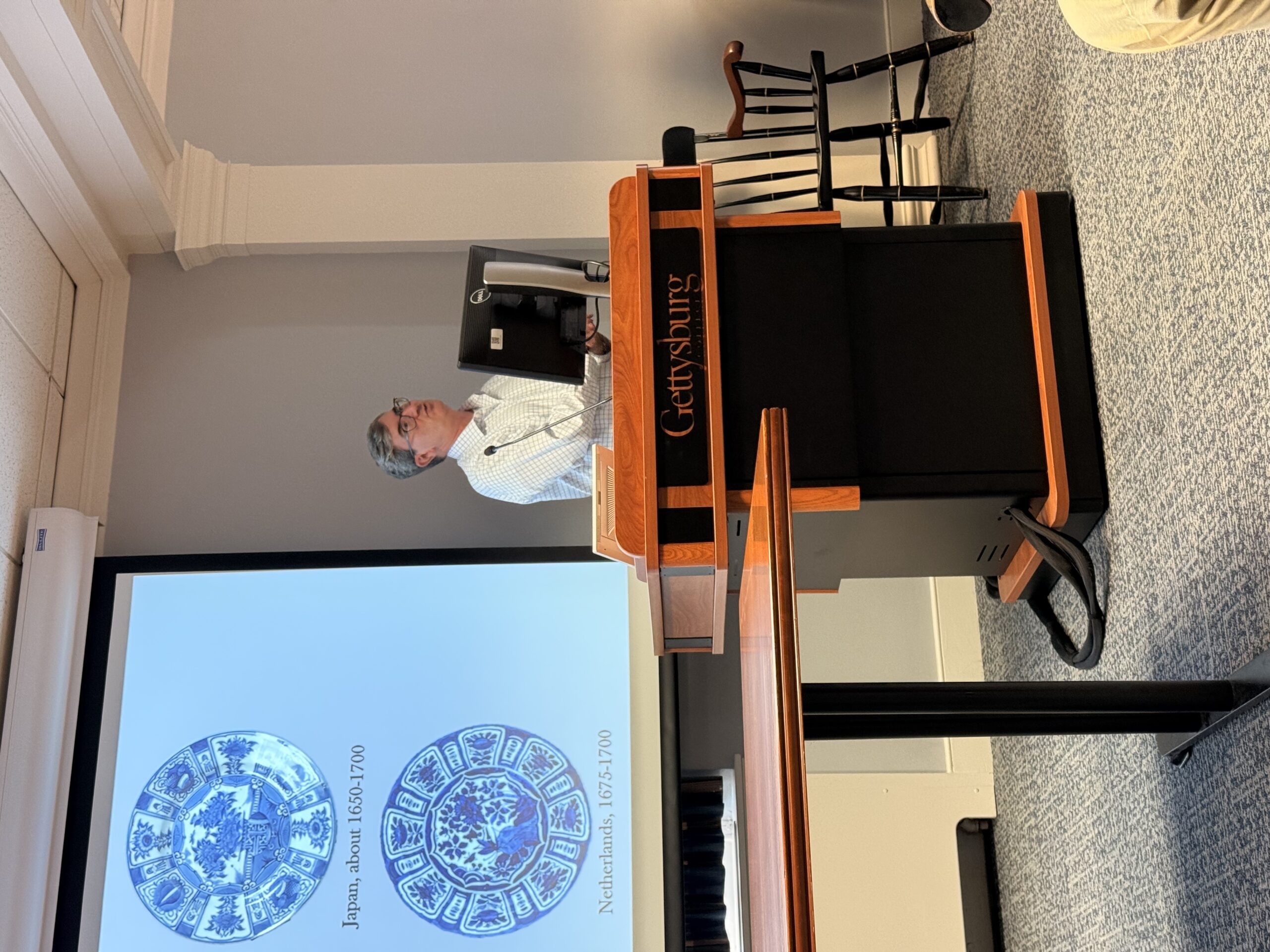
Ron Fuchs Gives Presentation on Chinese Blue and White Porcelain (Photo Celena Glaghassi/The Gettysburgian)
Fuchs began his presentation by discussing globalism in modern society, highlighting interconnectedness and how “cultural connections [bring] together the design, the raw materials and the makers to create these global objects.” He provided the iPhone as an example, explaining how the product is designed in the United States, the microchips are developed in Taiwan, raw materials like Cobalt and Lithium come from Africa and South America and all those pieces are assembled in China.
“I think an iPhone really symbolises our modern world in material form. But, while the pros and cons of globalization are hotly debated today, I think it’s important and useful to realize that this (globalization of products) is not a new phenomenon,” said Fuchs.
He then began to explain global ceramic traditions from the early Renaissance. In the Western world, he explained, “we typically divide ceramics into three categories: earthenware, stoneware and porcelain.” Porcelain, the main focus of Fuchs’ presentation, is a strong, dense, white, translucent ceramic.
Fuchs moved on to the history of Chinese porcelain, which dates back to the Common Era. He explained that although Chinese potters had experimented with the use of blue and white contrast in ceramics as early as the ninth century, it was not until the 13th century that the art technique began to gain popularity in China. He claimed that the idea of creating blue and white ceramics, however, is not one that is native to China.
According to Fuchs, blue and white pottery is instead a culmination of ideas and designs that “probably came from Western Asia or the Middle East, where there was a tradition of making earthenware in an opaque white glaze […] painted with blue designs.”
During the Yuan Dynasty (1279 to 1368), Mongols ruled China as part of an empire that stretched over the majority of Asia. Fuchs said that the trade and cultural exchange of this period led to an increased demand for Chinese porcelain. It quickly became a sign of wealth and prestige for people to have porcelain imported from China.
“Whether you were in the Middle East … Africa … Europe … or the Americas, owning Chinese goods in the early modern period meant that you were wealthy,” said Fuchs.
As the market expanded with more demand for Chinese porcelain, countries like the Netherlands, Turkey and Persia (modern-day Iran) began making copies of the porcelain using cheaper materials, which made the products more accessible to people in the middle and lower classes.
Fuchs emphasized that the history of Chinese blue and white porcelain is emblematic of early cultural exchange.
Dating back to the ninth century, the Chinese blue and white porcelain market can be thought of as the first example of a global brand, something that is both recognizable and valuable.
“I sort of half jokingly say you can explain everything through Chinese porcelain,” he said.
Fuchs ended his presentation by thanking everyone who attended and thanking the Department of Art & Art History for inviting him.


