
By Ella Prieto, Editor-in-Chief
On Thursday, the Gettysburg Area School District (GASD) School Board Candidate Forum II took place in Mara Auditorium, as a part of the Eisenhower Institute’s (EI) annual Democracy Week. The event was sponsored by the Eisenhower Institute, the Public Policy and Political Science Departments, Gettysburg College Democrats, Gettysburg College Republicans, the Pre-Law Club and the Patrick Henry Debate Society. It was moderated by free-lance local journalist Alex J. Hayes, and students from the Patrick Henry Debate Society kept time for the candidates.
Out of the eight invited candidates, Julieta Booz (D), Donna Harrison (R), Kathleen Pratt (D) and Charles Weise (D) participated. Dale Brennan (D) sent a representative to read an extended opening statement, as he could not make it due to a prior campaign commitment.
Brennan’s representative provided the first opening statement. He was allotted five minutes.
“Dale Brennan will bring real-world public school experience to the Gettysburg Area School District School Board. He is a retired public school teacher from Maryland with more than 30 years of public school experience, seeing firsthand how school board policies and decisions that don’t prioritize students can affect the culture of an entire school or community,” stated the proxy.
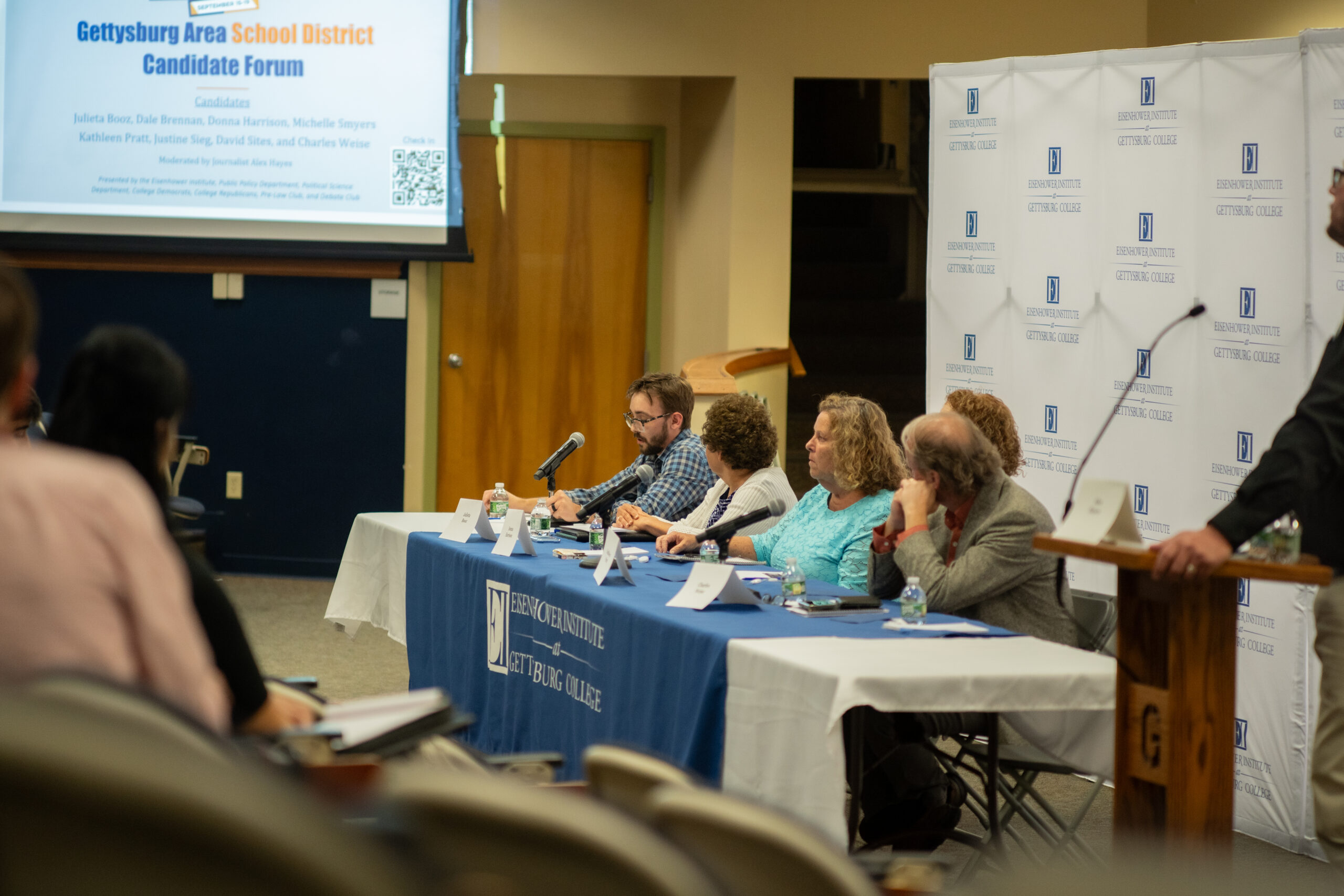
Representative of candidate Dale Brennan giving an opening statement. (Photo William Oehler/The Gettysburgian)
He elaborated on Brennan’s campaign’s viewpoints and promises, including visits to all the GASD schools on a regular basis, keeping an open line of communication with the community at large, and advocating for a balanced budget that covers the basic needs. This encompasses never voting to raise taxes until he is assured that the school board has in good faith explored other options.
Next, each candidate presented their opening statements, lasting two minutes. Booz was first, and shared her background as a naval program manager. She explained that the skills she learned in that position, such as listening to stakeholders, balancing budgets that Congress would authorize and finding solutions between different groups.
“Our children are our investment in our future,” said Booz. “…And I want to make sure that us on the school board can provide the tools and resources that all students need so they can fulfill their dreams as well as become contributing adults to our community.”
Harrison followed, also providing her background as a teacher and then principal in GASD. Additionally, she grew up in Gettysburg and attended grades one through 12th in the district.
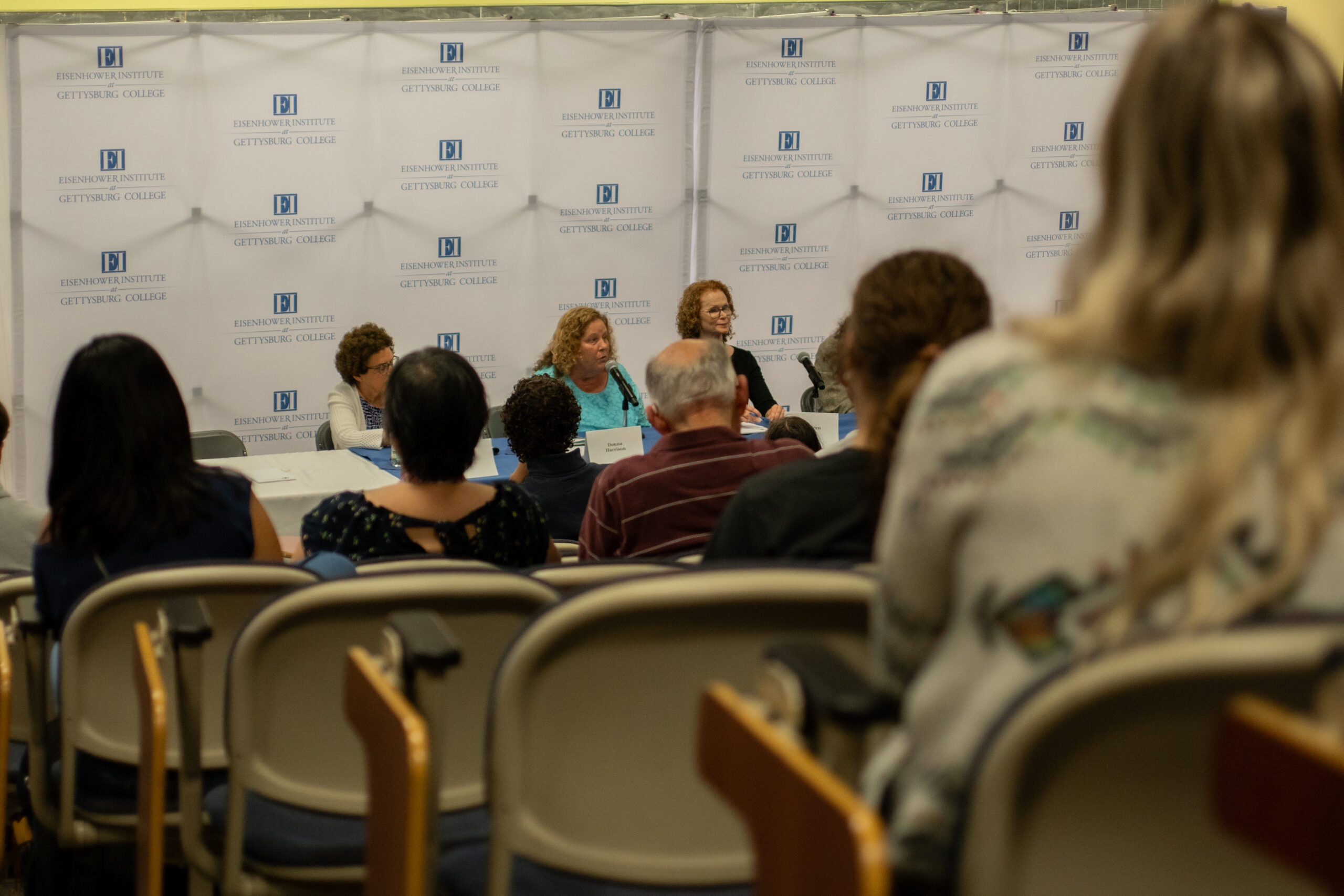
Candidate Donna Harrison giving her opening statement. (Photo William Oehler/The Gettysburgian)
“I love this district, this district is where my heart is, so that’s why I decided to run for school board,” expressed Harrison. “…this school board needs to make decisions that are in the best interest of the children, of the future.”
Pratt, who served previously on the board from 2017 to 2021, highlighted three statements from her campaign cards: “I have a proven record of common sense taxation…I have a strong record of expanding opportunities for students…and I respect the expertise of teachers.”
Weise was the last to give a statement. He touched on his job as a Professor of Economics at Gettysburg College, and his role as a parent for his three children, who went through GASD from Kindergarten through 12th grade.
“I decided to enter this race because… I am very concerned about the challenging financial environment and political environment that face us,” he asserted.
After the opening statements, candidates engaged in a question-and-answer session. Hayes prepared several questions, and others came from the audience. Candidates had two minutes to answer the question, and if one candidate mentioned another, the candidate mentioned was allowed a one-minute rebuttal.
The first question asked the candidates to explain what they believe to be the duties of a GASD school board member. Harrison provided the first answer, saying that the job entails overseeing what’s happening in the school district, not micromanaging. Pratt was next, and stated three primary duties: hiring and supervising the superintendent of the district, creating and updating policy and managing the money of the district. Weise reiterated the previously mentioned duties of oversight and budgeting, but added hiring the “best people” and providing resources to the schools. Booz finished the answering portion, agreeing with her fellow candidates’ statements, building upon certain points such as listening to stakeholders when deciding the budget and being careful when writing policy.
Next, Hayes highlighted data from the Pennsylvania Department of Education that reported GASD having 229 fewer students in the 2023-24 school year than it did in the 2019-20 school year. The Department also projects that the district may have 500 fewer students by the 2033-34 school year. With that data in mind, he asked how the candidates believe the district should adapt to declining enrollment.
Pratt explained that the district has a five-year plan looking at student population, which tends to ebb and flow. At this point, she believes the district is wise to allocate funding not just for the number of bodies and seats in the upcoming year, but for the projections as well. Weise answered that he liked to look at the data, but that he does not believe the projections are severe, and that he would hesitate to make any extreme decisions. He pointed out that 200 fewer students is also only about 40 fewer students per school. Booz answered that she had been asked a similar question during the primaries and had been researching the issue. She found that GASD did fund a demographic study in May, which also reported that there will be an ebb and flow in the student population over the next ten years. From that study, she said, “there was no reason to look at cutting back schools or consolidating classrooms.”
Harrison finished the answers for that question, which reiterated the previous points by Weise and Booz.
Hayes then asked what specific budget adjustments or revenue-generating strategies would each candidate support. Weise answered first, stating his concern about the cost of cyber schools and the Adams County Technical Institute (ACTI).
“I support the current system, and I support an expansion of that program,” clarified Weise. “But there is a plan to send $50 million or more on new land for a new campus.”
Booz answered next, mentioning her experience with budgeting as a naval program manager. She assured the audience that she would listen to stakeholders, and also mentioned the costs of cyber and charter schools as worrying.
Harrison started with the costs of cyber and charter schools, saying she would aim to bring students back into GASD. She did defend the costs of the ACTI, stating that the program has to turn students away because there is simply not enough space in their current building. Still, she said she would aim to budget smartly, thinking about what is needed and how many students will benefit.
Pratt referenced her Master’s in Business Administration, which assists her in analyzing budgets with a multi-prong approach. She was most worried about the federal rescission of funding, particularly with Title I. Thus, she promised to protect “the most vulnerable students.” Pratt also pointed out that, due to Pennsylvania law, non-charter public schools cannot market their schools to create additional revenue beyond tax dollars. She offered that the district could have a lobbyist at the state level advocating to change that law.
Hayes turned to school libraries, asking the candidates their views on library educational resources and how they think school libraries should contribute to the district.
Booz answered that she had reviewed the library policy and liked it, because it works to curate a variety of books that are age-appropriate for all students, which she believes they do a good job at, based on testimonials of parents.
Harrison agreed, saying the librarians do an excellent job at choosing books. Additionally, she explained that no books enter a school library without being board-approved first. While classroom books do not have to be board-approved, Harrison trusts teachers based their hiring process.
Pratt described the district librarians as “rockstars” and said she trusted them to only include age, academic and curricular appropriate books. She noted that every teacher also has alternate materials if a parent does not want a student to engage in the selected material.
Weise echoed his candidate’s sentiments, saying he respected the judgment of the professionals who choose the library books.

Audience members at the School Board Candidate Forum II. (Photo William Oehler/The Gettysburgian)
The final prepared question referenced the previously mentioned planning phase of creating a new campus for the ACTI. Hayes asked the candidates their thoughts on how ACTI and partner schools, including the GASD, can best work together to serve students.
Harrison began, articulating that a partnership would continue to provide support for the new building.
Pratt explained that the ACTI has a board of directors with representatives from every school district that sends students there, so the question she is most focused on is how the districts can work together. She feels that the expansion “really needs to happen”, and even though it will cause a 1% increase in taxes, she feels it is worth it for the students who would not be able to attend the ACTI otherwise.
Weise answered that while he thinks the ACTI is a great program, he thinks that expanding the existing facility would be more cost-effective than building a brand new campus. He also proposed partnering with the Gettysburg branch of Harrisburg Area Community College to use some of their buildings and programs to offset costs.
Booz stated that she has been researching the ACTI and feels that the board has to continue to look at the costs estimated by contractors and decide what they truly need, but that she strongly supports it.
Hayes transitioned into questions from the audience that were read from notecards passed up. The first question asked that, given the current controversy over DEI (Diversity, Equity, Inclusion), what the candidates’ positions were on hiring minority teachers in the district.
“I don’t think that something like DEI goes in and out of fashion,” started Pratt. “I think that it is embedded in our very fabric, period.”
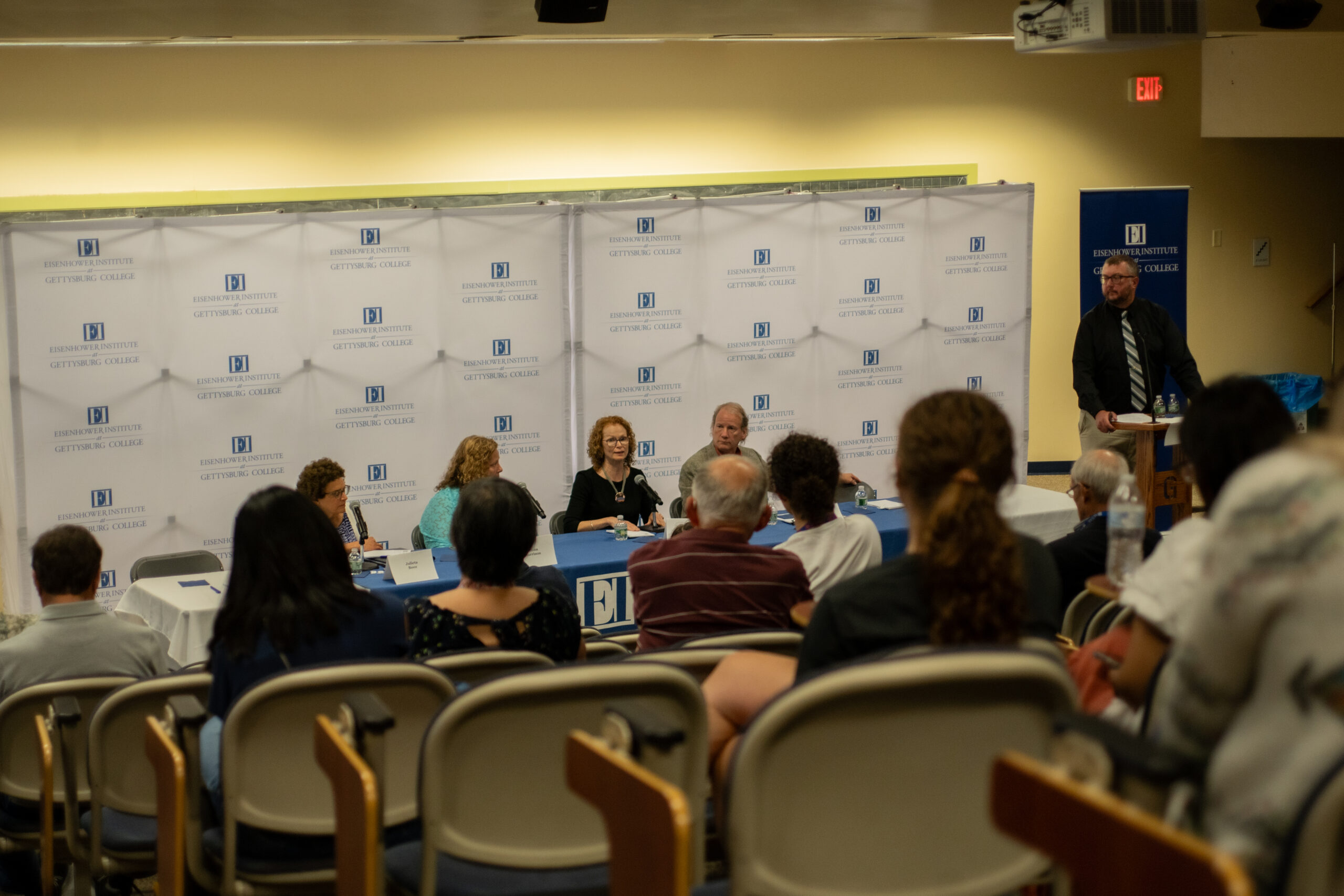
Candidate Kathleen Pratt answering a question. (Photo William Oehler/The Gettysburgian)
She referenced her work on the committee Pathways to Racial Justice, which works towards a solution in creating an environment that is attractive to faculty and staff applicants of color.
“I think we are made all the better when we live and work and learn from people who don’t look like us, who don’t come from the same background we come from,” stated Pratt. “And isn’t education at its very core about personal evolution? Yes, it is.”
Weise shared that GASD only has one teacher of color, which he believes to be a symptom of failure, a signal that something is wrong in the hiring process.
“Whatever procedures are being followed don’t seem to be attracting applicants that will bring a diverse pool of people to Gettysburg,” he explained. “…DEI has been tainted by the political rhetoric, but it really means having a fair process where people of all backgrounds from different parts of the state can apply for jobs at Gettysburg, and we can pick the very best ones.”
Weise said he would look into the hiring process and make sure that schools are using state-of-the-art policies to ensure a diverse pool and a fair process.
Booz agreed, saying she “would love to see that our teachers and staff at Gettysburg reflect the diverse population that we have here, as well as maybe even expand so we can learn from other cultures, other approaches to life.” She echoed that the district must do a better job at attracting a more diverse pool of applicants.
Harrison noted that Pennsylvania schools are putting out about 50% fewer teachers than they did ten years ago, so that makes it more difficult to have a diverse teaching population. Still, she echoed that GASD has to market and make people comfortable to entice them to teach here.
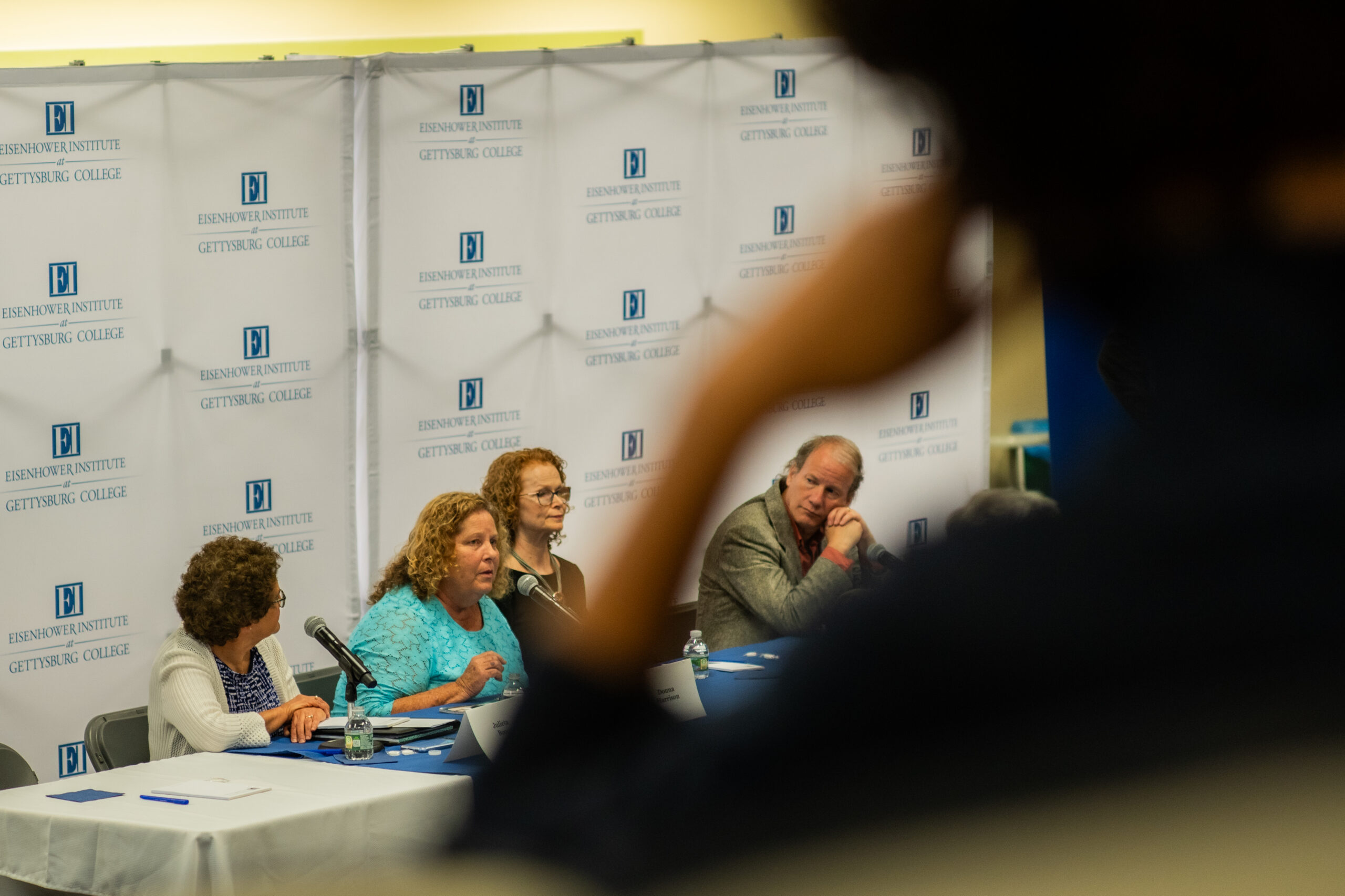
Candidate Donna Harrison answering a question.(Photo William Oehler/The Gettysburgian)
The next audience question asked how the candidates plan to actively engage with parents, community members, and taxpayers in the district’s decision-making process.
The candidates mentioned that they would hope to increase the number of people who come to school board meetings so they can hear directly from people, but also do more community outreach, such as attending sporting events and parades. Weise mentioned possibly having a form for people to fill out as well, with comments and concerns.
The forum ended with two-minute closing remarks from the four candidates, starting with Weise. He again discusses his work at Gettysburg College, and stated that the district could use some of the same policies to better itself, such as evaluations and hiring practices. Additionally, he hopes to push the district to improve education at the schools to bring back students from charter schools.
Pratt said, “I am running again because I have experience serving on the board. Day one, I’m in action, and I see myself as someone who has the skill set, and frankly, the strength to preserve and protect our most vulnerable students and also the interests of our taxpayers.”
Harrison discussed her accomplishments from serving as a teacher and a principal in GASD, such as when her school won a National Blue Ribbon award, which only 1% of half the schools in Pennsylvania receive.
“I got it with my leadership and being able to get my staff to do what they needed for our students. I feel like I have that leadership to come onto the school board,” she finished.
Booz concluded the statements, mentioning her past work and research she had done to prepare for a position on the school board.
“I love this community. I love what I see in the students,” she expressed. “I love the energy that the students bring, and I care that all our students can follow their dreams and become contributing adults to our community.”
Hayes ended the event, encouraging everyone in the audience to vote, as well as to tell their friends and family to vote, on Nov. 4.


