
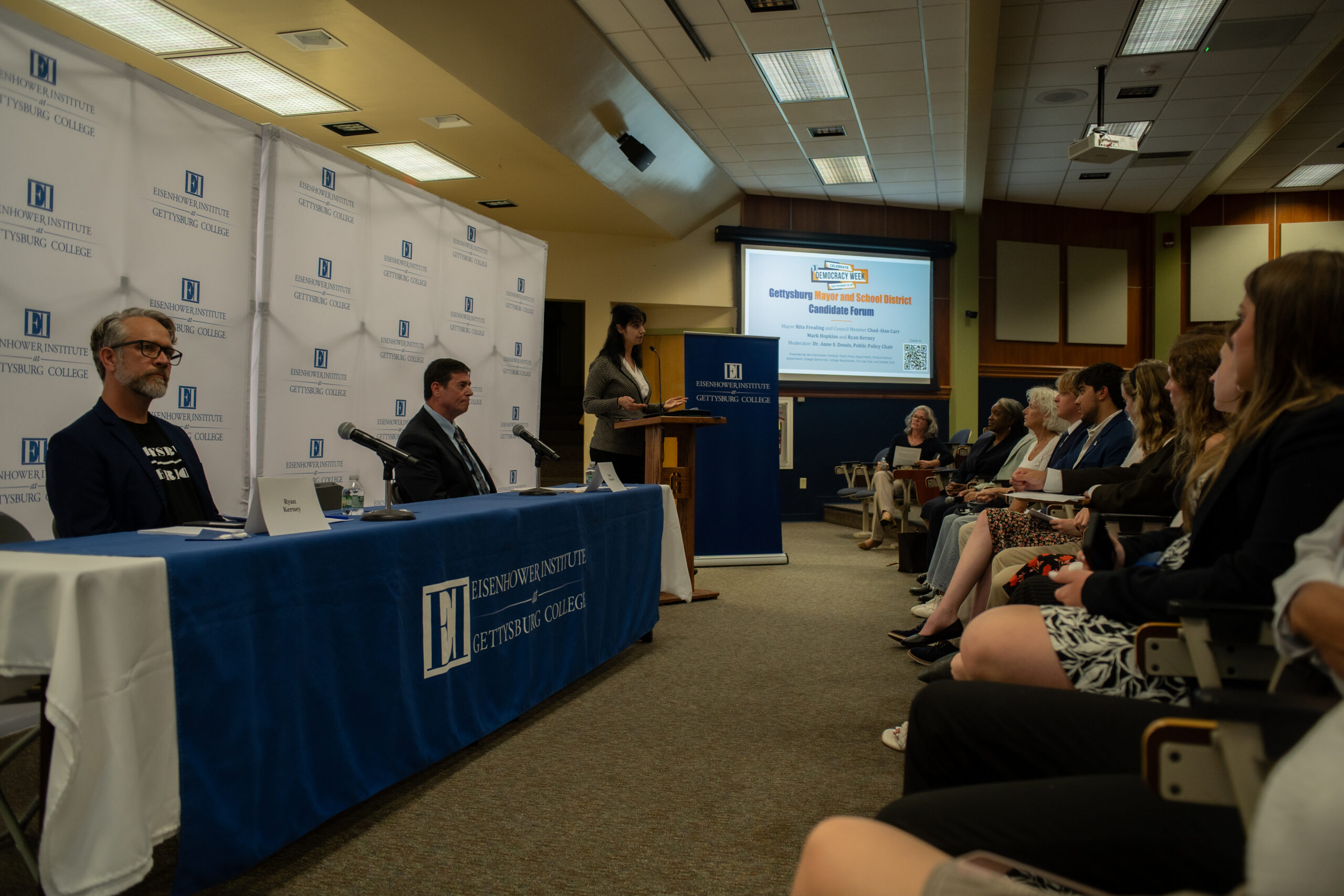
Candidates Ryan Kerney (Left) and Mark Hopkins (Right) at the Special Election School Board Candidate Forum. (Photo William Oehler/The Gettysburgian)
By Brandon Fey, News Editor
On Tuesday, Sept. 16, the College hosted a public forum featuring the candidates for the special election seat of the Gettysburg Area School Board—Mark Hopkins and Ryan Kerney. This forum was held immediately after a previous forum for the Gettysburg mayoral candidates in the Mara Auditorium and followed the same format. The event was presented by the Eisenhower Institute, the Public Policy and Political Science Departments, Gettysburg College Democrats, Gettysburg College Republicans, the Pre-Law Club and the Patrick Henry Debate Society. This was part of the programming for the Eisenhower Institute’s annual “Democracy Week.”
The forum was moderated by Associate Professor Anne Douds of the Department of Public Policy. Douds began by thanking the campus organizations that sponsored the event and outlining the rules of the evening, which were approved by both candidates prior to the event. Each candidate was allowed two minutes to give an opening statement, and two minutes were then given to each candidate to answer formal questions, alternating in the order of first response. Audience members were allowed to applaud, but interruptions and partisan signage were forbidden. The Patrick Henry Debate Society moderated the time of each response.
Before opening statements, Assistant Professor Alauna Safarpour of the Department of Political Science outlined the duties of members of the Gettysburg Area School Board. She explained that the November General Election ballot will include eight candidates competing for four at-large seats on the board, in addition to one “special election seat” to be held by either Hopkins or Kerney. The special election seat will fill the position of the previous board member, Cynthia Ayers, who resigned in April.
Safarpour explained that the special election carries a two-year term, and all school board members are unpaid. She said that members of the board are tasked with establishing school policies, guiding curricula, adopting textbooks, hiring and evaluating the superintendent and educators, and ensuring that our schools have adequate resources. Under Pennsylvania state law, school boards are also responsible for levying taxes to fund schools. They have the authority to collect property taxes (per capita occupation), as well as income taxes, to pursue proper funding. Ayers cited her inability to fulfill her promise not to raise such taxes as her impetus for abstaining.
Opening Statements
Mark Hopkins discussed his credentials as a retired combat veteran with a Master’s in Education from Washington State University and an additional master’s degree from Penn State University. He has lived in Gettysburg for about ten years with his wife and has raised five children who attended both public and private schools and universities. “I believe in a quality education for all students, regardless of status, and the elimination of indoctrination of impressionable young minds,” he said. He argued that “children have the right to be children,” and spoke against “persuasion or indoctrination” of young children by adult influences outside of the home. He affirmed that children learn “the basics” before being subjected to “social engineering and special interest groups.” He concluded his statement by calling for common sense to prevail in education.
Ryan Kerney introduced himself as a father of four children who currently attend, or have recently graduated from, schools in the Gettysburg Area School District. He is a professor in the Biology Department at Gettysburg College, and stated that his opinions do not reflect those of his institution. Kerney mentioned the particular importance of this year’s Democracy Week due to recent political violence exhibited by the assassination of conservative influencer Charlie Kirk, in light of which, he mentioned a recent alleged Facebook comment on a borough page calling for a second civil war. “I don’t agree with most of Charlie Kirk’s messages, but I do respect his method; debating issues on college campuses should not be a life-threatening activity,” he said. He then thanked the organizers of the forum for their “commitment to democracy” by hosting the event, and thanked Hopkins for running for the position in addition to him, stating that he was looking forward to a healthy debate, which he said is preferable to “online vitriol.”
Qualifications
The first question asked about the candidates’ formal and informal qualifications to serve on the school board, and their engagement with the K through 12 community.
Kerney cited his 26 years as an educator, having taught from “middle school to medical school,” and his teaching at Gettysburg College for the past 12 years. He said that he has worked closely with his own children’s teachers in the district, and that he runs an outreach program that lends scientific equipment to local schools in south-central Pennsylvania. He mentioned that the program recently closed a three-year $300,000 grant from the National Oceanic and Atmospheric Administration, with which teachers were paid to develop an environmental literacy plan tailored to Adams County, that complies with the Commonwealth’s new science and environmental literacy standards. Kerney added that he had volunteered to help design those standards for the Pennsylvania State Department of Education last year. He said that he also volunteers for local schools by planting gardens, chaperoning field trips, judging a student debate team and helping with Junior Achievement.
Hopkins spoke about his master’s degree in education administration, in addition to having served for two years as a volunteer substitute teacher. He also said that he participated in numerous parent-teacher organizations and K through 12 extracurricular scholastic and sporting events. Hopkins said that he was active in establishing school computer labs when computers were first becoming available for K through 12 institutions as well.
Funding
The next question asked how each candidate would address recent cuts to federal funding that impact the school district, and what specific budget adjustments or revenue-generating strategies they would support in response.
Hopkins responded that he would address cuts to federal funding by reviewing other programs and resources in the current fiscal year budget that may have more funds than needed to run effectively. He said that this excess capital could be reallocated to fund the school programs impacted by the cuts. He also stated that federal funding accounts for about 2% of the budget, the remainder of which comes from state and local appropriations. He also said that the board should pursue budget adjustments and revenue-generating strategies that focus on maintaining educational excellence, as well as driving initiatives that will provide a continuing stream of future funding to the school district. He argued that community engagement is “extremely important” for generating revenue and should be a top priority for every school district.
Kerney said that the U.S. Congress’s March allotment for Titles II through IV funding was pulled in early July. He stated that while the Office of Management and Budget has allegedly claimed that those funds will be available, the Gettysburg Area School District’s website says these federal funds remain frozen. He said that federal funding is important for the professional development of educators, funding English language learning and safety training for staff. He also mentioned more recent congressional plans to cut Title I funding, for which he said that each of the district’s three elementary schools qualifies. He said that if the 27 percent funding cut is approved, the $836,000 received by the district will be reduced by $226,000. Kerney also said that the current state budget impasse has forced several districts around the state to find unassigned funds and pull bonds to cover their operating costs.
Curriculum
The next question asked about the candidates’ beliefs on balancing standard core subjects with vocational and technical training at the K through 12 level.
“I believe very strongly in the brick and mortar guts of our education system, and the classic topics such as biology, history, chemistry and the social sciences,” Kerney responded. “That being said, I can appreciate very much the importance of vocational training as it exists within our district right now.” He said that not all students in the Gettysburg Area High School are destined for collegiate education, and that many benefit from the existing trades instruction they can receive through the Adams County Technical Institute prior to graduating. He added that one of his “top priorities” is to see the success of vocational programs at the high school, which he said requires some “clever funding and positioning,” as county taxes were recently raised by 1 percent to fund Gettysburg’s portion of the institute.
Hopkins said that his stance on the balance between core content and vocational, career, and technical education is to use “common sense.” He described core content as “extremely important” for educational development, as every student should be required to meet minimal, measurable requirements and be given access to do so. He also described vocational, career and technical education as an “important pathway” for those who choose not to attend traditional collegiate institutions, but wish to pursue another career path. “My opinion is that every student should be required to participate in vocational or career and technical education courses to receive a well-balanced experience and career plan exploration,” he said.
Community Relations
Douds then asked how the candidates planned to engage parents, community members, and taxpayers in the district’s decision-making.
Hopkins emphasized that community relations should be “unbiased and nonpartisan.” He said that attending community meetings is a good way to engage the community and give input that may not otherwise be voiced in another forum. He argued that parents ought to always be encouraged to voice concerns or praise for their children without fear or retaliation from other members of the community. He said that support for quality education and student learning objectives should be paramount to any discussion with community members. He also stated if the district is to seek funding from community members, they will be more engaged and willing to give their support if the district is perceived as a “welcoming environment” for engagement between teachers, students and parents.
Kerney acknowledged that the Gettysburg Area School District exhibits a pattern of ignoring the ideas and concerns of parents and community members. He described a “lack of transparency and accountability” exhibited by several elected officials within the county, who have failed to hold town hall meetings and confront their constituents. He connected this behavior to members of the school board, stating that they ought to engage with constituents through open forums about issues of their concern, particularly taxes and the quality of instruction. “Our school board should not be insulated from direct community engagement,” he said.
District Goals and Efficiency
The next question referenced Gettysburg Area District Superintendent Dr. Jeffrey Matzner’s four entry goals outlined in his first 100-day plan. Douds asked what the candidates believed the school district should do with respect to the new goals, particularly the one about strengthening organizational efficiency and culture.
Kerney said that the comprehensive plan includes promoting a district dashboard to organize all student information as they pass from kindergarten to the twelfth grade. He said that this will include extracurricular sports, transcripts, as well as academic and professional aspirations, and is part of the superintendent’s vision for improved organizational efficiency. “Organizational efficiency requires attention to the personnel within the district,” he said. “I feel that having a stronger relationship between the administration and the academic staff is paramount, and I feel that our current board has spent too much time focusing on improvements to athletics infrastructure.” He described these focuses as the “detriment of more meaningful pursuits that our board could have been pursuing.”
Hopkins expressed his “full support” for the superintendent’s goals as related through his 100-day plan, particularly to engage teachers and the community, which he described as “a win for everyone.” He said that understanding the “key personnel” involved in an organization is the “most critical step” for achieving success. He also stated that strengthening organizational efficiency and culture is a continuous process. “Looking inward can effectively change one’s perception, as well as provide insight for improvement,” he said. “Collaborative efforts with the organization will ultimately provide positive input with lasting results.”
Cuts and Other Priorities
The final formal question of the forum asked the candidates about their broader priorities in addition to addressing federal funding priorities, and what areas they would consider for cuts, and which they would protect for school administration.
Hopkins said that each year brings budgetary concerns that should not hinder the quality of education provided. He said that he was not in a position to address specific programs that may face budgetary restraints, as he is not currently in the school system. Despite this, he stated, “I believe funds could be reallocated between programs if morally and legally applicable.”
Kerney stated that the incoming school board is going to have a “significant turnover” from the existing board. He said that while he agrees that the board should have a nonpartisan approach, it is unfortunate that Pennsylvania is among the four states in the country that mandate school board elections by party. He said that property taxes are already adjusted on an annual basis to meet the financial demands of the district, and they account for over two-thirds of the operating budget for the school. He said that the One Big Beautiful Bill Act has the potential to threaten $700 million of the Pennsylvania state budget and could have significant impacts on educational offerings in the district. “Our school board is going to need to be informed and exceptionally nimble to prioritize the goals set out in our recent comprehensive plan and the vision that we’ve agreed upon as a community to advance the mission of the school,” he said.
Audience Questions
The forum was then opened to questions from the audience.
There were a few questions posed about attracting diverse educators to the district.
Kerney expressed that he was in favor of attracting what he described as a “diversity of talent and perspectives” to the Gettysburg Area School District. “The attraction of diverse teachers to our district, I think, is of paramount importance,” he said.
Hopkins said that he was against diversity as a criterion for faculty members, describing a preference for “quality over quantity.” He asked rhetorically: “Do you want your children to be taught by educators based on their quality, or the color of their skin or where they come from?”
At the end, Executive Director of the Eisenhower Institute Tracie Potts thanked the candidates for their participation in the forum and thanked those who attended.
“We appreciate you being here tonight to be part of this,” she said. “Civic engagement is a responsibility that we all have, and when we are able to do it in a way that is informed, it makes our entire community better. The Eisenhower Institute and its partnering organizations hosted a second forum for the other school board candidates (not part of the special election) on Thursday, Sept. 18.


