
By Oumye Toure, Guest Columnist
India’s Persecution of Muslims: The Gujarat Genocide & Ongoing Violence
In 2002, the world witnessed the Gujarat genocide, in which Indian Muslims were murdered en masse by Indian Hindu mobs, enabled by Narendra Modi, then Chief Minister of Gujarat and current Prime Minister of India. During the genocide, muslim communities and businesses were systematically targeted and set afire by mobs, women were publicly gang-raped and murdered, children were forced to watch their parents being killed. An estimated 2,000 people were murdered during this massacre, which was facilitated and enabled by Indian Police. The genocide primarily resulted in meager temporary diplomatic boycotts and condemnation from international human rights organizations. Empirically, Indian Muslims have faced violence, discrimination in employment and education, and are forced to navigate barriers in achieving wealth and political power in the Hindu-majority state. A concerning 79% of Indian Muslims, roughly 158 out of 200 million, “fear further violence and government persecution.” That current Prime minister Modi, referred to as the Butcher of Gujarat, was elected despite knowledge of the dismal and inhumane violence against Muslims that he enabled as Chief Minister of Gujarat is a disturbing indication of public attitudes toward Muslims.
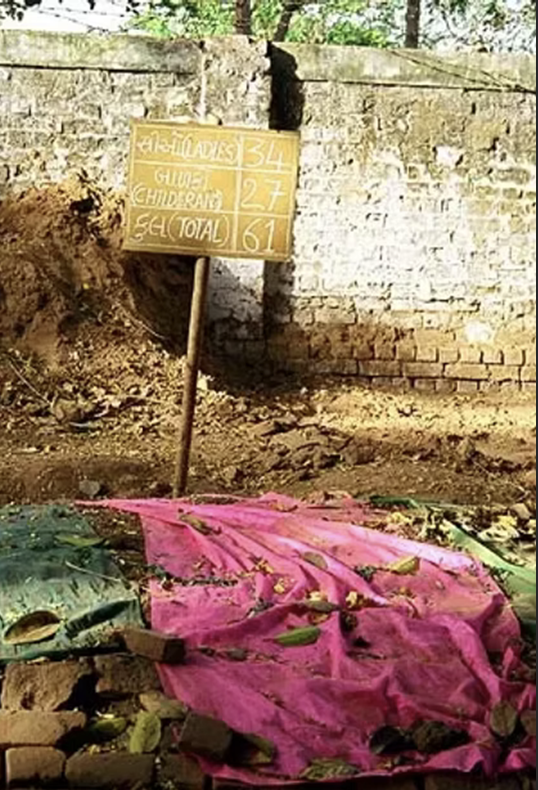
Photo Description: A mass grave in Ahmedabad, Gujarat, in which sixty-one bodies, thirty-four being women and twenty-seven being children, are buried.
Photo Description: A mass grave in Ahmedabad, Gujarat, in which sixty-one bodies, thirty-four being women and twenty-seven being children, are buried. Source: Genocide Watch and Human Rights Watch.
India is a Hindu-majority country in South Asia bordered by Pakistan, Nepal, China, Bangladesh, and Myanmar. Muslims constitute 14% of India’s population, being one of the world’s largest Muslim populations with 200 million people. The US Commission on International Religious Freedom (USCIRF) found Christians, Muslims, and Sikhs are most affected by religious violence in India. Although constitutional protections exist, Muslims have faced discrimination, prejudice, and decades of persecution, including riots, targeted attacks, and assaults, prior to India’s independence. Social and economic exclusion, murder, and property destruction are a few of the implications of this institutionalized discrimination. Under Modi, the Prime Minister serving his third consecutive term, violence toward Muslims has increased. Religious violence from Hindu groups toward Muslims in India has manifested in lynchings, mob violence, demolitions, and planned attacks on Muslim communities. Hindu nationalism and extremist Hindu-nationalist religious parties have played a large role in propagating and facilitating this violence, with Modi and the ruling Bharatiya Janata Party (BJP) (which Modi is part of) promoting policies that ignore Muslims rights, restrict religious freedom, and holistically disenfranchise Indian Muslims. Hindu nationalism, an ideology propagated by the BJP, promotes nationalistic and religious exclusion by arguing that non-Hindus are not Indian. A whopping 64% of Indian Hindus believe that “being Hindu is crucial for Indian identity” despite the empirical presence of multiple religious groups.
The Gujarat Genocide
On February 27th, 2002, a train carrying Hindu pilgrims was attacked in India. Subsequently, “59 people lost their lives in a fire that broke out in one of the train cars just outside the station of Godhra.” Muslims were assumed to be the perpetrators. Later, the Gujarat government-appointed commission concluded local Muslims set the fire, while a Justice Committee appointed by the Indian government’s Railway Ministers concluded the fire was accidental. Armed with a list of Muslim homes and businesses, they arrived in Muslim neighbourhoods by truckloads carrying swords, metal pipes, and Liquefied Petroleum Gas (LPG) cylinders.” By the afternoon of February 27th, Hindu mobs were targeting Muslim households and businesses, justifying their violence with Islamophobic rhetoric claiming Muslims were terrorist threats. According to Genocide Watch, “mobs carried out attacks in a highly coordinated manner. Chief Minister of Gujarat at the time, Narendra Modi, ordered police not to stop the Gujarat genocide. Local and state police were “spotted directing the violent mobs, controlling the police, and organising the distribution of weapons.” Secretly taped conversations revealed police gave mobs “unfettered freedom” and “encouraged the rioters to kill Muslims.” During the rampage, “at least 250 women and girls were gang-raped before being burned to death. A mob of 5,000 people set fire to the houses of Muslims in Ahmedabad’s Naroda Patia neighbourhood, resulting in the death of at least 65 people. Before being burned and hacked to death, women and girls were gang-raped in public. Their male family members were forced to watch the rapes and then were killed.” While this happened, Indian police told Indian Muslims, “We don’t have any orders to save you.” Parents were forced to watch their children murdered, while the majority of surviving children are orphans with lasting trauma. A mass grave discovered in January 2004 by a group of medical professionals and forensic specialists found bodies that “showed evidence of torture, mutilation, and burning…female bodies had burns from cigarettes on their bottoms and breasts. Sharp objects had been inserted inside their damaged, cut-open genitalia.” The calculated, unapologetic, and blatant nature of the Gujarat genocide is a testament to the social and institutional acceptance and proliferation of anti-Muslim violence and hate in India.
Anti-Muslim Violence in India
Violence toward Indian Muslims has a strong empirical presence and has only increased under Prime Minister Modi. According to PBS, Modi’s campaign was “filled with anti-Muslim hate speech”, and he referred to India’s Muslim population as “infiltrators.” Human Rights Watch similarly writes that Modi’s “inflammatory speeches, amid a decade of attacks and discrimination against minorities under the Modi administration, have normalized abuses against Muslims, Christians, and others.” Anti-Muslim hate speech in India rose by 62% in the second half of 2023, the year of Modi’s re-election. Multiple BJP-led state governments have “demolished Muslims’ homes, businesses, and places of worship without due process”, and have “carried out other unlawful practices.”
Many Hindu nationalists portray Muslims as “anti-national and traitors” who are “aligned with Pakistan” and “potentially radicalized.” This rhetoric references the partition of India and Pakistan, which were one country under British colonial rule, and implies that the allegiance of all Indian Muslims is to the muslim-majority country of Pakistan instead of their country of origin, India. Surerndra Jain, the International Joint Secretary for the Vishwa Hindu Parishad (VHP), said India is “Hindu land”, referring to Muslims as “cow slaughterers”, “Hindu murderers”, “Bangladeshi intruders” and “Pakistani spies.” Mob violence and lynching, common acts of violence towards Muslims, are often “fueled by rumors of cow slaughter or interfaith relationships.” A Human Rights Watch report explained that members of the ruling BJP “utilize communal rhetoric” to incite a violent vigilante campaign against the consumption of beef and individuals linked to the cattle trade. Put plainly, the consumption of cows, which many consider sacred in the Hindu religion, is used to justify the murder of Muslims who consume or trade cattle or cattle byproducts including leather. “Cow protection mobs” led by Hindu nationalists, predominantly in BJP-governed states, caused at least 44 deaths and 280 injuries between 2015 and 2018. Hindu nationalists are also “falsely accusing Muslims of systematically converting Hindu women to Islam, contributing to communal tensions and violence.”
In the span of one week in 2023, an Imam (Islamic leader) was stabbed and shot to death in a mosque (place of Islamic worship) that was subsequently burned to the ground, a young female Muslim doctor walking home was attacked and molested by an armed mob of men, and a railway officer shot three Muslim men dead while yelling about Hindu extremist politicians, including Prime Minister Modi. Mohammad Saad, a 22-year-old Imam, was murdered by “a rightwing Hindu mob of more than 100 men.” Two others were shot and severely injured. Similar to the Gujarat genocide, “Police had been standing watch around the mosque at the time [of the murder.]” According to Anwar, Saad’s brother, “He was attacked brutally.. His chest was torn. There were several bullet wounds and deep cuts, apparently inflicted by a knife. Even his hands had received cuts.” Devastatingly, before the murder, Saad assured his brother he would be safe at the mosque because of “police protection.” The mosque was then “reduced to blackened rubble”, and the mosque manager, 58-year-old Mohammad Aslam Khan, said he could not return to see the damage because he is “too afraid.” Zarin Khan, a 23-year-old doctor, was beaten, attacked with bats and iron rods, and molested by “a mob of 4 Hindu men.” The men tore her hijab (religious headcovering) off, shouted religious insults at her, and responded to her pleas for help by laughing and saying “You can’t do anything, the administration is ours.” A railway officer named Chetan Singh “called out” the names of Prime Minister Narendra Modi and Yogi Adityanath, a Hindu monk and BJP Chief Minister, while shooting three Muslim men dead. Singh also said they (Muslims) “operate from Pakistan” and, claiming that “If you want to live in India, you must vote for Modi and Yogi” while standing over the bloodied body of 48-year-old Mohammad Asgar.
Global Response: Gujarat Genocide & Anti-Muslim Hate
International human rights groups like Genocide Watch affirmed the genocidal nature of the anti-muslim attacks, while other countries employed diplomatic boycotts or deployed independent commission teams. In 2005, the Bush Administration denied Modi a visa under laws barring government officials responsible for “particularly severe violations of religious freedom.” Modi has never admitted responsibility for his involvement in the genocide and has since visited the United States. The UK and other European nations imposed a de facto travel ban on Modi. In 2012, James Bevan, the UK’s high commissioner, met Modi, ending the 10-year diplomatic boycott. According to the Guardian, Bevan spoke with Modi on ways to “develop co-operation between the UK and Gujarat across a very broad range of fields, including education, science and innovation, energy and climate change, and trade and investment,” therefore prioritizing state interest and economic gain over consequences for the Gujarat genocide. According to the BBC, the end of Britain’s boycott was described by local journalists as a “major boost to the pro-business leader’s [Bevan’s] quest for mainstream acceptance.” The BBC also explains significant private sector investment from the UK and elsewhere, “also appears to have been a major factor” in the boycott lift. A British official in Delhi said, “This is about Gujarat, not about who is the chief minister. One reason is to broaden and advance commercial interests. There are opportunity costs to not engaging.” Indian commentators also accused Britain of “moving in order to ingratiate themselves with a potential leader of India”, given Modi’s political popularity prior to his election as Prime Minister. Indeed, Modi became the prime minister of India, with Britain ending its 10-year diplomatic boycott for economic gain.
While the Organization of Islamic Cooperation, the United Nations Human Rights Office, and various individual Muslim countries have addressed and condemned the fundamentally discriminatory nature of India’s policies, no substantive intervention (economic or otherwise) has occurred. Violence against Indian Muslims continues and the Gujarat Genocide has, largely, gone underacknowledged while its perpetrators remain unpunished. Anti-Muslim hate has risen domestically, in the United States, and globally, in places like India and the occupied Palesitan territories. Legal and social acceptance and indifference toward anti-Muslim hate has largely contributed to it’s proliferation, as seen in India. Individual and communal steps must be taken to address anti-Muslim hate, establish and enforce consequences, and ensure Muslims are not unjustly targeted in any capacity.
Anecdote
Anti-muslim hate and legislation does not stop at Indias borders, it extends all over the world, including to the United States. Although I am not Indian, I am a visibly Muslim woman and student who has faced blatant anti-muslim hate because of my hijab (Islamic headcovering) on Gettysburgs College campus. My sophomore year, one student in a group of three white male students yelled “Allahu Akbar” at me and then ran away. After reporting this, the students were identified by campus security, although not to me. Elizabeth Farner, then director of student rights and responsibilities, who processed my report told me that this did not count as a conduct violation, indicating that it was not a violation of standards for student behavior. After receiving this report I requested that she meet with me. During our meeting I asked her what “Allahu Akbar” means and she said “What do you think it means?” instead of answering the question. The only “solution” offered thereafter was having a meeting with the 3 students to discuss why this was inappropriate, as if it was not already clear. Proactive and preventative steps must be taken by our community leaders, from students to faculty, and our administration to prevent Anti-Muslim hate. Muslim community members deserve to be respected and protected by our college.
Learn More:
- Learn about the economic disenfranchisement of Indian Muslims here.
- Yaqeen Institute and Qalam Institute both provide reliable information on Islam and Islamic practices.
- The Digital Sisterhood is a podcast that discusses Muslim experiences coming to faith and navigating various challenges, like fear, depression, loss, violence, and more.
- The Institute for Social Policy and Understanding provides objective research and education about American Muslims to support well- informed dialogue and decision-making.
- If knowledgeable Muslims around you are willing and able to answer your questions, ask!
Get Involved:
- Discussions must be held at the administrative and faculty level to understand the experiences of the Muslims who directly or indirectly are affected by anti-muslim hate crimes and discrimination. Proactive policies must be created to adequately address and prevent anti-muslim hate.
- Detect and appropriately respond to anti-Muslim behavior, such as terrorist jokes or other stereotypes made about or toward Muslims. Be empathetic towards others, whether friends, students, or community members, and keep in mind that change starts somewhere. Speak up against anti-Muslim behavior in classrooms, with friends, at family dinners, and wherever else applicable.
- Don’t believe everything you read or watch online/on TV. While online sources like Yaqeen Institute and Qalam Institute provide extensive and intricate knowledge about Islam from Islamic scholars and researchers, many other sources do not. Find reputable sources and real people to discuss Islam with, assuming they’re open to it.
- Anti-muslim legislation is a byproduct of social behaviors & monolithic stereotypes perpetuated by individuals and media sources that strip Muslims of their humanity. When you meet Muslims and have discussions about your common interests you begin to understand how Muslims have been misrepresented and demonized in mainstream media, and how that has led to blatantly anti-Muslim policies and practices.
- Advocate, intern, and volunteer with groups like CAIR, the Council on American-Islamic Relations to promote policies that protect the civil rights of Muslims (and everyone else) in the U.S.
- Help create a stronger, more understanding community and environment at school, home, and wherever you’re able. Find unity in our differences, whether religious, racial, educational, etc. and remind yourself that despite them we are the same in that we all need love, respect and hope to survive difficult times. Our differences are what make us human and should not breed violence and hate. Changing social behaviors and community-building bring changes often always noticed by the higher authorities in any institution, like faculty and administration.


