
By John McDermott, Contributing Writer
On Thursday, the Department of Ancient Greek and Roman Studies hosted a lecture by Professor Rachel Lesser titled “Homer’s Odyssey and Christopher Nolan’s ‘The Odyssey.’” The event ran from 7 to 8 p.m. in Joseph Theater (Breidenbaugh 201). Dr. Benjamin Luley, chair of the Ancient Greek and Roman Studies Department, introduced Dr. Lesser.
Lesser is a professor of ancient Greek and Roman studies at Gettysburg College, and is currently on sabbatical for the fall 2026 semester. Since t2016, she has taught courses on the Ancient Greek and Latin languages and life in ancient Greece. She earned her M.A. and Ph.D. in classics from the University of California, Berkeley, and she has specialized in the roles of women, gender and sexuality in Homeric epic and other ancient Greek poetry. She published her first book, “Desire in the Iliad: The Force That Moves the Epic and Its Audience,” in 2022, which examines the various expressions of desire in Homer’s “Iliad” and how they fit into the overall narrative.
Lesser began the lecture by discussing the historical context of “The Odyssey” poem, its various versions and comparing the film’s unique narration style to the poem. She went on to analyze poems that were written later as continuations of Homer’s stories and how these poems all share similar ideas that were incorporated into the film.
According to Lesser, Nolan’s film accurately portrays Homer’s hero Odysseus as a complex being. He is the only survivor of the Trojan War, but is also seen as a failed leader after his men perish in battle. The fall of Troy is seen as a traumatic event to Odysseus because he lost his men and faced the consequences of his own actions.
Another thematic similarity between the two works that Lesser discussed was the idea of hospitality from mortals to the gods. She compared this idea to what we call the “golden rule,” explaining that mortals had to treat guests well because they never knew who could have been a god in disguise.
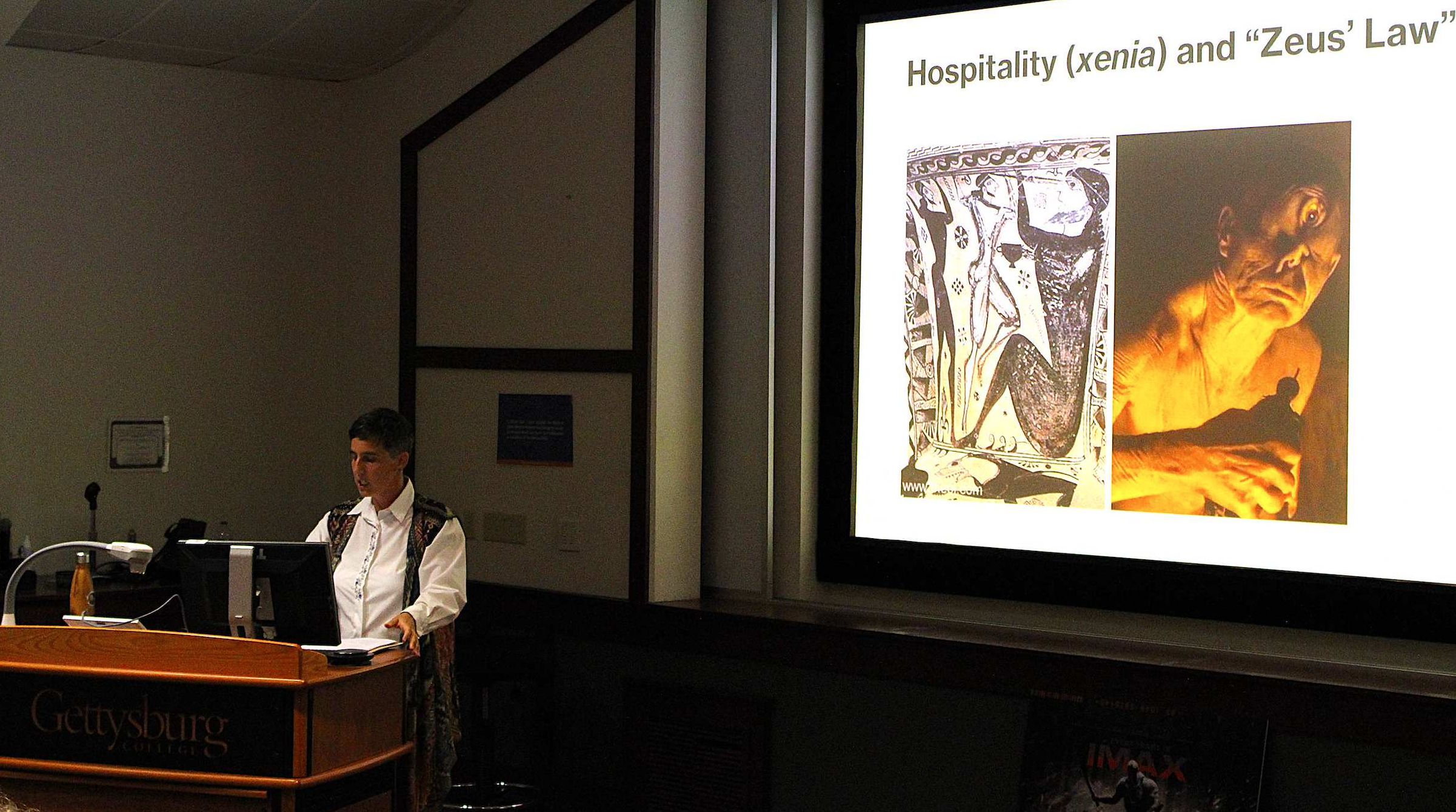
Lesser compares Nolan’s film to the original epic, “The Odyssey” (Photo: Emily Cook/The Gettysburgian)
A major difference between the ancient poem and the Hollywood blockbuster is that Homer portrays Odysseus as a trickster to a greater extent than Nolan does. In the poem, Odysseus takes inspiration from the goddess Athena, notorious for her intelligence and trickery. In the novel, she is always at Odysseus’ side, but Nolan does not emphasize her influence on him. Nolan’s Athena is more of a passive observer of Odysseus rather than a driving force behind his actions.
Lesser also believes that Nolan diminishes the role of other female characters who are influential in the poem, most notably Circe. She is a goddess who seduces Odysseus into staying on her island for a year and later nurses him back to health and helps him navigate the underworld. Nolan places little focus on her as well as Athena.
Lesser then spoke to her personal reaction to the film. “I absolutely was really excited, and I think in some ways it’s exceeded any expectations I might have had for making this the summer of the Odyssey, the year of the Odyssey. I think people talk about it as a monoculture moment where everyone’s talking about it,” she said.
She added that her lecture was meant to ignite interest in the student body. “I wanted to bring in students who might be interested and maybe they’ll continue to take courses and learn more about this beyond just the Odyssey.”


