
By William Oehler, Director of Photography
The enduring sentiment of Gettysburg College’s education as “consequential” creates an objective for every professor and student alike; but how does this ideal exist beyond the classrooms of college, into the halls and schools that lead us to Gettysburg’s hallowed grounds?
In the 1950s, Benjamin S. Bloom, alongside a group of educators, formalized the idea of Mastery-Based Learning with Bloom’s Taxonomy. This classification laid out specific learning objectives for students to create clear, defined goals for learning. Bloom’s Taxonomy offered an alternative to traditional methods for understanding and reporting student learning and grades.
Today, the mastery learning movement has evolved to become a pedagogical philosophy in-place in many independent and public-school systems. One of the most prominent modern responses to answering the call for enhanced, more comprehensive grade reporting comes from Scott Looney in 2014 and his Mastery Transcript Consortium (MTC).
Since 2006, Looney has served as the Head of School at The Hawken School in Cleveland, Ohio. He created the MTC to give students an option when it comes to grading. In a press release, Hawken stated, “While receiving academic credit for time in courses with letter grades serves some students well…we know that students are inherently different, and that traditional grading and crediting does not serve all learners well.”
Officially launched in 2017, the MTC began reporting Mastery Transcripts to institutions of higher education in 2021. Currently, more than four hundred public and private high schools report student learning using a version of the Mastery Transcript. The Transcript is broken down using competencies and skills as a primary way to deliver information, rather than classes and grades. This allows for a more authentic representation of the student to emerge, including their learning interests and style, and their school profile.
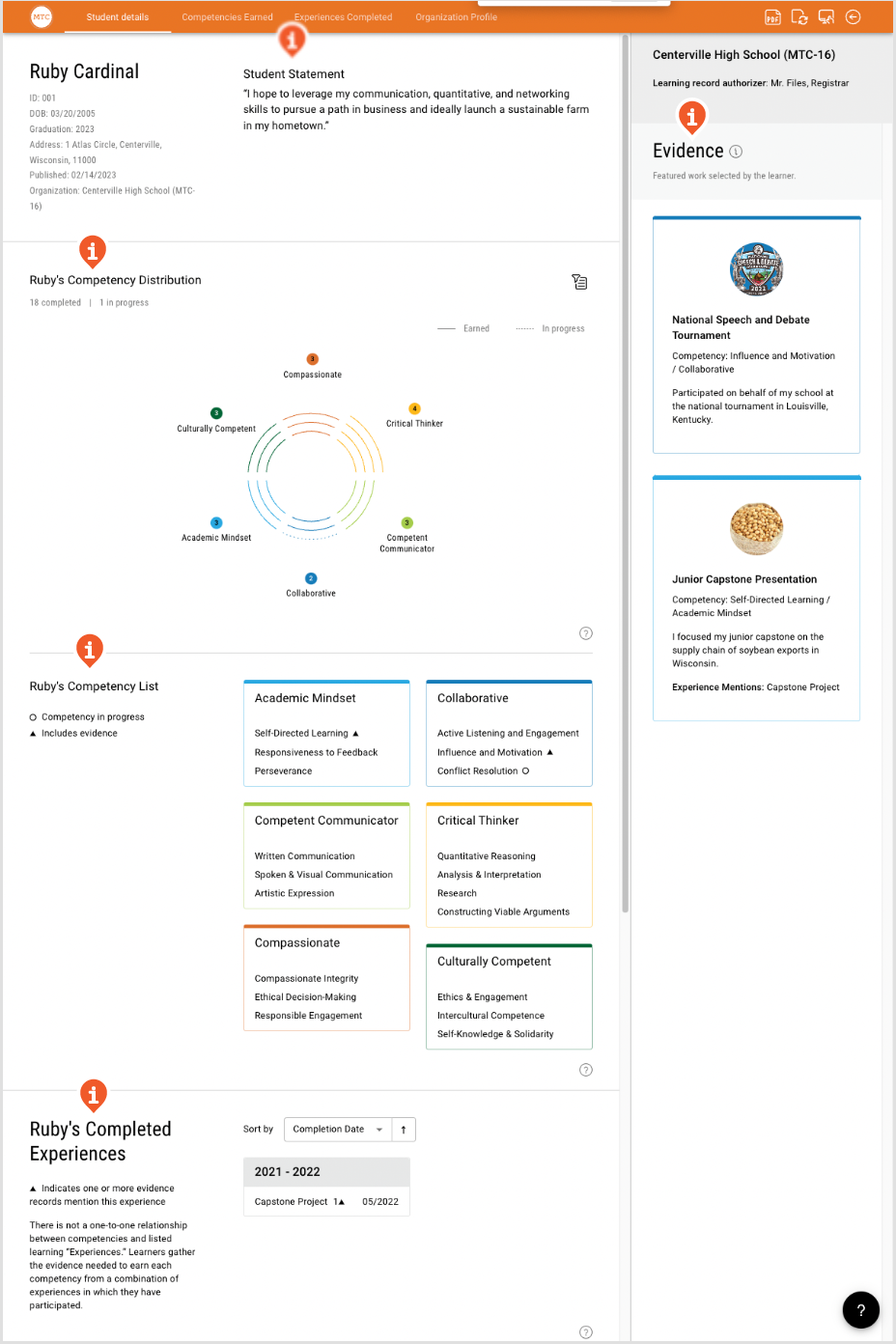
Example of Mastery Transcript.(Photo/Mastery Transcript Consortium website)
Theories in education, just like mastery, experience continual cycles of renaissance and retirement, or as Gettysburg College Professor Dave Powell calls them “zombie ideas.” Mastery learning is one of those theories. Its origins can be found in the early 1920s with Carlton Washburne’s work in the Winnetka, Illinois school system. Mastery became popular again with the inception of Bloom’s Taxonomy.
What does not change in every renaissance of mastery learning is its ability to disrupt the ideas of what education and learning can look like. Mastery at its core, offers a different way for students and instructors alike to interact with both each other and the development of knowledge and skills. The ways in which that information and demonstration of learning is then interpreted is what controls education.
Powell identified the Grammar of schools as one way education is controlled, both by the public and politics. The Grammar of schools encompasses all the commodities in education. Grades, test scores, school rankings, or as Powell puts it, “the expectations that people have for what school is supposed to be or what it is supposed to look like.” This idea has allowed for two converse products to exist in American education. These expectations can be both policy like the 2002 act known as No Child Left Behind (NCLB), or they could be formed through the politics of parents, and what they deem fit for their child.
Grammar of schools solidifies outdated practices in the classroom, therefore making it difficult for transformative change to occur in favor of a student’s education. But it has also allowed for pockets of revolution to thrive. Teachers and administrators like Looney can manage new ideas and ways to work for students if they stay within the Grammar of their institution. No matter how small, change does occur. This is why the current 21st century mastery rebirth is occurring.
The new pieces of Grammar brought forth through NCLB, centered around standards and standardised testing, have begged instructors to ask what more could be done for their students. Looney and his contemporaries who answered that call are showing what it means to work within the Grammar of schools and beyond.
Transcripts like those created by Looney and MTC are often morphed to fit the needs of any secondary school and their students; many refer to their transcripts as Portrait of a Graduate. The Pomfret School in Pomfret, CT uses an MTC template but customizes language and layout for their specific competencies and learning outcomes such as “Navigates a Situation Strategically” or “Leads and Collaborates with Humility.” Once a student demonstrates competence or mastery in a learning objective, this will be denoted in their learning record through specific assignments, classes, extra-curricular activities, or “tangible work samples associated with the skills they have developed.”
While MTC offers an alternative for students who succeed with individualized support and instruction, many schools allow for students to report using either a Mastery Transcript, a traditional transcript–using A-F scales and credit hours– or pieces of both.
Gettysburg College has long welcomed non-traditional forms of applications. Director of the Office of Admission, Mary Smith ’00, explained the College’s process when they encounter a Mastery or non-traditional transcript. Smith stated that a Mastery applicant will always have two Admission team-members working with their application. Both will read through the school profile, student profile, essay, recommendations, and any complexities that may arise. While Gettysburg College does accept any form of transcripts, it often does not encounter Mastery or other non-traditional versions.
Looking locally, Stone Independent School in Lancaster PA uses project-based learning with roots in mastery to develop student’s higher-order thinking. Using a Portrait of a Graduate model, based on Looney’s MTC, Stone and Head of School Mike Simpson have always been interested in how to best serve students.
Simpson and Assistant Head of School Abby Kirchner were invited to some of the earliest meetings with Looney at Hawkens even before Stone was built. The meetings consisted of around 35 of the top independent schools in the country including Phillips Academy Andover, Phillips Exeter and The Putney School. Simpson described those first meetings as “incredibly important.” It was the first time that Simpson and Kirchner were validated and included in the important conversations they knew needed to be had.
Today, Stone Independent has defined itself as an institution willing to put the hard work into redefining what secondary education can do for its pupils. After spending about five years with the MTC, Stone decided to chart its own path while still having foundations in Looney’s work. What Simpson found challenging however was the structuring around assessments. “It was not the deployment of the transcript, but the design of the education” for Stone.
As a project-based school, Stone had to “work from the outside in.” Any new model of education such as mastery, “needs a definable structure that all fits in together.” Without this structure, school incentives and their meaning, like grades on an A-F or 0-100 scale, become as Simpson described, arbitrary. In order to build structure into Stone’s design, Simpson and Kirchner “took [several] parts from different schools, that aligned and worked with each other.”
While Stone represents the push for change within the independent school system, Nathan Auck and the Utah State Board of Education (USBE) took Looney’s work and expanded it across public schools in their state. Starting in 2019 USBE partnered with MTC to see how they could scale a mastery-based learning and transcript design system.
During the 2022-2023 school year, a pilot program in Utah was deployed. In a brief that reported the program’s impact, it was described as “a multi-year proof of concept to create a competency-based, valid, and equitable alternative to the traditional transcript.” This first step in Utah’s incorporation of MTC in their state education was heavily supported by Auck.
Auck previously served as USBE’s Science, Technology, Engineering, and Mathematics (STEM) Coordinator and its Personalized Competency Based Learning (PCBL) Specialist. Auck spoke of some catalysts that lead to Utah instituting it’s PCBL framework, “a traditional school system is not built to elicit critical thinking, it is not measured…but the vision that a number of systems across the state of Utah had was to have a more coherent approach to eliciting those outcomes, the knowledge, skills, and dispositions…”
Connecting Auck’s work with Powell’s idea of the Grammar of schools, Auck mentioned what worked well when rolling out PCBL in relation to parents and their expectations. “Those communities that did a good job of messaging the change and ensuring that all community members had agency in the decision…had an easier time helping all stakeholders understand what the shifts were about.”
Oftentimes, when schools make a change such as that made by USBE, communities do not understand the nuances that mastery grading brings to a student’s learner profile. Auck described this in relation to traditional grading, “…A through F grades are really opaque ways to express what a student knows.” If a parent or community understands, rather, how mastery-based learning provides a clearer picture of what a student learned and the skills they developed, they will be more likely to support the change.
A conflict Auck saw when it came to transitioning from a mastery-based secondary education into higher education was based on professors’ disposition to sorting and traditional grading practices, “Educators have looked at educational research, they understand equity. They understand that the charge of public education is to support every kid in being successful, not as a sorting mechanism. And oftentimes, the identity of college professors has been predicated on this notion of sorting.”
He continued by expressing that most often, professors involved with the research and practice of education, understand how to make learning equitable, like mastery learning. But that professors purely trained in their field of expertise exhibit more reluctance towards progressive instruction.
On Gettysburg College’s campus, Professor Divonna Stebick experiences something similar in advocating for a practice she has begun using in many of her classes. Stebick also serves as the Director of the Office of Teacher Education and Certification (OTEC) and has been working with the concept of “ungrading” for many years. Stebick describes ungrading as “not not grading but rather capturing your learning on a continuum.” she continued by asking, “what does learning actually look like when we stop reducing it to a letter or a number?” Instead of handing an A to a student because that is what they may have earned, it is more important to understand what they learned and how a student demonstrates that learning. Traditional grading does not offer explanation for what a student confidently learned, nor does it provide a demonstration of their synthesis of learning.
Ungrading has gained momentum over the past decade and eliminates the use of grades through letters or numbers, replaced with consistent detailed feedback in connection to course learning goals, much like mastery learning. While not within the construct of mastery learning, both share similarities. At their core, both pedagogical practices place the student and their learning at the center of their intentions.
Professor Stebick shared her interactions with both students and professors on campus when she talks about or champions her use of ungrading. Many responded with shock, never being offered the opportunity to not judge or be judged through a letter or a number. Stebick has spoken to both administrators and professors on campus to proliferate the use of ungrading at the College, but like Auck, Simpson, and Powell have alluded to, it is difficult to transform practices especially in education, when expectations influenced by competition and judgement through opaque metrics.
Stebick is currently expanding use of ungrading in more classes in the coming semesters and championed the practice by saying that the student “takes on the ownership and responsibility of learning… more so than doing an assignment or showing up in order to get an A.” Stebick sees ungrading giving students the agency to explore and deepen their synthesis of knowledge.
Ungrading fits within the bounds of mastery learning’s goal of making education focused on learning and student-centered practices. It offers a way for progressive instruction to work in tandem with higher education. However, the interaction between secondary and higher education begins when a student sends their application to a prospective institution.
How does Looney’s Mastery Transcript serve a high school student in ways that a traditional transcript cannot? Powell, who has a son currently working through the college application process commented “You see these endless statistics of the incoming class that say the average GPA is 4.5 and the average SAT is 1580, and you think, what does this actually tell us about the experience of these individuals?”
Powell continued by asking if every student has more or less the same profile with the same high achievements, then that becomes “the pure fixation… if that is the only thing I have to do to establish competency, then that is the only thing I am going to focus on.” The fixation being data points of test scores and grade point averages.
The traditional sense of American education serves those who thrive in the typical and who can achieve access to amenities that provide for privilege. Traditional assessments do not provide students with opportunities to demonstrate learning or correction of learning if they fail the first time. Traditional, standardized testing, like the SAT, is not accessible to every student, and rewards those who are privileged enough to have access to tutoring.
So if a student is able to perform well on traditional assessments in school and get ‘good’ grades, and then pay for tutoring to perform well on a college entrance exam that produces a number to show a student’s worth as a learner; a student with a higher numerical value will gain access to what most Americans would consider a better college.
Not all learners are the same though. Enter mastery learning and Looney’s Mastery Transcript. According to Smith, Gettysburg College has been test optional for about fourteen years. This lowers the barrier of access to higher education significantly. But the competition to meet an established benchmark still exists at any school. The Mastery Transcript replaces this arbitrary benchmark with qualifiable data. Insights into a student that tells an admission office what exact skills they have mastered, how they mastered it, and what they specifically did to master the skill.
As Looney expressed, mastery learning and the Mastery Transcript is not the only answer to changing how we think about education. Traditional practices still work for some students. Education is not a one-size fits all concept, and the way students are admitted into higher education should mirror this diversity. As Powell put it, the admission process should be centered around allowing students “to present themselves as they are, not as they think they need to be seen, but as they actually are.”
This article originally appeared on pages 18-22 of the February 2026 edition of The Gettysburgian magazine.


