
By Celena Glaghassi, Staff Writer
On Tuesday, Nov. 11, the Psychology Department held “A Panel on Purpose and Practice in Social Work.” The event ran from 4 to 5 p.m. and was held in Mara Auditorium (Masters 110), featuring a panel with professionals from various sectors of the social work field. Panelists shared first-hand experiences, career path insights, and advice for making an impact in the community. Andrea Dolges, President of Prospective Solutions Group, began the event by sharing her story of how she got where she is today.
A graduate of Walden University, where she received her master’s degree in mental health counseling, Dolges began her speech by sharing her belief that “we all become helpers for a reason.” She shared the story of how her parents’ divorce changed her view on the world and inspired her to help children. Dolges also discussed how growing up with a mixed faith background was important to her because she never felt tied to just one identity. Raised by a Southern Baptist mother and a German Catholic father, and growing up with Buddhist and Judeo-Christian friends, she explained that religion shaped her as a person. In her professional career, she works as the President of Prospective Solutions Group, the Executive Director for the Center for Youth and Community Development and recently became the Chief Executive Officer (CEO) of her own private practice.
“What I’ve learned so far, 45 years old, is that you take whatever makes you, whatever constructs you, the pain, the positive, and turn it into the way you help— because that is where your passion will be,” Dolges said to conclude her segment.
The next speaker in the event was Kathy Gaskin. Like Dolges, she shared how her background influenced her career decisions. Raised in India by a physical therapist and a nurse, Gaskin knew she wanted to work in the health profession. However, her dislike for math and science pushed her away from medical school and toward history and music, which she studied for a year at Western Maryland College (now McDaniel College). After that year, she transferred to Shippensburg University in Pennsylvania, where she discovered the social work career field. As part of the coursework for her university, Gaskin interviewed victims of domestic violence—from then on, she was drawn to domestic violence work. Following an internship in that field, she became the director of Survivors, a small non-profit organization. She currently serves as the domestic violence task force chair for Healthy Adams County, a mental health clinic.
Her parting wisdom to the audience urged them to “make sure you’re involved in the community in other ways—not just the issue that you’re working on. Make sure you’re serving your community, and really getting to know your community.”
The next speaker, Sarah Fenky, began her speech by sharing some of the differences between her and the other speakers. An administrator at the Adams County Children and Youth Services, Fenky represents the public sector of the county government, specifically the Human Services Building in Gettysburg.
“I think it’s important that, whatever job you end up with in human services, that you get yourself out there and you’re connecting with each other,” said Fenky. “And it’s a really sacred role that… wherever you land, you’re working with people.”
Fenky holds an education degree in comprehensive social sciences from Shippensburg University. Drawn to Adams County,
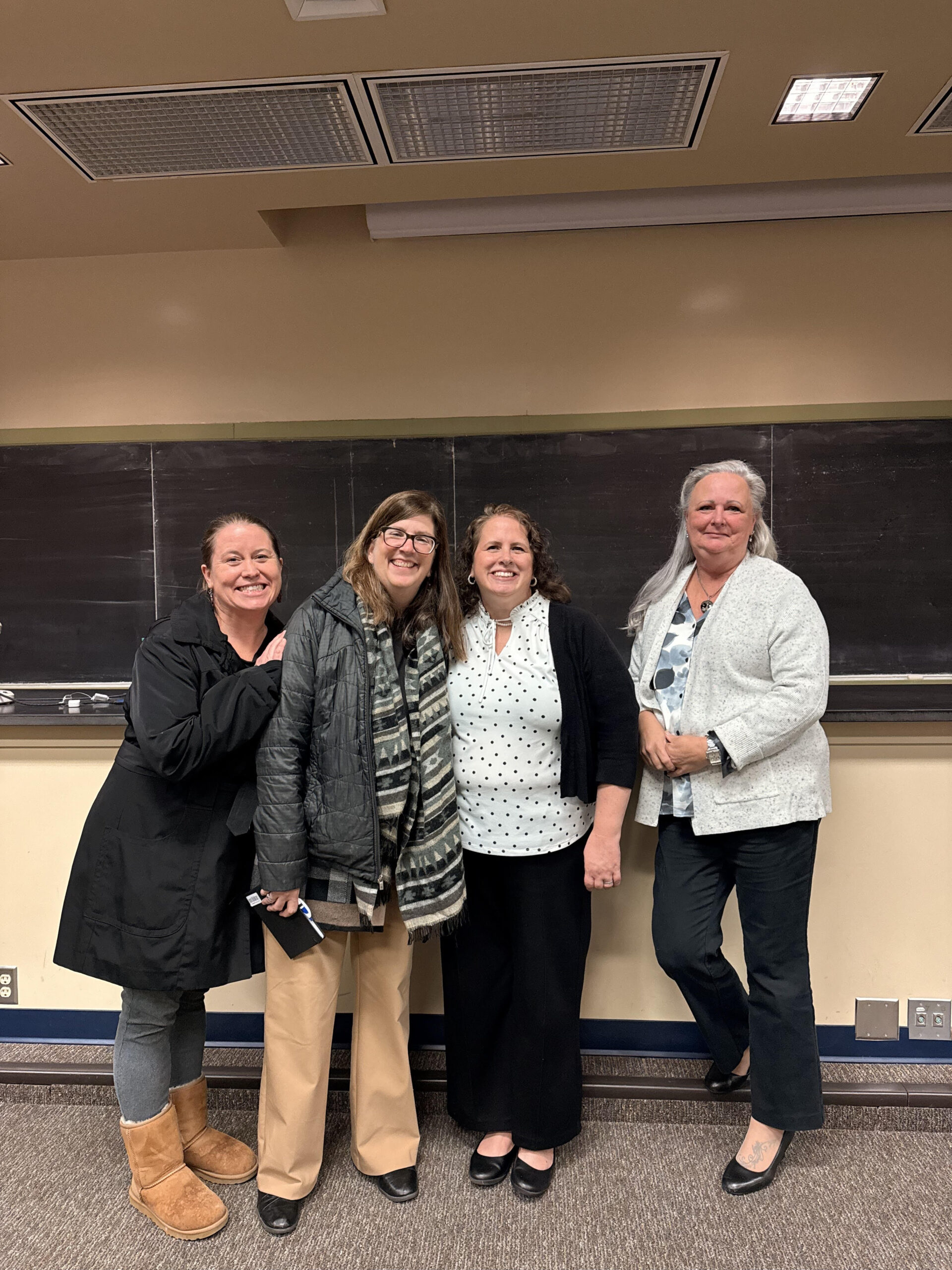
Panelists from the Event (Photo: Celena Glaghassi/The Gettysburgian)
where she felt had an environment designed to help families, “that was a real sense of social work compared to what I had experienced.” Working with the Adams County Children and Youth Services, she oversees the agency’s operations, family engagement programs and community education.
The final speaker, Elida Murray, currently serves as the executive director for the Adams County Children’s Advocacy Center. In this position, Murray coordinates child abuse investigations by supporting first responders, overseeing forensic interviews with children and leading community outreach and prevention efforts. Murray attended college full-time while navigating single parenthood, a key aspect of what she believes fueled her interest in early childhood development. Another aspect of what pushed her toward a career in social work is her childhood background. A survivor of child abuse, Murray had “always been really drawn to organizations that are about helping people.”
To conclude the event, Murray shared some parting words with the audience: “Think about volunteering and interning and do it early on. Try, if you think you want to be a child psychologist, go out and work in an environment that puts you in the purview of working within that business.”


