
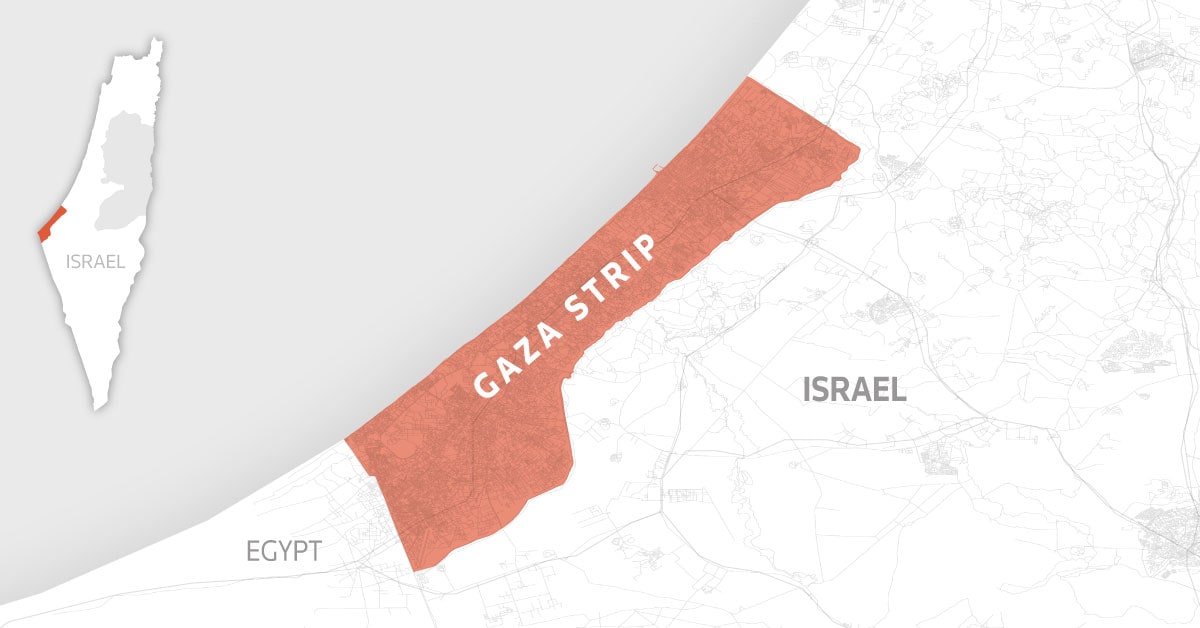
Map highlighting the Gaza Strip. (Courtesy of Reuters)
Editor’s Note: This article is the third in a new opinion series by the Anti-Racist Collective, a student organization seeking to “deconstruct racial discrimination on campus.” This series is titled “World Conflicts & Humanitarian Exigency.”
By Sophia Dotterweich, Guest Columnist
Since October 2023, more than 60,000 Palestinian men, women, and children have been killed in Gaza as a direct result of military activity carried out by the Israel Defense Forces (IDF). Other estimates assert that close to 680,000 Palestinians have been murdered by Israel. The Israeli military has employed a wide range of tactics, which have primarily impacted civilian populations—an estimated half of all casualties in the 21-month conflict have been women and children. These include extensive and ongoing bombings of civilian-dense areas, destruction of infrastructure (e.g., hospitals, farmlands, schools, and religious institutions), and forcible displacement of families from their homes. Most recently, the Israeli government has imposed a total siege on the city of Gaza, blocking all food (including baby formula), water, and medicine from entering the area. The United Nations reports that since May 2025, over 1,000 Gaza residents have been killed by Israeli law enforcement officials while attempting to access humanitarian aid provided by the Gaza Humanitarian Foundation (GHF), an organization backed by the United States and Israeli governments. In addition, hundreds of Gazans have already succumbed to starvation. The majority of those who have starved to death in Gaza have been children.
Israel’s purposeful and ongoing targeting of civilians, particularly its intense focus on harming children, has led several organizations to label the state’s actions as genocidal. The legal definition of genocide states that any act committed “with the intent to destroy, in whole or in part, a national, ethnic, racial, or religious group” is inherently genocidal. Groups that have recognized Israel’s genocide include Amnesty International and the United Nations (UN).
South Africa, also, has declared Israel to be a genocidal state, filing a case at the International Court of Justice in December 2023. This recognition of Israel’s apartheid is especially significant in light of South Africa’s historical apartheid, which was legally ended in 1994. Israel’s restrictions of movement, land, and resources, as well as de jure apartheid policies, make segregation of Jews and Palestinians the law of the land. Similarly, the separation of Black and white citizens in South Africa constituted an apartheid regime.
It is no secret that the United States has enabled Israel’s genocidal decimation of Gaza. America has been funding the state since 1948, and since October 2023, the U.S. has spent over $17 billion in support of Israel’s direct assaults on civilian populations—the “highest annual total ever.”
Despite the Trump administration’s ending of ongoing foreign aid in early 2025, economic assistance to Israel has been ongoing, as political figureheads from former Vice President Kamala Harris to President Donald Trump have stated that Israel has the “right to defend itself,” and is entitled to aid packages funded by American taxpayer dollars.
Protesters across the U.S. have spoken out against the use of their taxes to kill civilians in Gaza, with an estimated 12,000 pro-Palestinian protests taking place nationwide within the first year of the genocide.
Gentrification and Internal Displacement
While many Americans have at least some familiarity with taxpayer money funding military aid and economic assistance packages for Israel, many do not realize how the nation’s major cities also work to systematically fuel Israel’s genocidal actions. Across the country, government entities in cities like Arlington, Virginia, Fort Worth, Texas, and Cambridge, Massachusetts have worked to bring Israeli corporations, primarily in the military-industrial sector, to the area, along with weapons manufacturers from across the globe. Often, they rely on tax breaks, subsidies, and other benefits to do so. As a result, companies like Elbit Systems and Raytheon Technologies bring new jobs to cities and stimulate certain kinds of economic growth—at the cost of Palestinian lives in Gaza.
But the mass killings enabled by these weapons manufacturers and the alignment of American cities with Israel is not the only cost of these governmental connections with the country, which scholars from the Stroum Center for Jewish Studies have called a settler colony. These investments in Israel’s destruction of Palestine have led to gentrification of cities. As the influx of high-earning individuals raises an area’s median income, housing costs increase substantially and become unaffordable for many who had lived in the area prior to the arrival of these high-earners. This has increasingly resulted in the displacement of middle class and poor residents. Many of those driven from their native cities by gentrification have lived in the area for several generations, but are unable to withstand increased prices for housing, groceries, and other necessities.
In addition, people of color are significantly more likely to be impacted by gentrification. For example, the National Community Reinvestment Coalition reports that there are now 261,000 fewer Black people living in gentrified neighborhoods that were once majority-Black. Besides this, over 500 Black neighborhoods have undergone gentrification since 1980. Similarly, more than 21,000 Palestinians have been forcibly expelled from roughly 13,000 home sites in the West Bank since 2009. These numbers show the inherent link between the Israeli racism that upholds apartheid and the racially disparate consequences that Americans face as a result. It is becoming increasingly clear to city residents of all backgrounds that America’s allegiance to Israel is costing them the opportunity to live equitably in the cities they call home.
In the face of both gentrification and America’s unwavering support for Israel’s genocide and apartheid, Americans are calling for their tax dollars to benefit their own communities.
Community Actions
In Arlington, community members have launched the Arlington Apartheid Divest (AAD) campaign. This campaign aims to divert taxpayer dollars from the Arlington Economic Development Commission (AED) and the Virginia Israel Advisory Board (VIAB), two entities that work to bring Israeli and Israel-aligned companies to Arlington. Instead, the campaign states, taxpayer money should be invested in community assets like schools, affordable housing, and local businesses, to name a few.
Ultimately, campaigns like AAD and American communities at large must continue demanding that city governance put Americans first while preserving the humanity and dignity of people abroad. Politicians must stop fueling genocide overseas at the cost of their communities. We must demand change and speak against the oppression enabled by our dollars and perpetuated within our communities.
Organizations that Provide Assistance
Resources for Further Education


