
By Celena Glaghassi, Staff Writer
On Thursday, Nov. 6, the Department of Africana Studies collaborated with the Department of Economics and the Economic Progress Alliance of Crawford County to host Dr. Monde Muyangwa for her lecture, “U.S.-Africa Relations in an Evolving Global Order.” The event marked the twentieth annual Derrick K. Gondwe Memorial Lecture, and began at 5:10 p.m. in the Mara Auditorium.
Africana studies and linguistics professor Jennifer Bloomquist began the program by introducing the lecture as a tribute to professor Derrick Gondwe and his dedication to social justice. During his time at Gettysburg College, Gondwe was the founder of the African American studies program and the International Relations Council. He was also the first Black person to receive tenure at the College.
Professor Brendan Cushing-Daniels, associate professor of economics at Gettysburg, then introduced the speaker.
Dr. Monde Muyangwa holds a PhD in International Relations and a bachelor’s degree in philosophy, politics and economics from the University of Oxford. She also holds a bachelor’s degree in public administration and economics from the University of Zambia. She has over 27 years of experience, including work with African and foreign governments, international organizations, academic institutions and the private sector in the U.S. and Africa.
From 2014 to 2022, Muyangwa was the director of the Africa Program at the Woodrow Wilson International Center for Scholars. There, she led research projects designed to offer practical and action-oriented options for addressing Africa’s most critical challenges and hardships, while aiming to “foster policy-focused dialogue and options for stronger and mutually beneficial U.S.-Africa relations,” said Cushing-Daniels. From 2022 to January of 2025, Muyangwa worked as the USAID assistant administrator for Africa, where she led development efforts in 47 African countries, overseeing thousands of employees and managing a multi-billion-dollar development budget.
Muyangwa began her lecture by diving into the history of the current political climate in Africa, which dates back to World
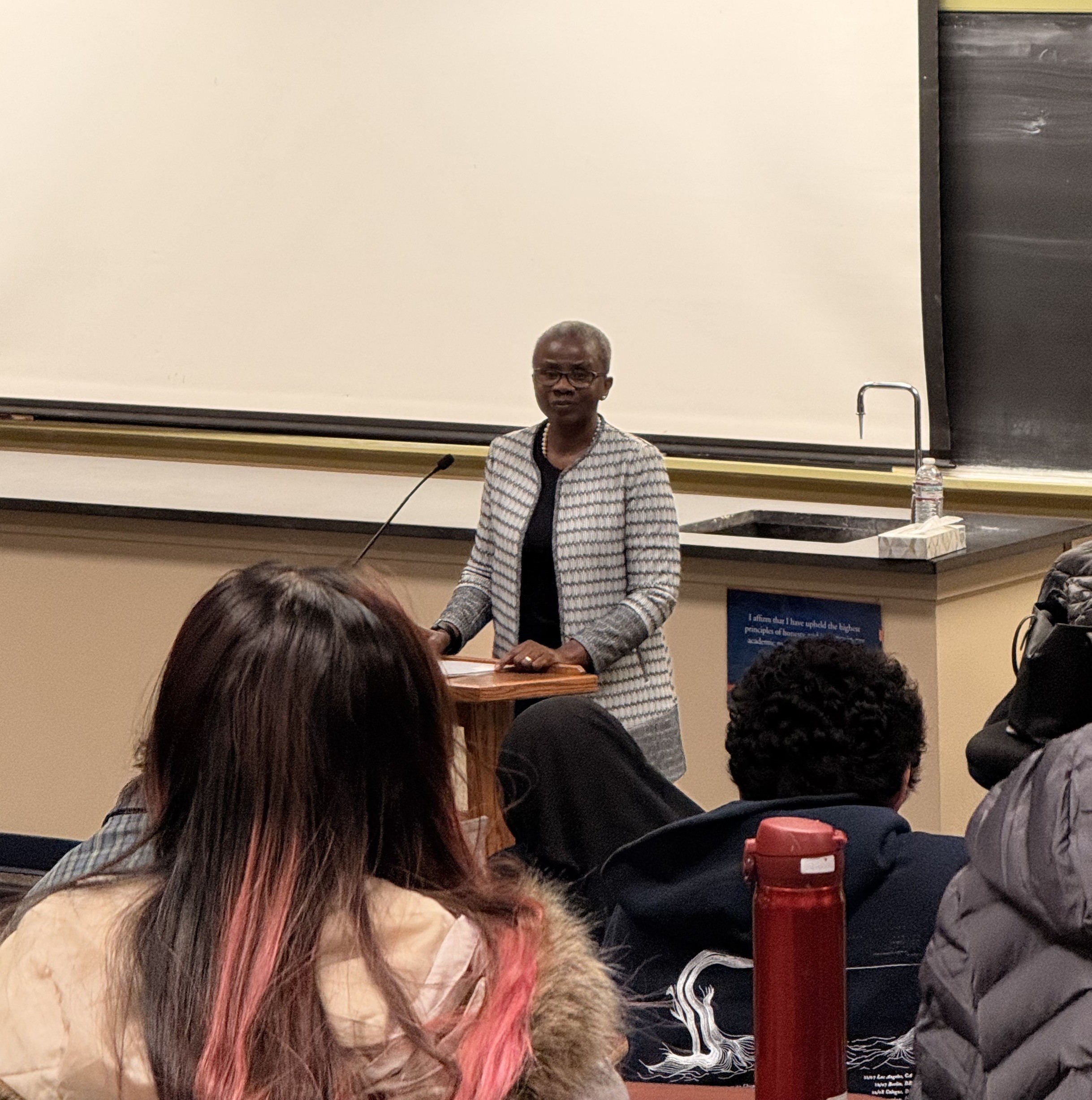
Dr. Muyangwa speaks to the audience (Photo: Celena Glaghassi/The Gettysburgian)
War II. “[The current order] is anchored by institutions such as: The United Nations (U.N.), the World Bank and the International Monetary Fund,” said Muyangwa.
She also discussed the role of the United States and its influence on the African economy, particularly after the beginning of the second Trump administration. “What the U.S. does also impacts global order …. and we saw that after he assumed office in January,” she said. Muyangwa critiqued the Trump administration, specifically the decision to withdraw from several U.N. agencies and initiatives—the World Health Organization, United Nations Human Rights Council and the Paris Climate Agreement.
“The administration also dismantled the United States Foreign Assistance Development Corporation, most notably by shattering the United States Agency for International Development and USAID.”
Muyangwa described the dismantling of USAID, the largest humanitarian development assistance agency in the world, as a decision that she believes shaped U.S. and global foreign policy as a whole. She urged the audience to continue having deep discussions and maintain an engagement with politics and the economy.
“We live in a global village; we should care about what happens to our neighbors,” said Muyangwa to conclude her speech.


