
WGS Hosts Viewing Party for Lecture on Black Communities and the Shore
By Rachel Nguyen, Staff Writer
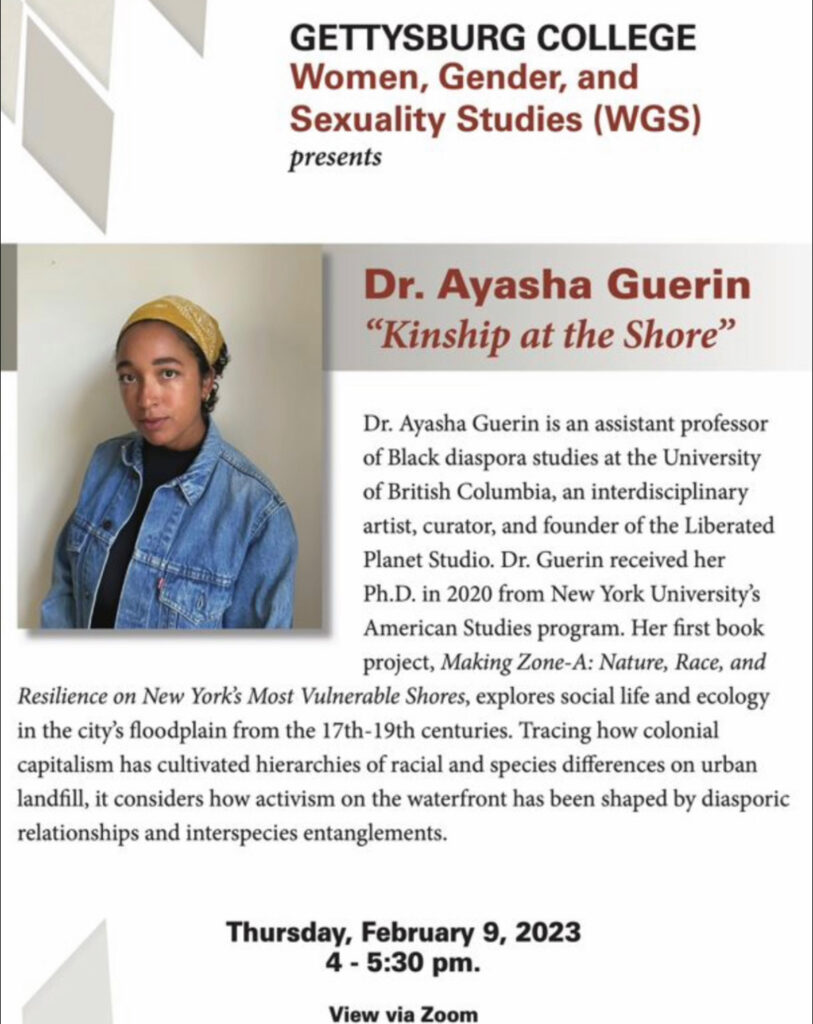
Poster for the WGS Event (Photo provided).
On Thursday, Woman, Gender, and Sexuality Studies (WGS) hosted a viewing party with Dr. Ayasha Guerin for her lecture “Kinship at the Shore.” The event is part of the WGS’s lecture series on Queer and Feminist Approaches to Land and Nature.
Guerin is an assistant professor of Black diaspora studies at the University of British Columbia, and she is an interdisciplinary artist, curator, and founder of the Liberated Planet Studio.
In her lecture, Guerin addressed the history of activities and urban design at the shores of economic centers such as Los Angeles and New York. This revealed the relationship between violence and exploitation by colonial capitalist policies and racism against African Americans.
Guerin started the lecture by describing the case of Bruce’s Beach in Manhattan Beach, which belonged to an African American family and was a beach resort for Black people to bathe, yet it was forfeited by the city. According to Guerin, this was one of many efforts to harass and prevent black people from accessing the shores.
“I think it’s important that we read this as a collective way into the water as a radical act of asserting black relation with the sea. It’s an example of how black people have continuously forged relationships with the land and water,” said Guerin.
In 2021, Los Angeles County leaders signed a bill to return the land to the descendants of the Bruce family, but the land is only zoned for the public. A month ago, the family’s descendants decided to sell it back to the county for 20 million dollars.
City Mayor Suzanne Hadley condemned the racism against the family, yet she said that an apology from the city could increase the risk of litigation. Guerin indicated the lack of public apology and the lack of respect and acknowledgment of the harm towards black and indigenous people.
Guerin also spoke about her first book titled “Making Zone-A: Nature, Race, and Resilience on New York’s Most Vulnerable Shores” which will explore the ecology in the city’s floodplain. The inspiration for this project came when Guerin explored the oyster industry in New York and found a connection to the liberation of African Americans during the slavery era.
Guerin explained that due to the Seaman’s Protective Certificate, African Americans could be oystermen, a job that provided opportunities for them to escape slavery and become free men. Sandy Ground is one of the oldest oyster communities in the free black settlement of Staten Island, and Thomas Drowning was the most successful Black man in the oyster industry. Both served as examples of the thriving of the African American communities against the slavery policy and racism in the 19th century. However, after new legislation in 1900, taxation was imposed on oyster beds, and there was an emergence of oyster capitalists with new technology and machinery. This led to the unemployment of African Americans and eventually, the end of the oyster industry due to the excessive pollution.
Guerin also mentioned the challenges that have occurred in the last century relating to urban design in Rockaway. City planner Robert Moses targeted the peninsula for slum clearance and urban renewal projects to build large-scale public housing. They took the city’s poorest residents and moved them far away from the resources they needed. In 2012, Hurricane Sandy destroyed nearly three-and-a-half miles of the five-mile Boardwalk and destroyed homes in the area. This prompted the community to make changes for the better, yet there were still challenges for citizens living in the area.
“Natural disasters are blamed when vulnerable populations are affected. But in reality, this vulnerability of storm surges is hardly a natural problem that so many of the city’s poor lives in a flood zone is by design, and it’s a matter of climate justice that it was designed for disaster,” said Guerin.
Next, Guerin shared information about her latest short film project which is a collaboration with aquaculture managers and water protectors. The short film is about the work of an oyster hatchery in Shinnecock Bay. Guerin stated that through its visual language, the film acknowledges “what we’ve lost and how we might repair and reimagine relations, other ways of living with animals, plants, and oceans, even storms and first that force change and regeneration.”
Through studying historical kinship and the intimacy of the shoreline, Guerin has become more conscious of how she has and will engage with nature.
“This requires treating our shorelines not as property, not as places to be possessed and controlled that are home to multi-species life and mutually sustaining relationships that require care and attention,” concluded Guerin.


