
By Sophie Lange, Staff Writer
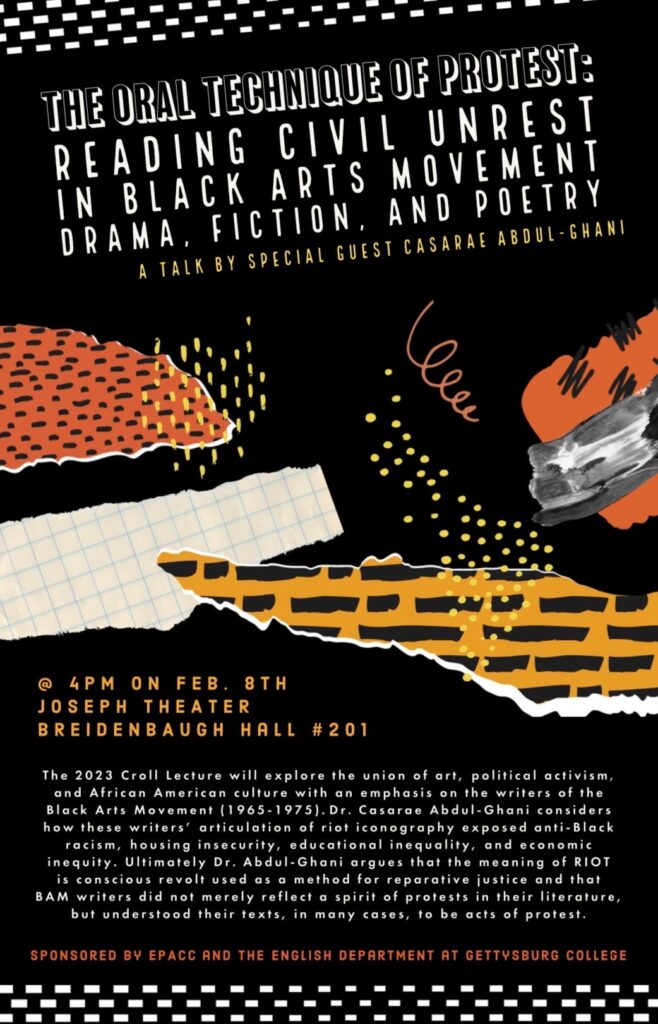
Croll Lecture poster (photo provided)
On Wednesday, the English department held the 2023 Croll Lecture in Joseph Theater. This was the first time the lecture took place in-person since the pandemic. The lecture was titled “The Oral Technique of Protest: Reading Civil Unrest in Black Arts Movement Drama, Fiction, and Poetry” and featured guest speaker Casarae Abdul-Ghan.
Abdul-Ghanis is an assistant professor at Temple University and offers classes in African American literature and cultural studies with a focus on the Black arts movement, Black women writers and popular culture. In 2022, the University Press of Mississippi published her book titled “Start a Riot! Civil Unrest in Black Arts Movement Drama, Fiction, and Poetry.” Her lecture was heavily based on the analysis of the literature included in her book.
Abdul-Ghan opened her lecture by speaking about four writers: Gwendolyn Brooks, Henry Dumas, Amiri Baraka, and Sonia Sanchez. She discussed how each of these writers had produced works inspired by the writings and ideas of Malcolm X.
In describing why she studied these authors, Abdul-Ghan said, “I would argue that much of the understudied works that I investigate in ‘Start a Riot!’ have a lot to do with these ideas that contest these notions about housing, economics, and racial inequality that really get covered in this conversation about riot.”
She continued her lecture with the analysis of a 2016 spoken-word poem by Khari B. from which her book takes its name. This analysis illustrated the way call-and-response techniques are used, specifically in African American protest poetry. She explained that call-and-response functions much in the way that everyday speech does, and it draws upon engagement from listeners. This was used for Khari B.’s poem to express a connection to the Baltimore riots that followed the murder of Freddie Gray, which were occuring at the time of the poem’s performance.
Abdul-Ghan also emphasized that Khari B.’s father was involved in the Black Arts Movement (BAM) to show how previous generations influenced the messaging used in music and writing.
Abdul-Ghan described how the poem “illustrates precisely how African Americans collectively form a liberating and politicized identity to counteract centuries of gruesome proletariat conditions and police violence… African Americans speak the grievances they profess, [and] in this case, their response to police brutality.”
She articulated how the Black protest literature of the 21st century that related to the Black Lives Matter movement cannot be separated from its roots. Abdul-Ghan argued that there is a centuries-long fight for civil rights that utilizes political strategies, and she believes that this defines the expression of civil unrest literature when related to the systemic discrimination faced by African Americans.
Abdul-Ghan noted that many scholars do not analyze riot and protest imagery beyond the texts with which they are working. However, she found that the anthology New Thoughts on the Black Arts Movement and a journal article titled “A Pedagogical Approach to Understanding Rioting as Revolutionary Action in Alice Childress’s Wine in the Wilderness” sparked her interest in these topics.
The second half of her lecture focused on the term “conscious revolt.”
Abdul-Ghan said, “I tried to figure out, well, what is beneath all of the chaos?… I call it ‘conscious revolt.’”
She explained that because of divisions across political and social lines, the term had grown to mean many different things. Originally, “conscious revolt” was used to describe interracial violence. It has now grown to describe situations in which Black Americans rise up against white property as a response to having their voices ignored when speaking of their inequalities. Abdul-Ghan emphasized that, contrary to popular belief, conscious revolts are not spontaneous but rather a result of the state disregarding civil unrest for decades.
Abdul-Ghan pointed out that “a riot involves at least one group…that publicly released grievances about a specific issue attacking or invading property, thus signaling that the state and local government officials and/or law enforcement have lost control in maintaining law and order.”
She illustrated that race is often used as a way to control the narrative within U.S. political and economic discussion and used quotes taken from works by Jodi Melamed and Toni Morrison to explain this. This is why she terms the demonstrations as “conscious revolts” because they demand a response to a state issue.
Abdul-Ghan described the way in which her book seeks to encourage others to discuss the riot iconography used in African American fiction as a way to find solutions to oppression. She followed this description by explaining that similar findings exist in Gwendolyn Brooks’s “Riot,” as the story moves from civil unrest to riots to reconciliation. She also acknowledged the existence of several more pessimistic views that are written into works that contain protest discourse.
To conclude her lecture, Abdul-Ghan focused on works by Sonia Sanchez. In her analysis of these works, she found that they focus less on rage as a compelling force. On the contrary, she asserts that riots are a cause of hostility and allow for self-degradation and misogyny. In her work, Sanchez also highlighted Black power ideology, human rights, and misogyny. Abdul-Ghan concluded by underscoring the importance of these values even in modern social justice and civil rights movements.


