
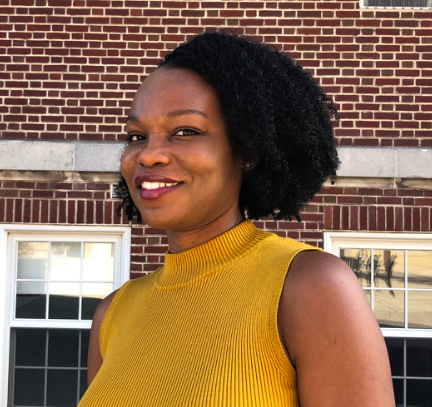
Nafissa Thompson-Spires, author of the Common Read for the Class of 2023 (Photo Katie Oglesby/The Gettysburgian)
By Cameron Jury, Contributing Writer
On Tuesday, members of the Class of 2023 filled the College Union Building ballroom to hear directly from the Nafissa Thompson-Spires, the author of the Common Read book for the year.
The Common Reading Program put on by the college each year encourages all incoming students to read the same book with the idea that once on campus, all of the students immediately have something in common and a topic to discuss. This year’s book, “Heads of the Colored People,” was particularly thought-provoking as it covered topics all surrounding black identity in the form of multiple short stories.
Thompson-Spires, a graduate from the University of Illinois and Vanderbilt University, maintained a friendly and welcoming presence as she began to speak to the first-year students. She established this presence immediately as she said hello and then proceeded to ask the room to take a group panoramic selfie for her Instagram. Then, she went straight into the discussion by reading two of the many short stories in the book–one about a black cosplayer, his girlfriend, and police brutality, and the other based on personal experience about negative tension between the only two black girls and their mothers at an all-white school. Both of these pieces captured the audience as they provoked giggles, frowns, and many screams of appreciation when one character had a good insult directed at another.
The book as a whole began for Thompson-Spires as simply a desire to see the concept of “black nerds” in modern-day media. Particularly, she wanted to know “what it means to live in a particular body and how that body gets judged.” As a result, the stories she chose to include in this collection have a wide range of topics, covering everything from depression to fetishes, and unhealthy trendy diets.
She spoke of the extensive research she conducted to accurately represent these point of views, though a few of the stories were based on her personal experiences. When describing her writing process, Thompson-Spires got a good laugh from the audience as she said, “I’m petty, so I write a lot about people who publicly upset me.” She described this method of her writing as a productive way to gain something positive out of an experience that can be really upsetting.
When Thompson-Spires sat down with The Gettysburgian, she said, “It would be amazing to me if people learned important lessons and become more ethical in the way that they interact with other people in the world and they consider attitudes and biases and practices around race.” Aside from that, she hopes people simply enjoy reading her book.
She also touched on the process of writing a book–a particularly tricky process when that book is in the form of multiple stories. She described her long days of experimenting with the stories by doing things such as switching them from the first to the third person, changing the gender of a character, or simply completely writing them over again. Along with her own self-criticism, she touched on the process of having to work with more than just yourself when writing a book. In particular, she described one story which she loved but her editor thought was too dark to include in the final manuscript for publication.
Finally, as a successful writer, Thompson-Spires touched on what it takes to go into creative writing. She spoke about how it is an extremely challenging field, as it is often not very lucrative. So, the solution she shared for those who want to pursue creative writing is to “find a passion that will fund that other passion,” develop yourself strongly in two fields, and have a really broad set of skills that can be applied in many situations. For Thompson-Spires, this involves teaching at Cornell University. For students who are considering being an English major, she says, “You’re not taking a vow of poverty by majoring in English. You’re actually opening up a lot of skills that people are looking for jobs.”
Editor’s Note: Contributing Writer Katie Oglesby ’23 conducted a one-on-one interview with Nafissa Thompson-Spires for this piece. (~P. Doscher)


