

President Janet Morgan Riggs pictured with Eric and Robert Kolbe along with Jim Chemmel after Kolbe donated funds to endow student research (Photo courtesy of Gettysburg College)
By Benjamin Pontz, Managing News Editor
Ten Gettysburg students who spent the summer on campus conducting research as part of the Kolbe Fellows program presented some of their findings at a luncheon held Thursday in CUB 260. The Kolbe Fellows program, endowed by funds from Eric Kolbe ’65, provides students a $3500 stipend plus $500 in research expense reimbursement to conduct a 10-week, faculty-mentored research project on campus over the summer.
While some projects help students to get a head start on subsequent capstone experiences, many were conducted by underclassmen within their interest areas.
“This year’s group had 2 first-year students (rising sophomores) and 4 sophomores (rising juniors), which I believe makes it the ‘youngest’ group of Mellon/Kolbe research students overall that we’ve ever had,” said Maureen Forrestal, Assistant Provost & Dean of Student Scholarly Engagement. “What that tells me is that students are coming to Gettysburg already aware of and interested in conducting research or creative projects on topics which they feel passionate about. They’re not waiting until their capstones to engage in these opportunities.”
Forrestal said that, with 80 first-year students signed up to present research at the Celebration of Academic First-Year Engagement (CAFE) Symposium next month, a figure that is more than double the previous record, she is optimistic that there will be strong interest in the Kolbe Fellowship program from the Class of 2021 this year.
The deadline for summer 2018 proposals is Monday, February 12, and requirements are available on the Student Scholarly Engagement website.
“I realize that conducting research during the summer isn’t for everyone and that there are plenty of other opportunities that you can engage in that will provide you with great experience that can help prepare you to achieve your future academic and career goals,” Forrestal said. “My strong feeling, however, is that you should at least consider the Kolbe (or another summer research program like X-SIG) as a possibility when deciding how you want to spend your time being productive this summer. You’ll rarely get another chance to explore in depth and expand upon an idea that’s your own, something you have a passion for, with a faculty member dedicating their time and sharing their experience with you and you alone as you go through the process…and you get paid while doing it!”
We reached out to several of this year’s Kolbe Fellows to talk about their experience in their own words. Three of their responses are printed below:
Kevin Aughinbaugh ’18
Kevin Aughinbaugh ’18
For my research, I chose to investigate how controversial events in Yellowstone National Park are framed and portrayed in the news media at both a local and national scale. I compare the 1988 wildfire season and the 1995 grey wolf reintroduction, as they were both highly controversial events that garnered both local and national news media attention.
Although my research is still ongoing as it is part of my Senior Environmental Studies Thesis, my results show that local newspapers were more diverse in the organizations and people they interviewed, while the national newspapers received most of their data from government and NGO sources.
Being a Kolbe fellow was a fantastic experience as I was able to spend a significant portion of time to the in-depth study of a single interesting topic. I would highly recommend anyone who has a passion for research to apply for this year’s Kolbe Fellowship.
Patrick McKenna, Jr. ’20

Pat McKenna ’20
The title of my research project was “Divergent State Investment Strategies for Funding Transportation: A Comparison of Four Geographically and Geopolitically Diverse States.” I wanted to analyze how different states around the country are funding their transportation systems at a time when aging infrastructure requires additional investment and an ossified federal government has been unable to provide long-term stability for states to adequately fund their networks. I researched this issue by looking at how states already fund their network, analyzing the political context around their policy makers, and analyzing the bills filed in the 2017 legislative session with regards to transportation infrastructure investment. This was an extremely rewarding experience that allowed me a lot of flexibility to design a research experiment as well as allowing me to structure my time in a manner that I could work more effectively. I would absolutely recommend this program to anyone interested in research as it is a great way to learn and also involve yourself in the campus community.
Amanda Richman ’18
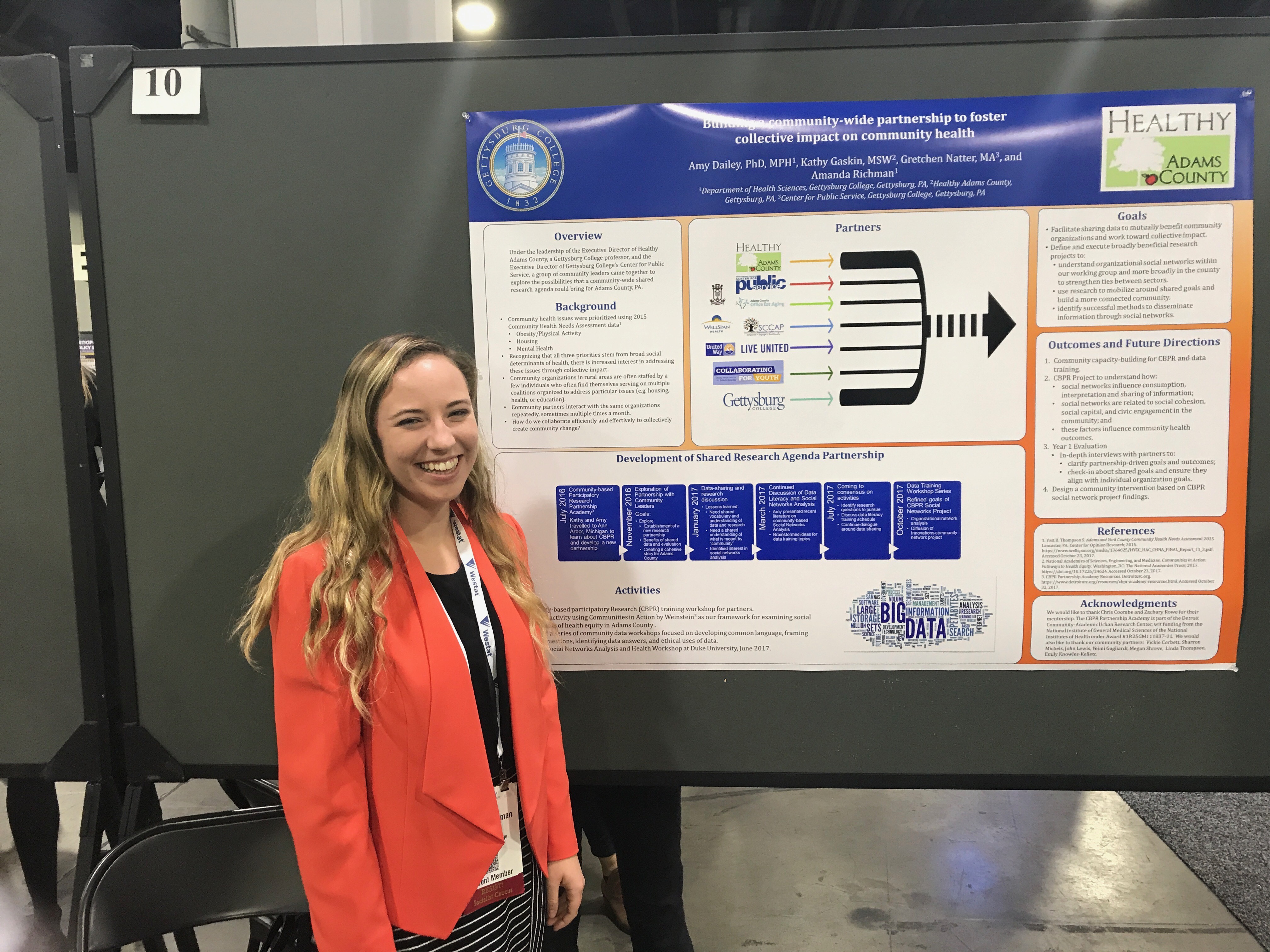
Amanda Richman ’18 presents research (Photo provided)
I spent this summer as a Kolbe Fellow learning about the challenges and joys of performing community-based research. I designed an interview guide and conducted interviews with community members about their social attitudes, particularly their perception of race and social class of other community members, their own social networks and how they get and share information. I had an incredible experience learning more about Adams County and the people that live beyond the Gettysburg College campus. The Kolbe program helped affirm my career goals of conducting public health research, allowed me to establish a better relationship with my faculty mentor, and gave me the opportunity to become friends with the other scholars. If you are interested in research at all, I would highly recommend applying to be a Kolbe Fellow!


